In May, the Castro machine labeled an 80-year-old retired waiter to be dangerous! Apparently, he still has quite a bit of fight in him: "I was born fighting!"
Here's the scoop, from Cubanet.com:
A Mercenary and Dangerous Old ManBy Leonel Alberto Pérez BeletteHavana (May 2008 – Cubanet) Members of the political police harassed an 80 year old opponent in his own home to prevent him from blemishing the festivities of the first of May.Alfredo Guilleuma Rodriguez has become a "danger" for the authorities of the state. So much so that the State decided to place to two police officers and a member of the Committee of Defense of the Revolution (CDR) on his doorstep with the objective to stop him from leaving his dwelling on May Day.According to him, he was told that he would not be able to leave while the parade was being performed. In spite of their threats, the elder was not scared because he needed to leave to find something for his grandson’s breakfast. After an exchange of words, in which he was branded a mercenary, the authorities were limited to following him to where he was going. Earlier, the leader of the police sector had already notified him that he was not going to permit him to moved around freely.
Why are they so infuriated with a grandfather that still needs a cane to travel? Guilleuma Rodriguez has spent his life fighting against tyrannies and as a true revolutionary. He fought against Hatchet, then against Batista and now against the ones in charge of Cuba.
Read the rest here.
Here's my view about how to deal effectively with the Castro regime: drown them out with capitalism!The embargo has been a miserable failure. It made sense when the Soviets were there, but now it makes no sense at all. It has not helped the Cuban people, plunging them deeper into poverty, while strengthening and expanding the power of the Castro machine. Fidel Castro thrived on this, since he could always blame the country's woes on the embargo, thus emboldening him to take ever more repressive measures to secure his own power base.
Imagine, for a moment, the possibilities of ending this ineffective embargo. As more investment comes in, Castro will have less and less opportunity to blame the U.S. for the nation's economic woes. The Cuban people will be more inclined to see the Castro regime as the cause of stagnation, and so Raul Castro and his cronies will be in a more precarious situation. The U.S., by taking a "back seat," will not be seen as the meddling neighbor, letting capitalism take its course in the island. The Castro regime will seem less and less relevent, as the elder Castro's raison d'etre-conflict with los yanquis-will be out of the picture.
But don't count on this being implemented any time soon. Why not? The Miami exiles, who represent a fairly sizeable voting bloc in Florida, will not for a moment support any effort to end this ineffective embargo. No one seeking political office will even touch it.
Understandably, they are angry, having lost loved ones in overnight raids, never to be seen again.
But my people need to ask themselves honestly: How has this embargo, now 40+ years strong, ruined Castro and helped the Cuban people? Answer: On both counts, not at all. What we have ended up with is a 49-year-old Soviet-style dictatorship, with an heir apparent.
For the sake of the Cuban people, let's put an end to this farce, and help them remove this cancerous growth that is the Castro machine by...ending the embargo!!!
Let's drown the Castro machine out with capitalism!
Thursday, July 10, 2008


Monday, July 07, 2008
Well, chaps, we had a good run!
Or, the end of Anglo-Catholicism
Biretta tip to: The Young Fogey
No, not surprising in the least. When the vote came in February of 1993 (under George Carey's watch) to ordain women to the priesthood, who could doubt that the other shoe was going to fall?
As the then bishop of London, The Rev. Dr. Graham Leonard (now an RC priest) put it, there is "no doubt that the Church of England has become a sect. It may be the Established Sect, but a sect nonetheless."
From The Telegraph:
After six hour of emotional debate, one bishop broke down in tears saying he was ashamed of the church for ignoring the deeply felt wishes of traditionalists.
The Rt Rev Stephen Venner, the Suffragan Bishop of Dover, was comforted by other church leaders on the floor of the General Synod in York as its 468 members took a major step towards women becoming bishops, with just an unwritten statutory code of practice to cater for those who firmly believe the Bible teaches that bishops must be male, as Jesus and his apostles were.
Bishop Venner, said: “I have to say that for the first time in my life I am ashamed.
“We have talked for hours about wanting to give an honourable place for those who want to disagree and we have turned down almost every realistic opportunity for those who are opposed to flourish.”
Hundreds of traditionalists, including several bishops, may leave the church after an epic four-hour debate ended with proposals to create new "men only" dioceses or "super bishops" narrowly thrown out by members of the General Synod in York.
Read the rest here
Biretta tip to: The Young Fogey
No, not surprising in the least. When the vote came in February of 1993 (under George Carey's watch) to ordain women to the priesthood, who could doubt that the other shoe was going to fall?
As the then bishop of London, The Rev. Dr. Graham Leonard (now an RC priest) put it, there is "no doubt that the Church of England has become a sect. It may be the Established Sect, but a sect nonetheless."
From The Telegraph:
After six hour of emotional debate, one bishop broke down in tears saying he was ashamed of the church for ignoring the deeply felt wishes of traditionalists.
The Rt Rev Stephen Venner, the Suffragan Bishop of Dover, was comforted by other church leaders on the floor of the General Synod in York as its 468 members took a major step towards women becoming bishops, with just an unwritten statutory code of practice to cater for those who firmly believe the Bible teaches that bishops must be male, as Jesus and his apostles were.
Bishop Venner, said: “I have to say that for the first time in my life I am ashamed.
“We have talked for hours about wanting to give an honourable place for those who want to disagree and we have turned down almost every realistic opportunity for those who are opposed to flourish.”
Hundreds of traditionalists, including several bishops, may leave the church after an epic four-hour debate ended with proposals to create new "men only" dioceses or "super bishops" narrowly thrown out by members of the General Synod in York.
Read the rest here
Wednesday, July 02, 2008
Assesing the Liturgical Reforms of Vatican II
From OrthodoxChristianity.net:
"Jesuit Fr. Robert F. Taft, an internationally acclaimed authority on the history of Eastern liturgies, has been teaching at the Pontifical Oriental Institute in Rome for almost 40 years and also serves as a consultor for the Vatican’s Congregation for the Oriental Churches. He holds the honorary title of archmandrite, conferred upon him by more than one Eastern church for his extraordinary contributions to liturgical studies and church unity....Liturgical pioneers drew inspiration from Russian Orthodox emigrés to France, who had fled from their homeland after the Bolshevik Revolution of 1917. These contacts proved crucially important because the Orthodox church, Fr. Taft notes, had preserved the liturgical spirit of the early church and continued to live by it.Liturgists in the West, however, did not attempt simply to imitate existing Eastern usage, but interpreted and applied it in the light of the needs of Latin Christianity. And that is why the liturgical movement, which Vatican II essentially validated, was so successful.But there were things that Vatican II “failed to do well or did not do at all,” Fr. Taft writes. He mentions three items: the process of initiation, the Liturgy of the Hours, and Communion from the tabernacle.He underscores the irony that one of Pope Pius X’s most celebrated and enduring reforms, namely, the lowering of the age of first holy Communion from adolescence to the age of reason....“This destroyed the age-old sequence of the rites of Christian initiation,” Fr. Taft insists....Fr. Taft argues, secondly, that the Liturgy of the Hours, despite its title, “is no liturgy at all, but still a breviary or book of prayers.”....Finally, the distribution of pre-consecrated hosts at Mass was “totally unthinkable in the early Christian East and West ... [and] is still inconceivable in any authentic Eastern Christian usage today.” Indeed, “Communion from the tabernacle is like inviting guests to a banquet, then preparing and eating it oneself, while serving one’s guests the leftovers from a previous meal.” "
And now, for a few words from The Young Fogey:
"Vatican II didn't define any Roman Catholic doctrine and its decrees on religious liberty and ecumenism, the real bone of contention with some traditionalist groups, are no problem but it was exactly the wrong thing at the wrong time.The legitimate liturgical movement was wonderful and indeed influenced by the Orthodox.The aftermath of Vatican II killed it.Pope Benedict XVI's 'reform of the reform' that McBrien hates so much is a try at reviving it.Robert Taft makes a good liturgical point on all three matters. Trying to bring the divine office (the hours as Orthodox say) back into the daily practice of most Roman Catholics is one valuable reform that either has spectacularly failed or never was tried.Tacked-on epiklesis and token deacons notwithstanding it's obvious to the common man that the aftermath of Vatican II moved Roman practice far away from the East and more in line with Protestantism. Traditionalist the late Michael Davies nailed this: for all the talk about ecumenism it's 'a harsh and even offensive condemnation' of Eastern practice.More than one Orthodox knows this.Richard McBrien and NCR are typical old, liberal-Protestant-wannabe RCs angry that the kids like Pope Benedict and his restoration of tradition better than their worn-out junk.I really suspect people of McBrien's kind don't like Communion from the Reserved Sacrament not for some purist liturgical reason (like Communion should be from the liturgical action happening right now) but because they think the Roman Catholic/Orthodox belief in the Real Presence is stupid and superstitious like the first Protestants did.I wonder what insulting things he'd say about the Orthodox if you put a few drinks in him.Note to McBrien and Taft: what Western Rite Orthodox do looks a lot more like Pope Benedict's revival than their junk.That should tell you what the mind of the Orthodox Church is on this."
Well done, Serge!
"Jesuit Fr. Robert F. Taft, an internationally acclaimed authority on the history of Eastern liturgies, has been teaching at the Pontifical Oriental Institute in Rome for almost 40 years and also serves as a consultor for the Vatican’s Congregation for the Oriental Churches. He holds the honorary title of archmandrite, conferred upon him by more than one Eastern church for his extraordinary contributions to liturgical studies and church unity....Liturgical pioneers drew inspiration from Russian Orthodox emigrés to France, who had fled from their homeland after the Bolshevik Revolution of 1917. These contacts proved crucially important because the Orthodox church, Fr. Taft notes, had preserved the liturgical spirit of the early church and continued to live by it.Liturgists in the West, however, did not attempt simply to imitate existing Eastern usage, but interpreted and applied it in the light of the needs of Latin Christianity. And that is why the liturgical movement, which Vatican II essentially validated, was so successful.But there were things that Vatican II “failed to do well or did not do at all,” Fr. Taft writes. He mentions three items: the process of initiation, the Liturgy of the Hours, and Communion from the tabernacle.He underscores the irony that one of Pope Pius X’s most celebrated and enduring reforms, namely, the lowering of the age of first holy Communion from adolescence to the age of reason....“This destroyed the age-old sequence of the rites of Christian initiation,” Fr. Taft insists....Fr. Taft argues, secondly, that the Liturgy of the Hours, despite its title, “is no liturgy at all, but still a breviary or book of prayers.”....Finally, the distribution of pre-consecrated hosts at Mass was “totally unthinkable in the early Christian East and West ... [and] is still inconceivable in any authentic Eastern Christian usage today.” Indeed, “Communion from the tabernacle is like inviting guests to a banquet, then preparing and eating it oneself, while serving one’s guests the leftovers from a previous meal.” "
And now, for a few words from The Young Fogey:
"Vatican II didn't define any Roman Catholic doctrine and its decrees on religious liberty and ecumenism, the real bone of contention with some traditionalist groups, are no problem but it was exactly the wrong thing at the wrong time.The legitimate liturgical movement was wonderful and indeed influenced by the Orthodox.The aftermath of Vatican II killed it.Pope Benedict XVI's 'reform of the reform' that McBrien hates so much is a try at reviving it.Robert Taft makes a good liturgical point on all three matters. Trying to bring the divine office (the hours as Orthodox say) back into the daily practice of most Roman Catholics is one valuable reform that either has spectacularly failed or never was tried.Tacked-on epiklesis and token deacons notwithstanding it's obvious to the common man that the aftermath of Vatican II moved Roman practice far away from the East and more in line with Protestantism. Traditionalist the late Michael Davies nailed this: for all the talk about ecumenism it's 'a harsh and even offensive condemnation' of Eastern practice.More than one Orthodox knows this.Richard McBrien and NCR are typical old, liberal-Protestant-wannabe RCs angry that the kids like Pope Benedict and his restoration of tradition better than their worn-out junk.I really suspect people of McBrien's kind don't like Communion from the Reserved Sacrament not for some purist liturgical reason (like Communion should be from the liturgical action happening right now) but because they think the Roman Catholic/Orthodox belief in the Real Presence is stupid and superstitious like the first Protestants did.I wonder what insulting things he'd say about the Orthodox if you put a few drinks in him.Note to McBrien and Taft: what Western Rite Orthodox do looks a lot more like Pope Benedict's revival than their junk.That should tell you what the mind of the Orthodox Church is on this."
Well done, Serge!
Friday, June 27, 2008
What Would Jesus Steal?
Gary North takes on the religious left.
From LewRockwell.com:
If voters can be made to feel guilty about their economic success, they can be manipulated. This is why the politics of guilt manipulation is at the heart of the welfare state.
In a systematic political program to make people feel guilty, the Social Gospel movement within Protestantism has played an important role for over a century. Economist-historian Murray Rothbard in a 1986 essay, "The Progressive Era and the Family," described this development.
In many cases, leading progressive intellectuals at the turn of the twentieth century were former pietists who went to college and then transferred to the political arena, their zeal for making over mankind, as a "salvation by science." And then the Social Gospel movement managed to combine political collectivism and pietist Christianity in the same package. All of these were strongly interwoven elements in the progressive movement.
The Social Gospel movement, which began in the United States in the 1880's, shared an ethical principle with the Progressive movement, which began at the same time and in the same social circles. This ethical principle can be summarized as follows: Thou shalt not steal, except by majority vote.
Read the rest here
Biretta tip to The Young Fogey
From LewRockwell.com:
If voters can be made to feel guilty about their economic success, they can be manipulated. This is why the politics of guilt manipulation is at the heart of the welfare state.
In a systematic political program to make people feel guilty, the Social Gospel movement within Protestantism has played an important role for over a century. Economist-historian Murray Rothbard in a 1986 essay, "The Progressive Era and the Family," described this development.
In many cases, leading progressive intellectuals at the turn of the twentieth century were former pietists who went to college and then transferred to the political arena, their zeal for making over mankind, as a "salvation by science." And then the Social Gospel movement managed to combine political collectivism and pietist Christianity in the same package. All of these were strongly interwoven elements in the progressive movement.
The Social Gospel movement, which began in the United States in the 1880's, shared an ethical principle with the Progressive movement, which began at the same time and in the same social circles. This ethical principle can be summarized as follows: Thou shalt not steal, except by majority vote.
Read the rest here
Biretta tip to The Young Fogey
Thursday, June 26, 2008
Feast of Corpus Christi

Today, Orthodox Christians of the Western Rite celebrate the feast of Corpus Christi, a western medieval feast that the Church, in her wisdom, ha deemed good and proper to have her Western Orthodox children celebrate. This feast day always falls on the Thursday after Trinity Sunday, and the faithful are enjoined to contemplate the mystery of this most holy sacrament. Following Trinity Sunday, we rejoice in it as it brings us into the divine life: Christ, the second person of the Holy and Undivided Trinity, gives Himself to us, so that we can enter into this communion of love that is God: Father, Son and Holy Spirit.
From the Pastoral Ponderings of Fr. Patrick Henry Reardon:
Speaking of the Holy Eucharist, the Fathers and early liturgical texts of the Church have recourse to the metaphor of the flaming coal (anthrax, pruna) in reference to the Lord's body. For instance, with Isaiah 6:7 obviously in mind, The Liturgy of St. James refers to "receiving the fiery coal" (labein to pyrinon anthrax) from the Eucharistic altar. Indeed, even without using this word, those same doctrinal sources regularly appeal to Isaiah's experience, when they speak of the Holy Eucharist. Thus, in The Liturgy of S. John Chrysostom, when the Christian has received the Holy Communion, the priest tells him: "Lo, this has touched your lips and has taken away your iniquity." In comparing the sacramental body of Christ to Isaiah's living coal, these texts testify that the flesh of the risen Christ bears the fire of the Holy Spirit, drawn from the hearth of the heavenly altar.

It is through this purifying and sanctifying coal that we are deified in the Holy Eucharist. Thus, St. John of Damascus wrote, "Let us draw near to Him with burning desire and . . . let us take hold of the divine coal [tou theiou anthrakos], so that the fire of our longing, fed by the flame of the coal, may purge away our sins and enlighten our hearts. Let us be enkindled by touching this great divine fire, and so come forth as gods" (The Orthodox Faith 4.13).
In addition to the symbolism of the fiery coal from the altar, the Eucharistic bread itself seems naturally to evoke the image of the oven. This image is amply justified in the Epiclesis, the prayer that asks the Father to send down the Holy Spirit to transform the bread and wine into the Lord's Body and Blood. Rupert of Deutz perceived this truth, when he wrote, "The Virgin conceived Him of the Holy Spirit, who is the eternal fire; and through the same Holy Spirit He offered Himself as a living victim to the living God, as the Apostle says [Ephesians 5:2]. Accordingly, on the altar He is immolated by the same fire. For it is by the operation of the Holy Spirit that the bread becomes the body, and the wine the blood, of Christ" (On Exodus 2.10).
The Divine Liturgy, we may say, is the oven of the Holy Spirit. That grain of wheat, which was sown in the earth on Good Friday, sprang forth as the infinite Paschal harvest and now abides forever in the granary of heaven.
Christ our Lord is not content, however, simply to abide in His glorified body. In this body, Christ can be found in only one place. He is needed, however, in many places, and this is the reason He provided a new, sacramental mode of presence. In the Holy Eucharist, He lives on thousands of altars at once, available--edible!--for the myriads of believers who draw near in the fear of God and with faith and love.
In the mystery of the Holy Eucharist, the wheat, which is Christ's glorified body, is baked in the oven of the Holy Spirit, so that the nutritive energies of God may pass into those who receive Him in faith. Through the cells and sinews of our own flesh there course those divine energies that transform and deify our bodies and souls--our whole being--with the dynamism of immortality--eternal life.
Commenting on the Bread of Life Discourse in John 6, St. Clement of Alexandria plays on the image of fire stimulating the yeast in the dough, as heat raises the sown seed: "Here is observed the sacrament of the bread [to mystikon tou artou], for He says it is His flesh and as manifestly raised up; just as fire raises up the sowing from corruption [ek phthoras kai sporas], so like baked bread it has truly been raised up through fire for the enjoyment of the Church" (The Teacher 1.6).
St. Clement likewise speaks of this sacramentally conferred immortality in connection with the Lord's blood, which we receive from the Chalice. Recalling, with Leviticus 17:11, that "the life of the flesh is in the blood," he comments: "To drink of the blood of Jesus means nothing less than to participate in the Lord's incorruption [tes kyriakes metalabein aphtharsias]. For the Spirit is strength to the Word, just as the blood to the body" (op. cit. 2.2).
This Eucharistic participation in the fire of Spirit is symbolized in the boiling water added to the Chalice right before the reception of Holy Communion. As the deacon pours this water into the blood of Christ, he identifies its symbolism: "The fervor of faith, the fullness of the Holy Spirit."
From St. John Chrysostom's Catechesis (3:13-19):
If we wish to understand the power of Christ’s blood, we should go back to the ancient account of its prefiguration in Egypt. “Sacrifice a lamb without blemish”, commanded Moses, “and sprinkle its blood on your doors”. If we were to ask him what he meant, and how the blood of an irrational beast could possibly save men endowed with reason, his answer would be that the saving power lies not in the blood itself, but in the fact that it is a sign of the Lord’s blood. In those days, when the destroying angel saw the blood on the doors he did not dare to enter, so how much less will the devil approach now when he sees, not that figurative blood on the doors, but the true blood on the lips of believers, the doors of the temple of Christ.
If you desire further proof of the power of this blood, remember where it came from, how it ran down from the cross, flowing from the Master’s side. The gospel records that when Christ was dead, but still hung on the cross, a soldier came and pierced his side with a lance and immediately there poured out water and blood. Now the water was a symbol of baptism and the blood, of the holy eucharist. The soldier pierced the Lord’s side, he breached the wall of the sacred temple, and I have found the treasure and made it my own. So also with the lamb: the Jews sacrificed the victim and I have been saved by it.
“There flowed from his side water and blood”. Beloved, do not pass over this mystery without thought; it has yet another hidden meaning, which I will explain to you. I said that water and blood symbolized baptism and the holy eucharist. From these two sacraments the Church is born: from baptism, “the cleansing water that gives rebirth and renewal through the Holy Spirit”, and from the holy eucharist. Since the symbols of baptism and the Eucharist flowed from his side, it was from his side that Christ fashioned the Church, as he had fashioned Eve from the side of Adam Moses gives a hint of this when he tells the story of the first man and makes him exclaim: “Bone from my bones and flesh from my flesh!” As God then took a rib from Adam’s side to fashion a woman, so Christ has given us blood and water from his side to fashion the Church. God took the rib when Adam was in a deep sleep, and in the same way Christ gave us the blood and the water after his own death.
Do you understand, then, how Christ has united his bride to himself and what food he gives us all to eat? By one and the same food we are both brought into being and nourished. As a woman nourishes her child with her own blood and milk, so does Christ unceasingly nourish with his own blood those to whom he himself has given life.

Adoremus in aeternum Sanctissimum Sacramentum!
(Let us forever adore the Most Holy Sacrament)
Christ is in our midst!
Monday, June 23, 2008
Sunday of the Holy Trinity

Yesterday, one week after Pentecost sunday, Orthodox Christians who follow the Western Rite began the longest season on the Church's calendar: Trinitytide. The feast itself is celebrated one day, with no octave, recalling the unity of the Godhead, but it also initiates, for those congregations influenced by English ussage, a whole season that lasts until Advent.
From the earliest centuries of the Church, the doctrine of the Trinty has figured prominently in the life of the Church, as the foundation of Christian belief and practice; thus, every liturgy is a liturgy to the Holy Trinity, just like every Sunday liturgy is a celebration fo the Paschal mystery of Our Lord's resurrection. But just as the Church dedicates one day of the year to highlight the paschal mystery, so also, in the western half of Christendom, one day is set aside in order to contemplate the central, incomprehensible mystery of God's triune being. This celebration rounds out all the feasts relating to our Lord's earthly life-His birth, life, death, resurrection, ascension, and then, the descent of the Holy Spirit on Pentecost.
When the formal celebration of Trinity Sunday began is not clear, but it became especially popular in England, primarily because the day of Thomas Beckett's martyrdom occured on that Sunday, in 1162. By then, it had already become a fixture in the Sarum Missal, spreading throughout Northern Europe, down through Normandy, and into Northern Italy, until Pope John XXII decreed its observance throughout the Western Church in 1334.
All Sundays are reckoned from Trinity Sunday in the Sarum Missal, as well as in the Book of Common Prayer. While the Roman practice was to reckon all Sundays after Trinity as Sundays after Pentecost (until the liturgical "reforms" of 1969), all Sundays are reckoned after Trinty in the Carthusian, Dominican and Carmelite breviaries.
The usual color for this season is green, which brings to mind our Lord's words in Revelation 21:5: "Behold, I make all things new..." We entered into the Paschal mystery, now brings us into the life of the Holy Trinity, the eternal peace of God, who, in His Triune goodness, gives life to His whole creation. The lectionary from this time forward will contain the scriptural lessons from the whole year, thus bringing to mind that all things are brought together in God: Father, Son and Holy Spirit.
Benedicta sit Sancta Trinitas!
Thursday, June 19, 2008
Prayers for Pope Shenouda III
Statement from Cleveland Clinic Regarding Pope Shenouda
CLEVELAND, June 12 /PRNewswire/ -- "H. H. Pope Shenouda III, Pope of
Alexandria and Patriarch of the sea of St. Mark, underwent a one-hour
surgery at the Cleveland Clinic this morning to repair his broken left
femur after he suffered a fall. The surgery was successful and he is
recovering well. He will remain in the hospital for approximately one week
and then receive physical rehabilitation as a part of his recovery," said
Wael Barsoum, M.D., orthopaedic surgeon at the Cleveland Clinic.
He seems to be recovering well, but do continue to pray for His Holiness.
Pray also for the Coptic Christians under his pastoral care, and other Christians in Egypt undergoing persecution from extremist Islamic groups.
Biretta tip: Ben Johnson
CLEVELAND, June 12 /PRNewswire/ -- "H. H. Pope Shenouda III, Pope of
Alexandria and Patriarch of the sea of St. Mark, underwent a one-hour
surgery at the Cleveland Clinic this morning to repair his broken left
femur after he suffered a fall. The surgery was successful and he is
recovering well. He will remain in the hospital for approximately one week
and then receive physical rehabilitation as a part of his recovery," said
Wael Barsoum, M.D., orthopaedic surgeon at the Cleveland Clinic.
He seems to be recovering well, but do continue to pray for His Holiness.
Pray also for the Coptic Christians under his pastoral care, and other Christians in Egypt undergoing persecution from extremist Islamic groups.
Biretta tip: Ben Johnson
Gotta Love those Romanians!
From BBCNews:
"Romanian villagers have voted to re-elect a dead man as their mayor, to prevent his living rival winning.
Neculai Ivascu - who led Voinesti for almost two decades - died from a liver disease on Sunday, too late to cancel the contest.
"I know he died, but I don't want change," one villager told Romanian TV. (emphasis mine)
Ben Johnson: This takes, "That government is best which governs least" to new extremes.
I don't know. Given the rapid growth of the central government (brought to us by the Republicrats and the Demoreps), this may be the ultimate "no confidence vote" that really, REALLY makes the point. This gives me a few cheeky ideas for election day!
Biretta tip: Ben Johnson
"Romanian villagers have voted to re-elect a dead man as their mayor, to prevent his living rival winning.
Neculai Ivascu - who led Voinesti for almost two decades - died from a liver disease on Sunday, too late to cancel the contest.
"I know he died, but I don't want change," one villager told Romanian TV. (emphasis mine)
Ben Johnson: This takes, "That government is best which governs least" to new extremes.
I don't know. Given the rapid growth of the central government (brought to us by the Republicrats and the Demoreps), this may be the ultimate "no confidence vote" that really, REALLY makes the point. This gives me a few cheeky ideas for election day!
Biretta tip: Ben Johnson
Wednesday, June 18, 2008
H.L. Mencken on Public Schooling

"The aim of public education is not to spread enlightenment at all; it is simply to reduce as many individuals as possible to the same safe level, to breed a standard citizenry, to put down dissent and originality. School days, I believe, are the unhappiest in the whole span of human existence. They are full of dull, unintelligible tasks, new and unpleasant ordinances, and brutal violations of common sense and common decency."
Tuesday, June 17, 2008
Cyd Charisse, +Requiescat in Pace

Actress, Dancer, Classic Hollywood Beauty! She passed away today at Cedar Sinai, apparently of a heart attack. She was 86, and still looked as stunningly beautiful as ever.
Among her most memorable moments: Dancing with Fred Astaire in The Band Wagon and Gene Kelly in Singin' in the Rain
One of the most remarkable things about her: She remained married to the same man for 60 years! Rare in Hollywood, and as it's turning out, everywhere else as well.
As a boy, I watched a lot of classic movies, and I must say, when I saw her in Singin' in the Rain and The Band Wagon, I had an instant crush on her.
A true class-act!
+Requiem aeternam dona eae, Domine, et lux perpetuam luceat eae.
+Requiescat in Pace.
May her memory be eternal!!!!
Tom Paine and Our Pain: Rothbard, Monarchies and Republics
From Nouspraktikon's Weblog:
It is a maxim of conservative thought, which should be fully shared by paleolibertarians, that good things evolve, while evil things burst suddenly into the world with revolutionary force. In the short time since the death of Murray Rothbard (1995), paleolibertarian theory has continued to clarify itself through small increments of incisive reasoning. This is, of course, as Murray would have wanted it, for if there was anything that he was more skeptical of than the idea of a “new libertarian man” it would have to be the notion that he himself provided an infallible model of such a person.
One of the most surprising turns in the late and post-Rothbardian period of libertarian theorizing has been the rehabilitation of monarchism stimulated by Hans Hermann Hoppe in his Democracy: The God That Failed. This paleoconservative/paleolibertarian synthesis is indeed a promised land which Rothbard, even looking out from the highest Pisgah peak of his theory could but vaguely dicern. Thus the excerpting of a portion of Rothbard’s history of the independence movement Concieved in Liberty by the Ludwig von Mises Institute provides a valuable opportunity to assess the limits of Rothbardian thinking, as well as to explore a new trajectory of thought which was mostly unguessed at during his lifetime. I can add nothing to the brilliant analysis of “private government” (aka monarchy) as a stable and equitable economic system contained in Hoppe. However there is another dimension to the critique of republicanism which was overlooked by Rothbard, a dimension which, for want of a better term, might be called “social psychology.” Hoppe is no doubt aware of this dimension, but in his works he makes the case for “private government” according to the strict methodological rationalism of the Austrian school. Although I am every bit of a rationalist as Hoppe, here my approach will be more phenomenological, which might be termed rational inquiry into the irrational.
Read the rest here
Hat tip to The Young Fogey
It is a maxim of conservative thought, which should be fully shared by paleolibertarians, that good things evolve, while evil things burst suddenly into the world with revolutionary force. In the short time since the death of Murray Rothbard (1995), paleolibertarian theory has continued to clarify itself through small increments of incisive reasoning. This is, of course, as Murray would have wanted it, for if there was anything that he was more skeptical of than the idea of a “new libertarian man” it would have to be the notion that he himself provided an infallible model of such a person.
One of the most surprising turns in the late and post-Rothbardian period of libertarian theorizing has been the rehabilitation of monarchism stimulated by Hans Hermann Hoppe in his Democracy: The God That Failed. This paleoconservative/paleolibertarian synthesis is indeed a promised land which Rothbard, even looking out from the highest Pisgah peak of his theory could but vaguely dicern. Thus the excerpting of a portion of Rothbard’s history of the independence movement Concieved in Liberty by the Ludwig von Mises Institute provides a valuable opportunity to assess the limits of Rothbardian thinking, as well as to explore a new trajectory of thought which was mostly unguessed at during his lifetime. I can add nothing to the brilliant analysis of “private government” (aka monarchy) as a stable and equitable economic system contained in Hoppe. However there is another dimension to the critique of republicanism which was overlooked by Rothbard, a dimension which, for want of a better term, might be called “social psychology.” Hoppe is no doubt aware of this dimension, but in his works he makes the case for “private government” according to the strict methodological rationalism of the Austrian school. Although I am every bit of a rationalist as Hoppe, here my approach will be more phenomenological, which might be termed rational inquiry into the irrational.
Read the rest here
Hat tip to The Young Fogey
Sunday, June 15, 2008
Pentecost 2008

VENI, Creator Spiritus,
mentes tuorum visita,
imple superna gratia
quae tu creasti pectora.
Qui diceris Paraclitus,
altissimi donum Dei,
fons vivus, ignis, caritas,
et spiritalis unctio.
Tu, septiformis munere,
digitus paternae dexterae,
Tu rite promissum Patris,
sermone ditans guttura.
Accende lumen sensibus:
infunde amorem cordibus:
infirma nostri corporis
virtute firmans perpeti.
Hostem repellas longius,
pacemque dones protinus:
ductore sic te praevio
vitemus omne noxium.
Per te sciamus da Patrem,
noscamus atque Filium;
Teque utriusque Spiritum
credamus omni tempore.
Deo Patri sit gloria,
et Filio, qui a mortuis
surrexit, ac Paraclito,
in saeculorum saecula.
Amen.
(Come, Holy Spirit, Creator blest,And in our souls take up your rest;Come with your grace and heavenly aidTo fill the hearts which you have made.O Comforter, to you we cry,O heavenly gift of God Most High,O fount of life and fire of love,And sweet anointing from above.You in your sevenfold gifts are known;You, finger of God's hand we own;You, promise of the Father, youWho do the tongue with power imbue.Kindle our senses from above,And make our hearts o'erflow with love;With patience firm and virtue highThe weakness of our flesh supply.Far from us drive the foe we dread,And grant us your peace instead;So shall we not, with you for guide,Turn from the path of life aside.Oh, may your grace on us bestowThe Father and the Son to know;And you, through endless times confessed,Of both the eternal Spirit blest.Now to the Father and the Son,Who rose from death, be glory given,With you, O holy Comforter,Henceforth by all in earth and heaven. Amen.)
Here's a beautiful rendition of this ancient hymn to the Holy Spirit.
Collect for Pentecost:
O God, who as at this time didst teach the hearts of thy faithful people, by sending to them the light of the Holy Spirit; Grant us by the same Spirit to have a right judgement in all things, and evermore to rejoice in His holy comfort; Through Jesus Christ our Saviour, who liveth and reigneth with Thee, in the unity of the same Spirit, one God, world without end. Amen.
Byzantine Troparion for Pentecost:
Blessed art Thou, O Christ our God, Who hast revealed the fishermen as most wise by sending down upon them the Holy Spirit - through them Thou didst draw the world into Thy net. O Lover of Man, glory to Thee!
A blessed Penecost Feast to all!
Saturday, June 14, 2008
UN to UK: Get Rid of the Monarchy
UK to UN: Mind your own knickers.
Me to UK: Bravo! Well done, old chaps!!!
God Save the Queen!
Courtesy of: The Young Fogey
Me to UK: Bravo! Well done, old chaps!!!
God Save the Queen!
Courtesy of: The Young Fogey
Thursday, June 05, 2008
Let us follow the Lamb!

I interrupt this bloggin hiatus to bring you a short meditation on so great and sublime a feastday as the Orthodox world is celebrating today.
There was a time when I thought of this event as a joyful event for our Lord, but a sad one for us. After all, as he returns to His Father and claims the Kingdom for his own, with Angels, Archangels, Powers, Thrones and Dominions welcoming Him with Hosannahs and Alleluias, veiling their faces, we on earth are left without the blessed presence of our Master.
But there is a deep mystery here, something that the "deeper magic" has provided as a result of Christ overcoming the "deep magic," the law of the curse. When He conquered sin and death at His resurrection, he foiled them, for thinking they had a mere man, they encountered God. Christ, with that same human nature, with its transfigured flesh, blood, organs, soul and will, goes into the Holy of Holies, the eternal abode of the Father, taking His place at His right hand. In other words, the second person of the Holy, Consubstantial Life-Giving Trinity is enthroned in heaven with his human flesh! One of us sits enthroned in the heavenly places and that is where we must also go. We are invited to ascend with Him to the presence of the Father. The Ascension of Our Lord is the capstone of His earthly life, signaling for us the true essence of human destiny, transfigured in Christ. This is the end of the New Birth: transfigured humanity taking its place with the Lamb, who now sits enthroned on the right hand of the Father! Let us follow Him!
From St. Augustine's Sermon LXVI:
But what said the Lord Jesus? “Why are ye troubled, and why do thoughts ascend into your hearts?” If thoughts ascend into your heart, the thoughts come from the earth. But it is good for a man, not that a thought should ascend into his heart, but that his heart should itself ascend upwards, where the Apostle would have believers place their hearts, to whom he said, “If ye be risen with Christ, mind those things which are above, where Christ is sitting at the right hand of God. Seek those things which are above, not the things which are upon the earth. For ye are dead, and your life is hid with Christ in God. When Christ your life shall appear, then shall ye also appear with Him in glory.” In what glory? The glory of the resurrection. In what glory? Hear the Apostle saying of this body, “It is sown in dishonour, it shall rise in glory.” (Courtesy of Ben Johnson)
Christ is Ascended!
Tuesday, April 29, 2008
+Depart in Peace! Alleluia, Alleluia!
Yes, another blogging hiatus.
I am in the final throws of finishing the editing process on my dissertation (as well as writinf two more chapters), and the next few weeks are going to be quite hectic with a flurry of activity.
First, there's what is oftimes called the "summer camp for medievalists": The 43rd International Medieval Congress, held at the University of Michigan in Kalamazoo (no, I don't "have a girl" there, for you Glenn Miller fans). I will be attending some cool sessions, getting a sense of where the field of medieval studies is currently in the disciplines of history, philosophy and literature.
Then comes Don Rags. This is the end-of-semester evaluation that we put our students through, grilling them on what they have learned in the course of their readings and class discussions. These are oral exams, so they have to articulate, concisely and acurately, such concepts as being and becoming in Plato's dialogues, happiness as the highest good in Aristotle's Nicomachean Ethics, etc. I have thirty-four students under my mentoring care that I am responsible for making sure they can sufficiently articulate these concepts in good, clear and cogent arguments. Anything less than "A" level work is grounds for being put on probation, and even might merit expulsion. I will be paired with a colleague, who will have just as many mentees as I do, so you can imagine how tough and tight the schedules are going to be.
And on top of that, there is, again, my dissertation. I was hoping to defend this spring semester, but the more realistic and probable scenario is no later than October.
So there you have it. This will not leave much time for blogging. I will start up again some time in the summer.
But for now, I wish you all a happy and blessed Pascha. Christ is Risen! Alleluia, Alleluia!
I am in the final throws of finishing the editing process on my dissertation (as well as writinf two more chapters), and the next few weeks are going to be quite hectic with a flurry of activity.
First, there's what is oftimes called the "summer camp for medievalists": The 43rd International Medieval Congress, held at the University of Michigan in Kalamazoo (no, I don't "have a girl" there, for you Glenn Miller fans). I will be attending some cool sessions, getting a sense of where the field of medieval studies is currently in the disciplines of history, philosophy and literature.
Then comes Don Rags. This is the end-of-semester evaluation that we put our students through, grilling them on what they have learned in the course of their readings and class discussions. These are oral exams, so they have to articulate, concisely and acurately, such concepts as being and becoming in Plato's dialogues, happiness as the highest good in Aristotle's Nicomachean Ethics, etc. I have thirty-four students under my mentoring care that I am responsible for making sure they can sufficiently articulate these concepts in good, clear and cogent arguments. Anything less than "A" level work is grounds for being put on probation, and even might merit expulsion. I will be paired with a colleague, who will have just as many mentees as I do, so you can imagine how tough and tight the schedules are going to be.
And on top of that, there is, again, my dissertation. I was hoping to defend this spring semester, but the more realistic and probable scenario is no later than October.
So there you have it. This will not leave much time for blogging. I will start up again some time in the summer.
But for now, I wish you all a happy and blessed Pascha. Christ is Risen! Alleluia, Alleluia!
Monday, April 28, 2008
The Resurrection: The Central Mystery of Christ's Sacrifice
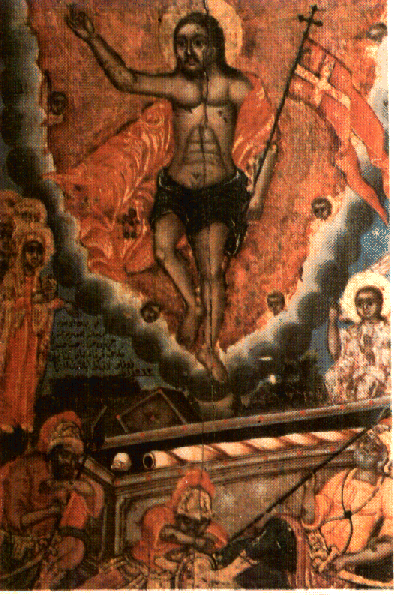
From Pastoral Ponderings by Fr. Patrick Henry Reardon
Too often---if my impressions are correct---the Resurrection and Ascension of our Savior are treated simply as the aftermath of the sacrifice of the Cross, the first effects of Redemption, so to speak. A Christian theology informed by Holy Scripture, however, will insist that the Lord's Resurrection and the Ascension were also integral components of that sacrifice. His glorification on high accomplished that latreuic perfection which was but faintly symbolized in the Old Testament sacrifices that prefigured it.
The victims of those sacrifices, after all, were not only immolated, expressing the self-gift of those who offered them; they were also transformed by sacred fire and thereby ascended to God as the expression of Israel's worship. God received them in the fire.
In the case of our High Priest and Victim, the Holy Spirit was the true fire that transformed His immolated Body and raised it up to the Father as the perfect oblation, the supreme act of worship. The Father received that sacrifice in the fire of the Holy Spirit. This, I take it, is what St. Paul had in mind when He wrote that Christ "gave Himself for us, an offering and sacrifice to God for a sweet-smelling aroma" (Ephesians 5:2). On the cross Christ "through the eternal Spirit offered Himself without spot to God" (Hebrews 9:14).
This truth respecting the sacrificial quality of the Lord's glorification is perhaps best expressed in the Epistle to the Hebrews, which portrays Jesus' entry into the true and heavenly sanctuary as the final act---the liturgical act!---by which He was perfected in His priesthood. Indeed, if Jesus "were on earth, He would not be a priest" (8:4).
That entrance into the Holy Place not made with hands was also the perfection of Christ as our Victim, because in it was achieved the goal of all sacrifice---the Victim became completely the possession of God, transformed by the divine acceptance of the gift. It was the fire of the Holy Spirit that raised Jesus from the dead and handed Him to the Father as the perfect sacrifice, through and in which the human race has access to the Throne. This is why the Church calls the event of the Cross the "Paschal Sacrifice."
According to St. Augustine, "this sacrifice was offered by the one true Priest, the Mediator of God and man; and it was proper that this sacrifice should be pre-figured by animal sacrifices, . . . for a natural body is endowed with heavenly attributes, as the fire in the sacrifice typified the swallowing up of death in victory" (Against Faustus 22.17).
The immolated flesh of Christ, because of the perfect love that He offered to the Father in the self-gift of the Cross, received the Holy Spirit as the iron receives the fire and is thereby transformed. It was the energy of the Holy Spirit in the flesh of Christ (for His soul had departed) that preserved Him from decay and raised Him from the dead.
The glorious Christ abides, therefore, in the divinized state of sacrifice. He is the Lamb who forever stands "as though immolated"---hos esphagmenon (Revelation 5:6)---our Spirit-bearing Mediator with the Father. In this state of glory, ascended on high, He is the channel of the Spirit's sundry gifts (Ephesians 4:4-13).
The Holy Spirit Himself was the first gift of the risen Christ to the Church: "Jesus said to them again, 'Peace to you! As the Father has sent Me, I also send you.' And when He had said this, He breathed on them, and said to them, 'Receive the Holy Spirit'" (John 20:21-22). It is a principle of the New Dispensation that this Holy Spirit comes to the Church through Christ's transformed, divinized flesh.
The Eucharistic Mysteries are especially pertinent to this principle. How do bread and wine become the very Body and Blood of Christ? Because, says St. John of Damascus, "The Holy Spirit is present and does these things." He goes on, "The bread and wine are not mere representations of the Body and Blood of Christ---God forbid!---but the same deified Body of the Lord." We partake of these Mysteries, Damascene insists, "that we may be inflamed and deified by participation in the divine fire." This is how the Christian is transformed: "Being purified thereby, we are united to the Body of Christ and to His Spirit" (On the Orthodox Faith 4.13).
Christus Resurrexit!

St. John Chrysostom's Paschal Homily:
If any man be devout and loveth God,Let him enjoy this fair and radiant triumphal feast!If any man be a wise servant,Let him rejoicing enter into the joy of his Lord.
If any have laboured long in fasting,Let him how receive his recompense.
If any have wrought from the first hour,Let him today receive his just reward.
If any have come at the third hour,Let him with thankfulness keep the feast.
If any have arrived at the sixth hour,
Let him have no misgivings;
Because he shall in nowise be deprived therefore.
If any have delayed until the ninth hour,
Let him draw near, fearing nothing.
And if any have tarried even until the eleventh hour,
Let him, also, be not alarmed at his tardiness.
For the Lord, who is jealous of his honour,
Will accept the last even as the first.
He giveth rest unto him who cometh at the eleventh hour,
Even as unto him who hath wrought from the first hour.
And He showeth mercy upon the last,
And careth for the first;
And to the one He giveth,
And upon the other He bestoweth gifts.
And He both accepteth the deeds,
And welcometh the intention,
And honoureth the acts and praises the offering.
Wherefore, enter ye all into the joy of your Lord;
Receive your reward,
Both the first, and likewise the second.
You rich and poor together, hold high festival!
You sober and you heedless, honour the day!
Rejoice today, both you who have fasted
And you who have disregarded the fast.
The table is full-laden; feast ye all sumptuously.
The calf is fatted; let no one go hungry away.
Enjoy ye all the feast of faith:
Receive ye all the riches of loving-kindness.
Let no one bewail his poverty,
For the universal Kingdom has been revealed.
Let no one weep for his iniquities,For pardon has shown forth from the grave.
Let no one fear death,For the Saviour's death has set us free.
He that was held prisoner of it has annihilated it.
By descending into Hell, He made Hell captive.
He embittered it when it tasted of His flesh.
And Isaiah, foretelling this, did cry:Hell, said he, was embittered
When it encountered Thee in the lower regions.
It was embittered, for it was abolished.
It was embittered, for it was mocked.
It was embittered, for it was slain.I
t was embittered, for it was overthrown.
It was embittered, for it was fettered in chains.
It took a body, and met God face to face.
It took earth, and encountered Heaven.
It took that which was seen, and fell upon the unseen.
O Death, where is thy sting?O Hell, where is thy victory?
Christ is risen, and thou art overthrown!Christ is risen, and the demons are fallen!
Christ is risen, and the angels rejoice!
Christ is risen, and life reigns!
Christ is risen, and not one dead remains in the grave.
For Christ, being risen from the dead,
Is become the first-fruits of those who have fallen asleep.
To Him be glory and dominionUnto ages of ages.
Amen.
Victimae Paschali laudes:
1. Victimae paschali laudes immolent Christiani
2a. Agnus redemit oves:Christus innocens Patri
Reconciliavit peccatores.
2b. Mors et vita duello conflixere mirando,
Dux vitae mortuus, regnat vivus.
3a. Dic nobis Maria, quid vidisti in via?
Sepulcrum Christi viventis,
Et gloriam vidi resurgentis:
3b. Angelicos testes, sudarium et vestes.
Surrexit Christus spes mea:
Praecedet vos in Galilaeam.
4a. Credendum est magis soli Mariae veraci Quam Judaeorum Turbae fallaci.
4b. Scimus Christum surrexisse a mortuis vere:
Tu nobis, victor Rex, miserere. Amen. Alleluia.
English: Christians, to the Paschal victim offer your thankful praises!A lamb the sheep redeemeth:Christ, who only is sinless,reconcileth sinners to the Father.Death and life have contendedin that combat stupendous:the Prince of life, who died,reigns immortal.Speak, Mary, declaring what thou sawest, wayfaring:"The tomb of Christ, who is living,the glory of Jesus' resurrection;"Bright angels attesting,the shroud and napkin resting."Yea, Christ my hope is arisen;to Galilee he will go before you."Christ indeed from death is risen,our new life obtaining;have mercy, victor King, ever reigning!Amen.
Hear a beautiful choral recording of the Victimae Paschali laudes
Here's another one, from a celebration of the paschal mass according to the Tridentine usage.
IMHO, one of the most beautiful paschal anthems ever written, right up there with the Paschal Troparion: Christ is risen from the dead, trampling down death by death, and upon those in the tombs bestowing life!
A blessed Pascha to all.
Christus Resurrexit! Vere Resurrexit!
Christos Anesti! Alithos Anesti!
Christos Voskres! Voistinnu Voskres!
Christ is Risen! Truly He is Risen!
And of course, I must add Chaucerian English: Crist is Arisen! Arisen He Sothe!
Friday, April 18, 2008
Old Footage of an Easter Mass according to the Tridentine Rite...
narrated by this man:

Bishop Fulton Sheen (+1979), Bishop of Rochester and major media figure.
Here he masterfully explains every aspect of the mass as we are treated to a beautiful celebration of the Paschal liturgy.
View it here
A cautionary note to some of my Orthodox and Eastern Catholic readers: Bishop Sheen has a very "Anselmian" interpretation of the atonement as he explains the nature of the "prayers at the foot of the altar." Of course, similar intuitions are found in St. Nicholas Cabasilas, but nonetheless, I think the need for repentance that the prayers at the foot of the altar convey can be interpreted in very non-Anslemian ways.
Bishop Fulton Sheen (+1979), Bishop of Rochester and major media figure.
Here he masterfully explains every aspect of the mass as we are treated to a beautiful celebration of the Paschal liturgy.
View it here
A cautionary note to some of my Orthodox and Eastern Catholic readers: Bishop Sheen has a very "Anselmian" interpretation of the atonement as he explains the nature of the "prayers at the foot of the altar." Of course, similar intuitions are found in St. Nicholas Cabasilas, but nonetheless, I think the need for repentance that the prayers at the foot of the altar convey can be interpreted in very non-Anslemian ways.
Wednesday, April 16, 2008
Clyde Cook, President Emeritus, Biola University, +Requiescat in Pace

1935-2008
Read this Wikipedia article on his amazing life.
He was president when I attended Biola as an undergraduate (1984-1988), and continued to head the university when I returned in 1996 as a faculty member in the Torrey Honors Institute, which he helped get off the ground.
+Requiem aeternam dona ei, Domine, et lux perpetuam luceat ei!
+Requiescat in pace!
Tuesday, April 15, 2008
Please, Not Another FDR
by Christopher Westley,
The Ludwig von Mises Institute
"Harold Meyerson, writing in the Washington Post, calls for a new New Deal. The old one worked just fine, and current times call for some of the same medicine.
"Harold says it, and he's not alone. FDR's nanny-like visage has been showing up on left-liberal and neocon publications — web and print — by folks who don't understand that their favorite New York patrician-president is the reason for this economic season, to the extent that his legacy justifies intervening in market forces."
Read the rest here
The Ludwig von Mises Institute
"Harold Meyerson, writing in the Washington Post, calls for a new New Deal. The old one worked just fine, and current times call for some of the same medicine.
"Harold says it, and he's not alone. FDR's nanny-like visage has been showing up on left-liberal and neocon publications — web and print — by folks who don't understand that their favorite New York patrician-president is the reason for this economic season, to the extent that his legacy justifies intervening in market forces."
Read the rest here
Thursday, April 10, 2008
What is "Orthodox Theology"?
From Eirenikon:
"What almost always passes for "Orthodox theology" among English-speaking Orthodox these days is actually just a branch of the larger Orthodox picture. Indeed, it tends sometimes to be rather sectarian.
The Orthodox Church is an ancient castle, as it were, of which only two or three rooms have been much in use since about 1920. These two or three rooms were furnished by the Russian émigrés in Paris between the two World Wars. This furniture is heavily neo-Palamite and anti-Scholastic. It relies heavily on the Cappadocians, Maximus, and Gregory Palamas (who are good folks, or course). Anything that does not fit comfortably into that model is dismissed as "Western" and even non-Orthodox.
Consequently, one will look in vain in that theology for any significant contribution from the Alexandrians, chiefly Cyril, and that major Antiochian, Chrysostom. When these are quoted, it is usually some incidental point on which they can afford to be quoted.
Now I submit that any "Orthodox" theology that has so little use for the two major figures from Antioch and Alexandria is giving something less than the whole picture.
Likewise, this popular neo-Palamite brand of Orthodoxy, though it quotes Damascene when it is convenient, never really engages Damascene’s manifestly "Scholastic" approach to theology.
Much less does it have any use for the other early Scholastic theologians, such as Theodore the Studite and Euthymus Zygabenus. There is no recognition that Scholasticism was born in the East, not the West, and that only the rise of the Turk kept it from flourishing in the East.
There is also no explicit recognition that the defining pattern of Orthodox Christology was formulated in the West before Chalcedon. Pope Leo’s distinctions are already very clear in Augustine decades before Chalcedon. Yet, Orthodox treatises on the history of Christology regularly ignore Augustine.
Augustine tends to be classified as a "Scholastic," which he most certainly was not.
But Western and Scholastic are bad words with these folks.
In fact, however, Augustine and the Scholastics represent only other rooms in the larger castle.
For this reason I urge you, as you can, to read in the Orthodox sources that tend to get skipped in what currently passes for "Orthodoxy." For my part, I believe the Russian émigré theology from Paris, which seems profoundly reactionary and anti-Western, is an inadequate instrument for the evangelization of this country and the world. I say this while gladly recognizing my own debt to Russian émigré theology."
– Father Patrick Henry Reardon (All Saints’ Orthodox Church, Chicago), an excerpt from an e-mail to an inquirer that’s been making the rounds in the Orthodox and Catholic blogospheres
"What almost always passes for "Orthodox theology" among English-speaking Orthodox these days is actually just a branch of the larger Orthodox picture. Indeed, it tends sometimes to be rather sectarian.
The Orthodox Church is an ancient castle, as it were, of which only two or three rooms have been much in use since about 1920. These two or three rooms were furnished by the Russian émigrés in Paris between the two World Wars. This furniture is heavily neo-Palamite and anti-Scholastic. It relies heavily on the Cappadocians, Maximus, and Gregory Palamas (who are good folks, or course). Anything that does not fit comfortably into that model is dismissed as "Western" and even non-Orthodox.
Consequently, one will look in vain in that theology for any significant contribution from the Alexandrians, chiefly Cyril, and that major Antiochian, Chrysostom. When these are quoted, it is usually some incidental point on which they can afford to be quoted.
Now I submit that any "Orthodox" theology that has so little use for the two major figures from Antioch and Alexandria is giving something less than the whole picture.
Likewise, this popular neo-Palamite brand of Orthodoxy, though it quotes Damascene when it is convenient, never really engages Damascene’s manifestly "Scholastic" approach to theology.
Much less does it have any use for the other early Scholastic theologians, such as Theodore the Studite and Euthymus Zygabenus. There is no recognition that Scholasticism was born in the East, not the West, and that only the rise of the Turk kept it from flourishing in the East.
There is also no explicit recognition that the defining pattern of Orthodox Christology was formulated in the West before Chalcedon. Pope Leo’s distinctions are already very clear in Augustine decades before Chalcedon. Yet, Orthodox treatises on the history of Christology regularly ignore Augustine.
Augustine tends to be classified as a "Scholastic," which he most certainly was not.
But Western and Scholastic are bad words with these folks.
In fact, however, Augustine and the Scholastics represent only other rooms in the larger castle.
For this reason I urge you, as you can, to read in the Orthodox sources that tend to get skipped in what currently passes for "Orthodoxy." For my part, I believe the Russian émigré theology from Paris, which seems profoundly reactionary and anti-Western, is an inadequate instrument for the evangelization of this country and the world. I say this while gladly recognizing my own debt to Russian émigré theology."
– Father Patrick Henry Reardon (All Saints’ Orthodox Church, Chicago), an excerpt from an e-mail to an inquirer that’s been making the rounds in the Orthodox and Catholic blogospheres
Out Today: The Monastic Breviary Matins
I announce to you a great joy. Lancelot Andrewes Press has finally released the Monastic Breiviary for the office of Matins!
Here is an excerpt from the LAP website:
• Monastic Breviary Matins is a complete
English translation of the ancient Monastic
Night Office, and is necessary for those who
wish to recite the complete traditional Monastic
Divine Office in English.
• Contains beautiful, classic translations
of the Psalms, Canticles, Hymns, Responsories,
Lessons, Gospels, Collects and other elements
of the Monastic Night Office, including
the Lives of the Saints and readings from the
great Fathers and Doctors of the Church.
• Originally published in 1961 by the Society
of the Sacred Cross, an Anglican religious
community for women, in Tymawr, Wales.
• A companion volume to The Monastic
Diurnal, originally published by Oxford University
Press in 1932 and reprinted in 2006 by
Lancelot Andrewes Press.
• As with The Monastic Diurnal, this
translation conforms to the Coverdale Psalter
of the classic Book of Common Prayer, as well
as the Authorised (“King James”) Bible.
• Parallel sets of Office texts and rubrics
conforming to both the traditional Roman
and Anglican usages, where necessary.
The cost is $45, which includes shipping and handling (if odering in the U.S.).
I guess I know where my book allowance from my next paycheck is going to go!
Here is an excerpt from the LAP website:
• Monastic Breviary Matins is a complete
English translation of the ancient Monastic
Night Office, and is necessary for those who
wish to recite the complete traditional Monastic
Divine Office in English.
• Contains beautiful, classic translations
of the Psalms, Canticles, Hymns, Responsories,
Lessons, Gospels, Collects and other elements
of the Monastic Night Office, including
the Lives of the Saints and readings from the
great Fathers and Doctors of the Church.
• Originally published in 1961 by the Society
of the Sacred Cross, an Anglican religious
community for women, in Tymawr, Wales.
• A companion volume to The Monastic
Diurnal, originally published by Oxford University
Press in 1932 and reprinted in 2006 by
Lancelot Andrewes Press.
• As with The Monastic Diurnal, this
translation conforms to the Coverdale Psalter
of the classic Book of Common Prayer, as well
as the Authorised (“King James”) Bible.
• Parallel sets of Office texts and rubrics
conforming to both the traditional Roman
and Anglican usages, where necessary.
The cost is $45, which includes shipping and handling (if odering in the U.S.).
I guess I know where my book allowance from my next paycheck is going to go!
Wednesday, April 09, 2008
Act repeal could make Franz Herzog von Bayern new King of England and Scotland
Good news for Jacobites! Gordon Brown, in an effort to redress historic injustices, works to repeal the Act of Settlement of 1701, which prohibits any Catholic from sitting on the English throne. For those who hold to the traditional Stuart line as the legitimate heirs to the throne, their man, Franz Herzog von Bayern, Duke of Bavaria and blood descendant of King Charles I, would have a shot at the throne as a Stuart contender against the Prince Charles.
Read the story here.
LOL: "Franz becomes the rightful claimant to the throne. We would just exchange one German family for another one." Remember, the present royal family descends from the Protestant Stuarts who married into the royal houses of the Hanoverian princes in the 18th century. Up until 1917, their family name was Saxe-Coburg-Gotha, when it was changed by George VI to Windsor.
Read the story here.
LOL: "Franz becomes the rightful claimant to the throne. We would just exchange one German family for another one." Remember, the present royal family descends from the Protestant Stuarts who married into the royal houses of the Hanoverian princes in the 18th century. Up until 1917, their family name was Saxe-Coburg-Gotha, when it was changed by George VI to Windsor.
Conservatives: Stay or go?
"Larison identifies the traditionalist conservative dilemma: to be in a position to move the culture, you probably will have to violate your traditionalist principles. Excerpt: 'Conservatives who don’t eschew pursuing professional and academic degrees are said to lack authenticity and credibility when they make arguments to go home, and the temperamental conservatives who don’t pursue such paths find themselves arrayed against institutions dominated entirely by people who valorize constant mobility and who embrace political and cultural values antithetical to everything the conservatives treasure.' It's a real problem. How credible are traditionalists who advise people to stay home, develop roots, etc., from comfortable positions in the academy, in the think tanks, or, well, in newsrooms -- all far from their homes? Aren't we really saying, "Don't be like us!"? Or: "Do as we say, not as we do"?"-Rod Dreher
This prompts the question of whether or not a truly conservative ethos can be lived out in a highly mobile society. Wendell Berry doesn't think so.
On a side note, Steve says: "The role of the conservative is not to stand before the march of history and stop it but rather to slow it or redirect it."
Good point! This is what a conservative ethos is all about: not to "stop" change, but to slow it down enough for us to consider how it will be incoporprated with our recieved traditions. And this requires (shall I use such an un-pc word?) some kind of "discrimination," a careful sorting of what and how certain changes can be incoroporated into the fabric of our society and what can't.
Incidently, the Senate was supposed to be the "conservative" branch, each member given six years in order to slow down radical legislation from the more "radical" branch-the House of Representatives.
This prompts the question of whether or not a truly conservative ethos can be lived out in a highly mobile society. Wendell Berry doesn't think so.
On a side note, Steve says: "The role of the conservative is not to stand before the march of history and stop it but rather to slow it or redirect it."
Good point! This is what a conservative ethos is all about: not to "stop" change, but to slow it down enough for us to consider how it will be incoporprated with our recieved traditions. And this requires (shall I use such an un-pc word?) some kind of "discrimination," a careful sorting of what and how certain changes can be incoroporated into the fabric of our society and what can't.
Incidently, the Senate was supposed to be the "conservative" branch, each member given six years in order to slow down radical legislation from the more "radical" branch-the House of Representatives.
Tuesday, April 08, 2008
Contra linguae vulgari

Arturo Vasquez discusses the necessity for sacred language in the worship of the Church.
"It is a common argument nowadays that a sacred language would never fly with modern man, that if the Catholic Church went back to having all Latin services tomorrow, people would leave in droves. People want to understand what is being said in services, people benefit from learning the “Word of God” etc. This may be true, but it is a rather curious assumption, since the now largest religion in the world, Islam, uses Koranic Arabic in its instruction and prayer from Morrocco to the southern Philipines, from mosques in sub-Saharan Africa to store front meeting places in the ghettos of Oakland. Venacularization may not be the best growth strategy if we look at the example of our main competitor."
Read the rest.
New Regulations Will Shape the Next Crisis
What do we have to worry about? According to Gary North at LewRockwell.com, everything!
Here's the truth of the matter: the government and the FED create a crisis. Then new regulations are put in place to address the crisis, but having the deleterious effect of creating bigger crises that bring about more regulation, thereby threatening our economic liberty.
Read it here
Here's the truth of the matter: the government and the FED create a crisis. Then new regulations are put in place to address the crisis, but having the deleterious effect of creating bigger crises that bring about more regulation, thereby threatening our economic liberty.
Read it here
Tibetan Protest in San Francisco Ahead of Olympic Torch Relay
So now China has its first Olympic games, and wants to polish its image to the world.
Tibet, of course, is going to make it very difficult for her to do that.
I think it quite interesting, and hypocritical, that the U.S., in cooperation with NATO, would recognize and virtually create an expanded Islamic state in the Balkans which oppresses Christians, would completely ignore Tibet's cry for self-determination. Tibet, IMHO, has an even better claim to independence and self-determination than Kosovo, and yet we turn a blind eye to China's relentless campaign of destruction and oppression of this ancient and venerable people.
Read the BBC article here
My two-cents worth:
We turn a blind eye primarily because we are now economically beholden to China! We are so much in debt that we dare not raise our voices to our new economic masters. They own our debt, and it will not be long before we, too, will be dictated to in our foreign and domestic policies. We can stop buying Chinese products, and that will force us to tighten our belts, pay our debts and live within our means. Will we do that? Not bloody likely.
In the meantime, China continues to grow exponentlially, and we are selling her the rope by which she will hang us as well. Or should I say, we are borrowing more to buy the rope (on credit), so that when we can no longer pay, China will hang us. She will continue to have a free hand in Tibet, and the "leader of the free world" will have nothing to say about it. We will go after small fish like Robert Mugabe, but will continue to be silent about China's oppression of Tibet.
Tibet, of course, is going to make it very difficult for her to do that.
I think it quite interesting, and hypocritical, that the U.S., in cooperation with NATO, would recognize and virtually create an expanded Islamic state in the Balkans which oppresses Christians, would completely ignore Tibet's cry for self-determination. Tibet, IMHO, has an even better claim to independence and self-determination than Kosovo, and yet we turn a blind eye to China's relentless campaign of destruction and oppression of this ancient and venerable people.
Read the BBC article here
My two-cents worth:
We turn a blind eye primarily because we are now economically beholden to China! We are so much in debt that we dare not raise our voices to our new economic masters. They own our debt, and it will not be long before we, too, will be dictated to in our foreign and domestic policies. We can stop buying Chinese products, and that will force us to tighten our belts, pay our debts and live within our means. Will we do that? Not bloody likely.
In the meantime, China continues to grow exponentlially, and we are selling her the rope by which she will hang us as well. Or should I say, we are borrowing more to buy the rope (on credit), so that when we can no longer pay, China will hang us. She will continue to have a free hand in Tibet, and the "leader of the free world" will have nothing to say about it. We will go after small fish like Robert Mugabe, but will continue to be silent about China's oppression of Tibet.
The Sermons of Cowards
From Fr. Methodius' blog:
The powerful nations of the West are fond of preaching sanctimonious sermons about freedom and democracy to tin-pot dictators like Robert Mugabe of Zimbabwe, but are too chicken to speak the truth to power when it come to the evils in their own back yards.
Read article here
Biretta tip to The Young Fogey
The powerful nations of the West are fond of preaching sanctimonious sermons about freedom and democracy to tin-pot dictators like Robert Mugabe of Zimbabwe, but are too chicken to speak the truth to power when it come to the evils in their own back yards.
Read article here
Biretta tip to The Young Fogey
Charlton Heston, +Requiscat in Pace

A bit belated, but I would be remiss in not reflecting on the death of my favorite actor.
A true Christian gentleman, that rare breed of fellows who knew how to relate to people. He held his conservative political convictions in such a way that he could engage in a calm, reasonable exchange with people who disagreed with him with great congeniality, respect and humour. His command of classical literature was astounding, with quotes from Cicero, Virgil, Juvenal and Seneca rolling out of his tongue as though they were old friends. A devout Presbyterian, faith was for him an indispensable part of who he was.
My favorite Heston films: The Agony and the Ecstasy, Ben Hur, The Ten Commandments, Omega Man, Planet of the Apes.
Good night, sweet prince, and flights of angels sing thee to thy rest!
+Requiem aeternam dona ei, Domine, et lux perpetuam luceat ei!
+Memory Eternal! Memory Eternal! May his memory be eternal!
Friday, April 04, 2008
St. Isidore of Seville

San Ysidro de Sevilla
Last of the Latin Fathers, perhaps first of the medieval Aristotelians (at least the Anglican Breviary attributes to him the promulgation of Aristotle in Spain before the Moors got there).
This was a man who combined deep piety and scholarly curiosity, composing a summa of universal knowledge known as the Etymologiae. This was an encyclopedic compilation of learned treatises on natural philosophy (drawing heavily from Aristotle). It had a long life as a basic textbook in the medieval universities, and its popularity continued well into the Renaissance. In Dante's Divine Comedy, he is mentioned in Paradise (XI:30) with the great theologians and doctors of the Church.
Here is a link to the complete text of the Etymologiae in Latin.
I have not found any online text in English, but here is a good translation by Priscilla Throop.
Bishop, Confessor, Doctor: Ora pro nobis!
Wednesday, April 02, 2008
War By Faith Alone
David Gordon reviews George Weigel's Faith, Reason and the War Against Jihadism(Doubleday, 2007):
The key to George Weigel's thought lies in his earlier massive volume Tranquillitas Ordinis (Oxford University Press, 1987). St. Augustine beautifully defined peace as the tranquility of order. Weigel twists Augustine's dictum for his own bellicose purposes. In standard just war theory, the conditions a legitimate war are required to meet are so demanding that, as the eminent theologian Charles Cardinal Journet contended,
"After reading this specification [by St. Thomas Aquinas of the criteria] for a just war we might well ask how many wars have been wholly just. Probably they could be counted on the fingers of one hand." (Journet, The Church of the Word Incarnate, Volume 1, Sheed and Ward, 1955, pp. 306–307)
Weigel endeavors to escape from these limits. Anything less than a stable, ordered world does not meet Augustine's definition of peace. But should not our goal be to promote this sort of peace, rather than be satisfied with peace as the mere absence of war? If so, we may aim actively to secure an ordered world. Needless to say, Augustine did not take his remark to have these implications. Quite the contrary, he helped initiate the tradition of strict limits on war to which Cardinal Journet refers. Faith, Reason, and the War Against Jihadism may be regarded as an application of Weigel's "tranquillitas ordinis fallacy" to current American foreign policy.[1]
The book consists of three parts: the initial part concentrates on Islamic theology and the other two on foreign policy issues. I propose to concentrate on the latter two parts, since theology far exceeds my competence. The sum and substance of the first part is that the notion of three Abrahamic faiths, Judaism, Christianity, and Islam, should be rejected. Islam diverges sharply from the other two faiths. The issue, further, cannot be confined to mere theological argument. Many Muslims wish to wage holy war against the West in order to bring about the triumph of their faith. In doing so, some countenance tactics of terror, as we learned to our horror on 9/11. Some Muslims seem amenable to compromise, but the danger from Islam must not be underestimated; and tough tactics are the order of the day. An "Open Letter to Pope Benedict XVI" signed by thirty-eight Islamic leaders is encouraging.
"Yet it is not without interest that this statement — which despite its shortcomings was still the most forthcoming from senior Muslim leaders in living memory — followed a robust critique [by the Pope] of the theological roots of jihadism, not the exchange of banalities and pleasantries that too often characterizes interreligious dialogue. Surely there are lessons here for the future." (p. 61)
I do not wish to argue for a different view of Islam from that which Weigel adopts: his foreign policy conclusions do not follow even if one sees Islam as he does. But his efforts to drive a wedge between Islam and the other two "Abrahamic" religions are sometimes forced. He rightly notes that Muslims believe that their faith has superseded Judaism and Christianity.
Read the rest of the article here
Very key point:
" Weigel says: 'Islam's radical stress on the unicity (oneness) of God, which Islam sharply distinguishes from the Christian Trinitarian concept of God, may also help explain the differing success each religion has had in creating societies characterized by a healthy, vibrant pluralism.' (p. 169, note 21) Weigel omits to mention that Judaism also insists on God's absolute unity. Indeed, Maimonides largely for that reason thought Islam closer to the truth than Christianity."
The key to George Weigel's thought lies in his earlier massive volume Tranquillitas Ordinis (Oxford University Press, 1987). St. Augustine beautifully defined peace as the tranquility of order. Weigel twists Augustine's dictum for his own bellicose purposes. In standard just war theory, the conditions a legitimate war are required to meet are so demanding that, as the eminent theologian Charles Cardinal Journet contended,
"After reading this specification [by St. Thomas Aquinas of the criteria] for a just war we might well ask how many wars have been wholly just. Probably they could be counted on the fingers of one hand." (Journet, The Church of the Word Incarnate, Volume 1, Sheed and Ward, 1955, pp. 306–307)
Weigel endeavors to escape from these limits. Anything less than a stable, ordered world does not meet Augustine's definition of peace. But should not our goal be to promote this sort of peace, rather than be satisfied with peace as the mere absence of war? If so, we may aim actively to secure an ordered world. Needless to say, Augustine did not take his remark to have these implications. Quite the contrary, he helped initiate the tradition of strict limits on war to which Cardinal Journet refers. Faith, Reason, and the War Against Jihadism may be regarded as an application of Weigel's "tranquillitas ordinis fallacy" to current American foreign policy.[1]
The book consists of three parts: the initial part concentrates on Islamic theology and the other two on foreign policy issues. I propose to concentrate on the latter two parts, since theology far exceeds my competence. The sum and substance of the first part is that the notion of three Abrahamic faiths, Judaism, Christianity, and Islam, should be rejected. Islam diverges sharply from the other two faiths. The issue, further, cannot be confined to mere theological argument. Many Muslims wish to wage holy war against the West in order to bring about the triumph of their faith. In doing so, some countenance tactics of terror, as we learned to our horror on 9/11. Some Muslims seem amenable to compromise, but the danger from Islam must not be underestimated; and tough tactics are the order of the day. An "Open Letter to Pope Benedict XVI" signed by thirty-eight Islamic leaders is encouraging.
"Yet it is not without interest that this statement — which despite its shortcomings was still the most forthcoming from senior Muslim leaders in living memory — followed a robust critique [by the Pope] of the theological roots of jihadism, not the exchange of banalities and pleasantries that too often characterizes interreligious dialogue. Surely there are lessons here for the future." (p. 61)
I do not wish to argue for a different view of Islam from that which Weigel adopts: his foreign policy conclusions do not follow even if one sees Islam as he does. But his efforts to drive a wedge between Islam and the other two "Abrahamic" religions are sometimes forced. He rightly notes that Muslims believe that their faith has superseded Judaism and Christianity.
Read the rest of the article here
Very key point:
" Weigel says: 'Islam's radical stress on the unicity (oneness) of God, which Islam sharply distinguishes from the Christian Trinitarian concept of God, may also help explain the differing success each religion has had in creating societies characterized by a healthy, vibrant pluralism.' (p. 169, note 21) Weigel omits to mention that Judaism also insists on God's absolute unity. Indeed, Maimonides largely for that reason thought Islam closer to the truth than Christianity."
Monday, March 31, 2008
A blessing in disguise?

Make mine a double scotch! With a round of some heavy-duty vodka!
Courtesy of 3rd Blog from the Right by way of The Young Fogey
Islam and "Sunday Christianity"
What happened in the 20th century after we made Christianity "easy"?
Fr. Timothy Kroh of St. Timothy's Episcopal Church in Chester, Pennsylvania tells us why young people in Chester are converting to Islam in large numbers. Hint: something about the demand for a true conversion, a real and radical change of life.
Read the article here.
Biretta tip to The Young Fogey
Fr. Timothy Kroh of St. Timothy's Episcopal Church in Chester, Pennsylvania tells us why young people in Chester are converting to Islam in large numbers. Hint: something about the demand for a true conversion, a real and radical change of life.
Read the article here.
Biretta tip to The Young Fogey
Monday, March 24, 2008
A Visit that Changed the World

This is the day when heaven broke into our world, because a poor Judean girl two-thousand years ago said "yes" to God, and nothing has been quite the same since.
A sermon by St. Proclus of Constantinople:
Our present gathering in honor of the Most Holy Virgin inspires me, brethren, to say of Her a word of praise, of benefit also for those come unto this churchly solemnity.
It comprises a praise of women, a glorying of their gender, which (glory) is brought it by Her, She Who is at one same time both Mother, and Virgin. O desired and wondrous gathering! Celebrate, O nature, that wherein honor be rendered to Woman; rejoice, O human race, that wherein the Virgin be glorified. "For when sin did abound, grace did superabound" (Rom 5:20). The Holy Mother of God and Virgin Mary hath gathered us here, She the pure treasure of virginity, the intended paradise of Second Adam -- the locus, wherein was accomplished the co-uniting of natures, wherein was affirmed the Counsel of salvific reconciliation.
Whoever is it that ever saw, whoever heard, that within a womb the Limitless God would make habitation, Whom the Heavens cannot circumscribe, Whom the womb of a Virgin limiteth not!?
He born of woman is not only God and He is not only Man: This One born made woman, being the ancient gateway of sin, into the gateway of salvation: where evil poured forth its poison, bringing on disobedience, there the Word made for Himself a living temple, bringing in thither obedience; from whence the arch-sinner Cain sprang forth, there without seed was born Christ the Redeemer of the human race.
The Lover-of-Mankind did not disdain to be born of woman, since this bestowed His life. He was not subject to impurity, being settled within the womb, which He Himself arrayed free from all harm. If perchance this Mother did not remain a Virgin, then that born of Her might be a mere man, and the birth would be no wise miraculous; but since she after birth remained a Virgin, then how is He Who is born indeed -- not God? It is an inexplicable mystery, since in an inexplicable manner was born He Who without hindrance went through doors when they were locked. When confessing in Him the co-uniting of two natures, Thomas cried out: "My Lord, and my God!" (Jn 20:28).
The Apostle Paul says, that Christ is "to the Jews indeed scandal, and to the Gentiles yet folly" (1 Cor 1:23): they did not perceive the power of the mystery, since it was incomprehensible to the mind: "for had they understood, they would not have crucified the Lord of Glory" (1 Cor 2:8). If the Word had not settled within the womb, then the flesh would not have ascended with Him onto the Divine Throne; if for God it were disdainful to enter into the womb, which He created, then the Angels too would have disdained service to mankind.
That One, Who by His nature was not subject to sufferings, through His love for us subjected Himself to many a suffering. We believe, that Christ not through some gradual ascent towards the Divine nature was made God, but being God, through His mercy He was made Man. We do not say: "a man made God"; but we confess, that God was incarnated and made Man.
His Servant was chosen for Himself as Mother by That One Who, in His essence did not have mother, and Who, through Divine foresight having appeared upon the earth in the image of man, does not have here father. How one and the same is He both without father, and without mother, in accord with the words of the Apostle (Heb 7:3)? If He -- be only a man, then He cannot be without mother -- but actually He had a Mother. If He -- be God only, then He cannot be without Father -- but in fact He has the Father. And yet as God the Creator He has not mother, and as Man He has not father.
We can be persuaded in this by the very name of the Archangel, making annunciation to Mary: his name -- is Gabriel. What does this name mean? -- it means: "God and man." Since That One about Whom he announced is God and Man, then his very name points beforehand to this miracle, so that with faith be accepted the deed of the Divine dispensation.
To save people would be impossible for a mere man, since every man has need in the Saviour: "for all, -- says Saint Paul, -- have sinned, and come short the Glory of God" (Rom 3:23). Since sin subjects the sinner to the power of the devil, and the devil subjects him to death, then our condition did become extremely hapless: there was no sort of way to be delivered from death.
There were sent physicians, i.e. the prophets, but they could only the more clearly point out the malady. What did they do? When they saw, that the illness was beyond human skill, they summoned from Heaven the Physician; one of them said "Lord, bend the heavens, and come down" (Ps 143[144]:5); others cried out: "Heal me, O Lord, and I shalt be healed" (Jer 17:14); "restore Thine power, and come yet to save us" (Ps 79[80]:3). And yet others: "For if God truly be settled with man upon the earth" (3[1] Kg 8:27); "speedily send before Thine tender mercy, O Lord, for we are brought very low" (Ps 78[79]:8).
Others said: "O woe to me, my soul! For the pious art perished from the earth, and of the upright amongst men there is none" (Mich 7:2). "O God, in help attend to me, O Lord, shield me with Thine help" (Ps 69[70]:1). "If there be delay, endure it, for He that cometh shalt come, and not tarry" (Hab 2:3). "Perishing like a lost sheep: seek out Thine servant, who doth hope on Thee" (Ps 118[119]:176). "For God wilt come, our God, and wilt not keep silence" (Ps. 49[50]:3).
That One, Who by nature is Lord, did not disdain human nature, enslaved by the sinister power of the devil, the merciful God would not accede for it to be forever under the power of the devil, the Ever-Existing One came and gave in ransom His Blood; for the redemption of the race of man from death He gave up His Body, which He had accepted of the Virgin, He delivered the world from the curse of the law, annihilating death by His death. "Christ hath redeemed us from the curse of the law" -- exclaims Saint Paul (Gal 3:13).
Thus know, that our Redeemer is not simply a mere man, since all the human race was enslaved to sin. But He likewise is not God only, non-partaking of human nature. He had body, since if He had not clothed Himself in me, He then likewise should not have saved me. But, having settled within the womb of the Virgin, He clothed Himself in my fate, and within this womb He perfected a miraculous change: He bestowed the Spirit and received a body, That One only indeed (dwelling) with the Virgin and (born) of the Virgin. And so, Who is He, made manifest to us? The Prophet David doth point it out for thee in these words: "Blessed is He that cometh in the Name of the Lord" (Ps 117[118]:26).
But tell us even more clearly, O prophet, Who is He? The Lord is the God of Hosts, says the prophet: "God is the Lord, and hath revealed Himself unto us" (Ps 117[118]:27). "The Word was made flesh" (Jn 1:14): there were co-united the two natures, and the union remained without mingling.
He came to save, but had also to suffer. What has the one in common with the other? A mere man cannot save; and God in only His nature cannot suffer. By what means was done the one and the other? Wherein that He, Emmanuel, being God, was made also Man; both this, that what He was, He saved by -- and this, that what He was made, He suffered as. Wherefore, when the Church beheld that the Jewish throng had crowned Him with thorns, bewailing the violence of the throng, it said: "Daughters of Zion, go forth and behold the crown, of which is crowned He of His mother" (Sng 3:11).
He wore the crown of thorns and destroyed the judgement to suffering from the thorns. He Only is That One both in the bosom of the Father and in the womb of the Virgin; He Only is That One -- in the arms of His Mother and in the wings of the winds (Ps. 103[104]:3); He, to Whom the Angels bowed down in worship, at that same time reclined at table with publicans.
Upon Him the Seraphim dared not to gaze, and at the same time Pilate pronounced sentence upon Him. He is That One and Same, Whom the servant did smite and before whom did tremble all creation.
He was nailed to the Cross and ascended to the Throne of Glory -- He was placed in the tomb and He stretched out the heavens like a skin (Ps. 103[104]:2) -- He was numbered amidst the dead and He emptied hell; here upon the earth, they cursed at Him as a transgressor -- there in Heaven, they exclaimed Him glory as the All-Holy.
What an incomprehensible mystery! I see the miracles, and I confess, that He is God; I see the sufferings, and I cannot deny, that He is Man. Emmanuel opened up the doors of nature, as man, and preserved unharmed the seal of virginity, as God: He emerged from the womb thus as He entered through the announcing; the same wondrously was He both born and conceived: without passion He entered, and without impairment He emerged, as concerning this doth say the Prophet Ezekiel: "He returned me back the way of the gates of the outer sanctuaries, looking upon the east: and these had been shut. And saith the Lord to me: son of man, these gates shalt be closed, and not open, and no one go through them: for the Lord God of Israel, He Only, shalt enter and come forth, and they wilt be shut" (Ez 44:1-2). Here it clearly indicates the Holy Virgin and Mother of God Mary.
Let cease all contention, and let the Holy Scripture enlighten our reason, so that we too receive the Heavenly Kingdom unto all eternity. Amen.
Friday, March 21, 2008
Happy 403rd Birthday, Kappelmeister!

The Master turns 403 today, and he is still setting the standard for instrumental and choral virtuosity, driven by one holy passion: Soli Deo Gloria! May his works know many, many more centuries of life and influence.
My thoughts on Bach as playd on piano: In my humble opinion, there was only one pianist who could pull this off-Glenn Gould. As a matter of fact, if Bach is being played on piano, and it's not Glenn Gould, then it's not Bach on piano. PERIOD! It is useless otherwise. Why, it's like trying to have the Benny Goodman Orchestra without Benny Goodman and Gene Krupa, or Led Zeppelin without John Bonham. It's simply not-going-to-happen!
To see what I mean, here's Glenn Gould playing the Bach's Partita NO. 6.
Now listen to the Rostropovich, AKA The Master Cellist, play Bach's Cello Suite No. 1.
Tuesday, March 18, 2008
Edmund Burke as Christian Statesman
An article by Fr. Francis Canavan, S.J., published by The Edmund Burke Society
First, Edmund Burke was a Christian, despite the doubts that critics have expressed about his faith. But he was the child of a mixed marriage between a Catholic mother and a Protestant father, a member of the Established Church of Ireland.
Because Edmund was somewhat sickly as a child he was sent to spend some years with his mother’s Catholic relatives in the healthier air of the Cork countryside. With them, he remained in friendly (and helpful) contact throughout his life. Always sympathetic with their lot and that of their fellow Catholics, he took an active part in relaxing the penal laws both in Ireland and England.
If Burke had a personal problem because of the religious division in his family, he resolved it by minimizing the theological differences among the various Christian churches. As he wrote to a Quaker friend while he was a student at Trinity College in Dublin, “we take different roads, it is true,” but “as there is but one God so there is but one faith and one Baptism.”
The one faith was, in his words, “Christianity at large.” It was “our common faith,” “our common hope,” the “one common bottom on which all the principal religions in Europe stand.” The European nations were thus members of “the great commonwealth of Christendom,” having “the very same Christian religion, agreeing in the fundamental parts, varying a little in the ceremonies and in the subordinate doctrines.”
Burke never troubled himself to list those fundamentals, but his conviction about them enabled him to favor a relatively high degree of religious tolerance while insisting on the value of national religious establishments, Protestant in Great Britain and Ireland, but Catholic in France. When the French Revolution arrived, he strove to rally the nations of Europe to defend the commonwealth of Christendom against it.
But he denied that he was pressing religion into the service of an aristocracy and its political order. On the contrary, he said: “Religion is so far from being out of the province or the duty of a Christian magistrate, that it is, and it ought to be, not only his care, but the principal thing in his care; because it is one of the great bonds of human society; and its object the supreme good, the ultimate end and object of man himself.”
The revolution in France, as he saw it, was the spawn of an anti-Christian Enlightenment and therefore an attack on a civilization whose basis was Christianity. If the Christian religion “is destroyed, nothing can be saved, or is worth saving,” because “on that religion, according to our mode, all our laws and institutions stand as upon their base. That scheme is supposed in every transaction of life; and if that were done away, every thing else, as in France, must be changed along with it.”
Read the rest here
First, Edmund Burke was a Christian, despite the doubts that critics have expressed about his faith. But he was the child of a mixed marriage between a Catholic mother and a Protestant father, a member of the Established Church of Ireland.
Because Edmund was somewhat sickly as a child he was sent to spend some years with his mother’s Catholic relatives in the healthier air of the Cork countryside. With them, he remained in friendly (and helpful) contact throughout his life. Always sympathetic with their lot and that of their fellow Catholics, he took an active part in relaxing the penal laws both in Ireland and England.
If Burke had a personal problem because of the religious division in his family, he resolved it by minimizing the theological differences among the various Christian churches. As he wrote to a Quaker friend while he was a student at Trinity College in Dublin, “we take different roads, it is true,” but “as there is but one God so there is but one faith and one Baptism.”
The one faith was, in his words, “Christianity at large.” It was “our common faith,” “our common hope,” the “one common bottom on which all the principal religions in Europe stand.” The European nations were thus members of “the great commonwealth of Christendom,” having “the very same Christian religion, agreeing in the fundamental parts, varying a little in the ceremonies and in the subordinate doctrines.”
Burke never troubled himself to list those fundamentals, but his conviction about them enabled him to favor a relatively high degree of religious tolerance while insisting on the value of national religious establishments, Protestant in Great Britain and Ireland, but Catholic in France. When the French Revolution arrived, he strove to rally the nations of Europe to defend the commonwealth of Christendom against it.
But he denied that he was pressing religion into the service of an aristocracy and its political order. On the contrary, he said: “Religion is so far from being out of the province or the duty of a Christian magistrate, that it is, and it ought to be, not only his care, but the principal thing in his care; because it is one of the great bonds of human society; and its object the supreme good, the ultimate end and object of man himself.”
The revolution in France, as he saw it, was the spawn of an anti-Christian Enlightenment and therefore an attack on a civilization whose basis was Christianity. If the Christian religion “is destroyed, nothing can be saved, or is worth saving,” because “on that religion, according to our mode, all our laws and institutions stand as upon their base. That scheme is supposed in every transaction of life; and if that were done away, every thing else, as in France, must be changed along with it.”
Read the rest here
Ash Wednesday Sermon

I am occasionally called upon, as a subdeacon in my parish, to give a short sermon. For Ash Wednesday (which was just five days ago for us Orthodox Christians worshipping in the venerable rites of the West), Father requested that I give a short meditation.
Yes, I know! Many of you, my Roman Catholic and Protestant readers, are in the midst of Holy Week, and we Orthodox are just getting Lent under way. Hopefully, the themes of this sermonette will be of some edification to you.
Here it is:
+In the name of the Father, and of the Son and of the Holy Ghost. Amen.
It has begun! The season for feasting is put aside today, as the Church, in her wisdom, enjoins us to put away all earthly care, to rest our bodies, minds, our tongues, and especially-our stomachs. It is a season for us to remember, with St. Paul, the Christian vocation of struggle against the world, the flesh and the devil, and to bring our bodies into subjection, that we may present both soul and body as a reasonable act of worship before God. Yes, our bodies do matter, because God loves the material world so much that He chose to come down and take on a material body, to bathe in it, dance and sing in it, to heal the sick and the blind with it, and finally to die and rise with it. And not only would He rise with it, but He would transfigure it by ascending with it to the right hand of the Father.
This is the glory that we ourselves are destined for. St. Paul draws a striking picture of the great destiny that awaits not only the Christian, but through the Christian, all of creation: “For I reckon that the sufferings of this present time are not worthy to be compared with the glory that shall be revealed in us. For the earnest expectation of the creature waiteth for the manifestation of the sons of God. For the creature was made subject to vanity, not willingly, but by reason of him who hath subjected the same in hope, because the creature itself also shall be delivered from the bondage of corruption into the glorious liberty of the children of God. For we know that the whole creation groaneth and travaileth in pain together until now. And not only they, but we ourselves, which have the firstfruits of the Spirit, even we ourselves groan within ourselves, waiting for the adoption, to wit, the redemption of our bodies.” (Romans 8:19-23) The groans of creation for its deliverance from bondage is a reflection of the inner groaning of our souls for redemption from the futility of sin and death. We are called to rise and acknowledge our true vocation as human persons, to be the priests of creation, to offer it up to God the father, in humble imitation of Him who for our sakes took on flesh, fulfilling the original vocation of the first Adam. We are called, at this time, to take up the arms of holy fight against those things that would keep us from our true destiny in Christ. The very chief thing we need to fast from is sin!
On this day, we have heard the solemn sentence: “Remember, Man, that thou art dust, and to dust shalt thou return.” We stand with Adam, lamenting the loss of Paradise, but looking forward with the hope of redemption and the ultimate goal of why we were created: to be deified in Christ, becoming by grace what He is by nature. The Church proclaims this reminder of our mortality not to be morbid, but to awaken us to the reality of the fact that sin has caused the corruption of our nature, and therefore we have but a little time left in this life. She seeks to awaken us with a hard and necessary reality chaeck. If you seek warm fuzzies, the Church has none to offer you. What she gives you instead is a cross to bear, made lighter by His sacrifice, surely, but one which we must bear in this life in order to reach our ultimate destiny. Lent is a reminder of the nature of the sojourn in this life we are all called upon to undertake. But this “vale of tears” leads ultimately to victory and the joy of resurrection. We have heard the cold, hard sentence that sin has brought upon us, but thank God, that is not where the story ends. It ends with the joyous proclamation of paschal joy, for in Christ’s resurrection, we too have the hope of rising with glorified bodies, and seeing Him face to face.
But for now, we are enjoined once again to take up the arms of holy fight, to realize how short our time is, and to get busy in the work of the Kingdom. Holy reading, regular prayer, regular confession with your priest, together with what Holy Church calls the corporal works of mercy-feeding the hungry and clothing the naked-put us in such a mind that we see our own need for God, and at the same time, show love for others as we see them as God sees them.
The time has come to fight, good Christian soul. Let us put away the works of darkness, and put on the armor of light, that our Lenten journey may be fruitful and prepare us for the paschal joy that awaits us.
+In the name of the Father and of the Son and of the Holy Ghost. Amen.
Metropolitan Laurus, Requiescat in Pace

With great sandess I report, a day late, the repose of one of the Orthodox Church's great hierarchs: Metropolitan Laurus of the Russian Orthodox Church Outside of Russia (ROCOR). He led the flock in its principled stance against the Moscow Patriarchate and its tendencies to compromise with the Godless Bolsheviks, but rightly reconciled with her when it was time to do so.
Reqiscas in Pace, sacerdos bonus et fidelis!
Memory Eternal! Memory Eternal! May his Memory be Eternal!
Friday, March 14, 2008
Plight of Christians in Iraq
The abduction and murder of Archbishop Paulos Faraj Rahho raises questions about the plight of Christians in Baghdad and the rest of Iraq. The answer-not good!
Apparently, the kidnapping of priests and hierarchs has become a commonplace occurance. Usually they are held for ransom, then released. In the case of the Archbishop, he had had a heart condition, so he may have died as a result of the stress of kidnapping. This would make sense, since the kidnappers might think he would bring a pretty considerable sum of ransom money, being such a high-ranking figure in Iraq's Christian community.
Pray for Iraq's Christians!
Read the BBC article here
Apparently, the kidnapping of priests and hierarchs has become a commonplace occurance. Usually they are held for ransom, then released. In the case of the Archbishop, he had had a heart condition, so he may have died as a result of the stress of kidnapping. This would make sense, since the kidnappers might think he would bring a pretty considerable sum of ransom money, being such a high-ranking figure in Iraq's Christian community.
Pray for Iraq's Christians!
Read the BBC article here


Thursday, March 06, 2008
Yemeni Jew Explains: Allah is a Name for God!
A bit anti-Christian, but nonetheless nails it: Christians, it is ok to call God "Allah"!
View it here.
Glory be to the Triune Allah: Father, Son and Holy Spirit.
Alu Akhbar! (God is Great!)
View it here.
Glory be to the Triune Allah: Father, Son and Holy Spirit.
Alu Akhbar! (God is Great!)
Wednesday, March 05, 2008
Darn Gringos!
by Arturo Vasquez
On a Catholic radio show, many people, including the host, chimed in on how they were unnerved by news of the exhumation of Padre Pio on the fortieth anniversary of his death. While they understood it on the intellectual level, they still found the idea unsavory.
Attitudes like that make me all the more pessimistic about the fate of the Church in this country. People can hoot all they want about how great it is to be Catholic and be triumphalistic about doctrine and apologetics. But when the rubber hits the road, and you have to whip out all of the blood and guts of the real Catholic Faith, people hesitate and are almost horrified by the ancient traditions of the Church.
One would wonder what the first inclinations of American Catholics would be when witnessing a martyrdom. I remember the case of Blessed Miguel Pro who was executed by the Masonic government in Mexico. I think his own family whipped out handkerchiefs to soak up the blood. “First class relics,” they thought.
Only proves one thing: Catholicism in this country doesn’t come instinctively for most. Hence, I suppose, my sometimes profound distaste for it.
My comment:
I can tell you what many might do in the presence of a martyrdom. While the family of Blessed Miguel Pro would take up hankerchiefs to soak up the great martyr’s blood, many American churchmen would be content to let the city sanitation department deal with the “handling” of the “remains.” Of course, we will need face masks (Lord only knows what germs and bacteria would be flying all over the place at such an unsanitary and unsavory site) and latex gloves if, and only IF, we need to handle “the remains” at all.
So much for the Incarnation of the Son of Man, who by His blood raised us from death to life, conquering death by death!
Kyrie eleison!
On a Catholic radio show, many people, including the host, chimed in on how they were unnerved by news of the exhumation of Padre Pio on the fortieth anniversary of his death. While they understood it on the intellectual level, they still found the idea unsavory.
Attitudes like that make me all the more pessimistic about the fate of the Church in this country. People can hoot all they want about how great it is to be Catholic and be triumphalistic about doctrine and apologetics. But when the rubber hits the road, and you have to whip out all of the blood and guts of the real Catholic Faith, people hesitate and are almost horrified by the ancient traditions of the Church.
One would wonder what the first inclinations of American Catholics would be when witnessing a martyrdom. I remember the case of Blessed Miguel Pro who was executed by the Masonic government in Mexico. I think his own family whipped out handkerchiefs to soak up the blood. “First class relics,” they thought.
Only proves one thing: Catholicism in this country doesn’t come instinctively for most. Hence, I suppose, my sometimes profound distaste for it.
My comment:
I can tell you what many might do in the presence of a martyrdom. While the family of Blessed Miguel Pro would take up hankerchiefs to soak up the great martyr’s blood, many American churchmen would be content to let the city sanitation department deal with the “handling” of the “remains.” Of course, we will need face masks (Lord only knows what germs and bacteria would be flying all over the place at such an unsanitary and unsavory site) and latex gloves if, and only IF, we need to handle “the remains” at all.
So much for the Incarnation of the Son of Man, who by His blood raised us from death to life, conquering death by death!
Kyrie eleison!
Tuesday, March 04, 2008
Do "Raghead" Christians Count?
by John Zmirak at Taki's Magazine
Conditions in the new Iraq continue to get worse for that country’s dwindling Christian population. On Friday, February 29, 2008 terrorists kidnapped Paulos Faraj Rahho archbishop of the Chaldean Catholic Church in the northern Iraqi city of Mosul, and killed three of his assistants. We still don’t know who’s responsible--our Shi’ite “allies” (who have marched around Christian neighborhoods closing down liquor stores and offering Christian women the choice of hijab or death), Sunni Ba’athists, or the tiny cadres of Al Qaeda in Iraq. It might just be bandits, preying on a group that has lost the protection its once enjoyed under the sturdily secular (if tyrannical) regime of Saddam Hussein. This is just the sort of thing which “unpatriotic” war skeptics feared, and some of us predicted: that in removing the iron fist of secular dictatorship, we might well unleash the will of the people. In Iraq, as in many parts of the world, what people will seem to want is the chance to gouge, slaughter, and drive out their neighbors. It’s hackneyed to point to the death of Tito and the subsequent bloody dismemberment of Yugoslavia, but the comparison holds--right down to the ethnic cleansing that even today the Kosovo Albanians are practicing against the harried remnant of Christian Serbs.
Read the rest of the article here
Conditions in the new Iraq continue to get worse for that country’s dwindling Christian population. On Friday, February 29, 2008 terrorists kidnapped Paulos Faraj Rahho archbishop of the Chaldean Catholic Church in the northern Iraqi city of Mosul, and killed three of his assistants. We still don’t know who’s responsible--our Shi’ite “allies” (who have marched around Christian neighborhoods closing down liquor stores and offering Christian women the choice of hijab or death), Sunni Ba’athists, or the tiny cadres of Al Qaeda in Iraq. It might just be bandits, preying on a group that has lost the protection its once enjoyed under the sturdily secular (if tyrannical) regime of Saddam Hussein. This is just the sort of thing which “unpatriotic” war skeptics feared, and some of us predicted: that in removing the iron fist of secular dictatorship, we might well unleash the will of the people. In Iraq, as in many parts of the world, what people will seem to want is the chance to gouge, slaughter, and drive out their neighbors. It’s hackneyed to point to the death of Tito and the subsequent bloody dismemberment of Yugoslavia, but the comparison holds--right down to the ethnic cleansing that even today the Kosovo Albanians are practicing against the harried remnant of Christian Serbs.
Read the rest of the article here
Monday, March 03, 2008
Meatfare Sunday: An Ode (to the tune of Terry Jacks)

Well, if you are Orthodox, lent is just a week away!
For those following the Byzantine observance, yesterday was Meatfare Sunday, the last day you can consume meat. In Russia, I'm told that the two weeks leading up to Lent are a big party, Cheesefare week being especially celebratory, with pastry shops open around the clock and champaigne and chilled vodka flowing quite liberally.
Rod Dreher (his carnivore self pictured above) has composed a witty little version of that Terry Jacks classic, Seasons in the Sun, to commemorate the sad parting with "all things fleshly":
Goodbye bacon, my trusted friend/ I've loved having you in my kitchen/ Together
we've drawn out your grease/ To season my black-eyed peas./ You're so good with eggs and cheese.
Goodbye pork ribs, it's hard to die
To yourself; I'll really miss pot pie
And steaks seared on the grill.
Chicken tacos? Steel the will!
Mortify that fleshly thrill!
(Chorus)We had joy, we had funWe had pulled pork on a bun.
But the meat on which we dine
For two long months we must pine.
Father Joseph, pray for me
I want lamb chops almost constantly.
Though I know it's very wrong
I'll inhale a grilled foot-long
When I quit this stupid song.
Vladyka, dear, it's hard to fast
Fried tofu is pretty poor ballast
And I'm real sick of eating beans.
Emitting aromas most unclean,
The kids call me Stinky Jeans.
(Chorus)We had joy, we had fun
We had pulled pork on a bun.
But we are called to be ascetic:
At this holy task I'm most pathetic.
Goodbye kebab and tandoori.
Meat lasagna -- arrivider-er-ci!
Beef tamales -- adios.
No more gravlax upon toast
By order of the Holy Ghost.
(Chorus)We had joy, we had fun
We had pulled pork on a bun.
Protein's in an eight-week rut:
Endless butter from the nut.
(Chorus)We had joy, we had fun
We had pulled pork on a bun.
For this devoted carnivore
Vegan life is a crashing bore.
(Chorus)We had joy, we had fun
We had pulled pork on a bun.
Heathens, grill for me by proxy.
I'm sold out to Orthodoxy.
"Some Damn Fool Thing in the Balkans"
by Pat Buchanan at Antiwar.com
"When the Great War comes, said old Bismarck, it will come out of 'some damn fool thing in the Balkans.'"
"The U.S. war on Serbia was unconstitutional, unjust, and unwise. Congress never authorized it. Serbia, an ally in two world wars, had never attacked us. We made an enemy of the Serbs, and alienated Russia, to create a second Muslim state in the Balkans. By intervening in a civil war where no vital interest was at risk, the United States, which is being denounced as loudly in Belgrade today as we are being cheered in Pristina, has acquired another dependency. And our new allies, the KLA, have been credibly charged with human trafficking, drug dealing, atrocities, and terrorism. And the clamor for ethnic self-rule has only begun to be heard. Romania has refused to recognize the new Republic of Kosovo, for the best of reasons. Bucharest rules a large Hungarian minority in Transylvania, acquired at the same Paris Peace Conference of 1919 where Croatia, Slovenia, and Bosnia-Herzegovina were detached from Vienna and united with Serbia."
Read article here
"When the Great War comes, said old Bismarck, it will come out of 'some damn fool thing in the Balkans.'"
"The U.S. war on Serbia was unconstitutional, unjust, and unwise. Congress never authorized it. Serbia, an ally in two world wars, had never attacked us. We made an enemy of the Serbs, and alienated Russia, to create a second Muslim state in the Balkans. By intervening in a civil war where no vital interest was at risk, the United States, which is being denounced as loudly in Belgrade today as we are being cheered in Pristina, has acquired another dependency. And our new allies, the KLA, have been credibly charged with human trafficking, drug dealing, atrocities, and terrorism. And the clamor for ethnic self-rule has only begun to be heard. Romania has refused to recognize the new Republic of Kosovo, for the best of reasons. Bucharest rules a large Hungarian minority in Transylvania, acquired at the same Paris Peace Conference of 1919 where Croatia, Slovenia, and Bosnia-Herzegovina were detached from Vienna and united with Serbia."
Read article here
Saturday, March 01, 2008
Good News for a Post-Christian World
The original Young Fogey shares this bit of wisdom:
Malcolm Muggeridge always talked about how Christendom was something that had ended — that we are now in effect back in the subterranean channels, having to do it all over again. And yet he was also, by nature, very happy and amusing. I should like to think that the inherent vibrancy of Christianity is waiting to be understood and appreciated. Mind you, I move among a set of people who are the intelligentsia. They are among the most deprived. If one were moving among most other sets of people, one would feel less loneliness in this matter. It is one thing to consult only with the faculty of Yale but quite another to consult the Civic Council of Columbus, Ohio. Christianity is more likely to be a staple part of their lives.
There is a sense in which being a conservative Christian and a traditional conservative (NOT a "neo-con") means that you are always going to be somewhat pessimistic of the times, and for good reason-traditional conservatism, like the ancient faith, understands that even in the best of times, human beings are flawed, and so in a sense, the times are always going to be "bad" until the fulfillment of the eschaton. We can make our world less wicked, but rooting out wickedness would require that we all wrench our hearts out, because that is where the line between good and evil runs. Traditional conservatism has no time for utopias. Government fascism, corporate fascism, communism, et al., are, in the end, (to quote the late Eric Voeglin) petty "immanentizations of the transcendent eschaton."
But then again, there is a lot to be hopeful about:
But on a personal level, I’m much more ebullient, and enthusiastic. How could I not be? As long as people are still singing the liturgy, writing books and making art and children, there is hope, and there is truth, goodness and beauty in the world.
Amen!!!
Malcolm Muggeridge always talked about how Christendom was something that had ended — that we are now in effect back in the subterranean channels, having to do it all over again. And yet he was also, by nature, very happy and amusing. I should like to think that the inherent vibrancy of Christianity is waiting to be understood and appreciated. Mind you, I move among a set of people who are the intelligentsia. They are among the most deprived. If one were moving among most other sets of people, one would feel less loneliness in this matter. It is one thing to consult only with the faculty of Yale but quite another to consult the Civic Council of Columbus, Ohio. Christianity is more likely to be a staple part of their lives.
There is a sense in which being a conservative Christian and a traditional conservative (NOT a "neo-con") means that you are always going to be somewhat pessimistic of the times, and for good reason-traditional conservatism, like the ancient faith, understands that even in the best of times, human beings are flawed, and so in a sense, the times are always going to be "bad" until the fulfillment of the eschaton. We can make our world less wicked, but rooting out wickedness would require that we all wrench our hearts out, because that is where the line between good and evil runs. Traditional conservatism has no time for utopias. Government fascism, corporate fascism, communism, et al., are, in the end, (to quote the late Eric Voeglin) petty "immanentizations of the transcendent eschaton."
But then again, there is a lot to be hopeful about:
But on a personal level, I’m much more ebullient, and enthusiastic. How could I not be? As long as people are still singing the liturgy, writing books and making art and children, there is hope, and there is truth, goodness and beauty in the world.
Amen!!!
Subscribe to:
Comments (Atom)