Monday, November 27, 2006

The Dominican Rite: A summary


Biretta tip to Subdeacon Ben Andersen (http://occidentalis.blogspot.com/)

Origin and developmentThe question of a special unified rite for the order received no official attention in the time of St. Dominic, each province sharing in the general liturgical diversities prevalent throughout the Church at the order's confirmation in 1216. Hence, each province and often each convent had certain peculiarities in the text and in the ceremonies of the Holy Sacrifice and the recitation of the Office.The first indication of an effort to regulate liturgical conditions was manifested by Jordan of Saxony, the successor of St. Dominic. The first systematic attempt at reform was made under the direction of John the Teuton, the fourth master general of the order. At his suggestion the Chapter of Bologna (1244) asked the delegates to bring to the next chapter (Cologne, 1245) their special rubrics for the recitation of the Office, their Missals, Graduals and Antiphonaries, "pro concordando officio". To bring some kind of order out of chaos a commission was appointed consisting of four members, one each from the Provinces of France, England, Lombardy, and Germany, to carry out the revision at Angers. They brought the result of their labours to the Chapter of Paris (1246), which approved the compilation and ordered its exclusive use by the whole Order and approved the "Lectionary" which had been entrusted to Humbert of Romains for revision. Another force preservative of the special Dominican Rite was the Decree of Pius V (1570), imposing a common rite on the universal Church but excepting those rites which had been approved for two hundred years. This exception gave to the Order of Friars Preachers the privilege of maintaining its old rite, a privilege which the chapters of the order sanctioned and the members of the order gratefully accepted.Several times movements have been started with the idea of conforming with the Roman Rite; but these have always been defeated, and the order still preserves the rite conceded to it by Pope Clement in 1267. [NLM: until our own modern day of course with the adoption of the Pauline Missal by the Dominican Order]The Dominican Rite, formulated by Humbert, saw no radical development after its confirmation by Clement IV. When Pius V made his reform, the Dominican Rite had been fixed and stable for over three hundred years, while a constant liturgical change had been taking place in other communities. Furthermore the comparative simplicity of the Dominican Rite, as manifested in the different liturgical books, gives evidence of its antiquity.The collection of the liturgical books now contains: (1) Martyrology; (2) Collectarium; (3) Processional; (4) Antiphonary; (5) Gradual; (6) Missal for the conventual Mass; (7) Missal for the private Mass; (8) Breviary; (9) Vesperal; (10) Horæ Diurnæ; (11) Ceremonial. With the exception of the Breviary, these books are similar in arrangement to the correspondingly named books of the Roman Rite.

Read the rest of the article here: http://thenewliturgicalmovement.blogspot.com/2006/11/dominican-rite-summary.html

Prayer for Orthodox-Roman Catholic Unity


From His Emminence, Metropolitan Nicholas of Amissos, American Carpatho-Russian Orthodox Diocese, on the occasion of the recent visit of Pope Benedict XVI to Constantinople to meet with Patriarch Bartholomew:

O Holy Father, from Whom all blessings flow, we come before Thee in meekness and bow down: humbly we beseech Thee to look kindly upon the meeting of Patriarch Bartholomew, Archbishop of Constantinople, and Pope Benedict, Pontiff of Rome. For too long, there hath been division and alienation in the Church, when there should have been the unity of the Body of Christ. We beg Thy mercy and wisdom, O Lord, to provide for the welfare of the holy churches of God and for their union. Let this occasion of fellowship be for the healing of old disputes. In Thy infinite power, protect these Shepherds of the Great and Holy Pasture of Christ. Shield them, and all who attend, from the peril of harm. And in Thy matchless grace, establish a bright new work in these latter days, so that the world might see the Face of Christ; so that men and women might repent, believe on the Lord Jesus Christ, and be saved in the Apostolic Church of God. For these supplications, we humbly beseech Thee, Holy Father, hear us and have mercy.

Biretta Tips to both Ben Andersen (http://occidentalis.blogspot.com/and ) and Ben Johnson (http://westernorthodox.blogspot.com/2006/11/met-nicholas-ut-unum-sint.html)

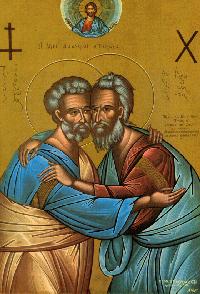
Since we are approaching the feast of St. Andrew, Patron of Constantinople (November 30), it is most proper, good Christian soul, that we pray that the recent meeting between His All-Holiness Bartholomew, Ecumenical Patriarch of Constantinople, and the Holy Father Benedict, Pope of Rome, will be rich in charity and foster a renewed understanding between these two communions.

I realize that such a wish puts me outside the "rigorist" set, those who prefer to see the Pope of Rome as "little better than a graceless witch-doctor who needs to accept Baptism by the monks of Athos" (Ben Andersen), but so be it. I, with Subdeacon Ben Andersen, will throw in my lot with "Metrpopolitan Nicholas, Patriarch Bartholomew, and all pious Orthodox who pray and work for the healing of the accursed schism of East and West, through the intercessions of our Blessed Lady and of Ss. Peter and Andrew, Apostles and brothers."

Now let's see if the way could be clear for a meeting between the "First Rome" and the "Third Rome".

Monday, November 20, 2006

St. Edmund, King and Martyr


From St. Dunstan's account of his martyrdom:


In King Aethelred's day1 a certain very learned monk named Abbo came over the sea from the south, from St. Benedict's resting-place2 to Archbishop Dunstan, three years before Dunstan died.3 During their conversation Dunstan related the story of St. Edmund, just as Edmund's sword-bearer related it to King Aethelstan4 when Dunstan was a young man and the sword-bearer was an aged man. Abbo recorded the entire story in a single book, and when the book came to us [i.e., Aelfric], we translated it into English, just as it stands now. The monk Abbo returned home to his monastery within two years, and was soon elevated to abbot of that same monastery.
[The Life]
Edmund the Blessed, King of East Anglia, was wise and worthy, and exalted among the noble servants of the almighty God. He was humble and virtuous and remained so resolute that he would not turn to shameful vices, nor would he bend his morality in any way, but was ever-mindful of the true teaching: "If you are installed as a ruler, don't puff yourself up, but be among men just like one of them." He was charitable to poor folks and widows, just like a father, and with benevolence he guided his people always towards righteousness, and restrained the cruel, and lived happily in the true faith.
Eventually it happened that the Danes came with a ship-army, harrying and slaying widely throughout the land, as is their custom. In the fleet were the foremost chieftans Ivar and Ubbi,5 united through the devil. They landed warships in Northumbria, and wasted that country and slew the people. Then Ivar went [south-]east with his ships and Halfdan6 remained in Northumbria gaining victory with slaughter. Ivar came rowing to East Anglia in the year in which prince Alfred--he who afterwards became the famous West Saxon king--was 21.7 The aforementioned Ivar suddenly invaded the country, just like a wolf, and slew the people, men and women and innocent children, and ignominiously harrassed innocent Christians. Soon afterward he sent to king Edmund a threatening message, that Edmund should submit to his alliegence, if he cared for his life. The messenger came to king Edmund and boldly announced Ivar's message: "Ivar, our king, bold and victorious on sea and on land, has dominion over many peoples, and has now come to this country with his army to take up winter-quarters with his men. He commands that you share your hidden gold-hordes and your ancestral possessions with him straightaway, and that you become his vassal-king, if you want to stay alive, since you now don't have the forces that you can resist him."
Then king Edmund summoned a certain bishop with whom he was most intimate, and deliberated with him how he should answer the fierce Ivar. The bishop was afraid because of this emergency, and he feared for the king's life, and counselled him that he thought that Edmund should submit to what Ivar asked of him. Then the king became silent, and looked at the ground, and then said to him at last : "Alas bishop, the poor people of this country are already shamefully afflicted. I would rather die fighting so that my people might continue to possess their native land." The bishop said: "Alas beloved king, thy people lie slain. You do not have the troops that you may fight, and the pirates come and kidnap the living. Save your life by flight, or save yourself by submitting to him." Then said king Edmund, since he was completely brave: "This I heartily wish and desire, that I not be the only surviror after my beloved thegns are slain in their beds with their children and wives by these pirates. It was never my way to flee. I would rather die for my country if I need to. Almighty God knows that I will not ever turn from worship of Him, nor from love of His truth. If I die, I live."
After these words he turned to the messenger who Ivar had sent him, and, undaunted, said to him: "In truth you deserve to be slain now, but I will not defile my clean hands with your vile blood, because I follow Christ who so instructed us by his example; and I happily will be slain by you if God so ordain it. Go now quickly and tell your fierce lord: 'Never in this life will Edmund submit to Ivar the heathen war-leader, unless he submit first to the belief in the Saviour Christ which exists in this country.'" Then the messenger went quickly on his way, and met along the road the cruel Ivar with all his army hastening toward Edmund, and told the impious one how he had been answered. Ivar then arrogantly ordered that the pirates should all look at once for the king who scorned his command, and sieze him immediately.
King Edmund, against whom Ivar advanced, stood inside his hall, and mindful of the Saviour, threw out his weapons. He wanted to match the example of Christ, who forbade Peter to win the cruel Jews with weapons. Lo! the impious one then bound Edmund and insulted him ignominiously, and beat him with rods, and afterwards led the devout king to a firm living tree, and tied him there with strong bonds, and beat him with whips. In between the whip lashes, Edmund called out with true belief in the Saviour Christ. Because of his belief, because he called to Christ to aid him, the heathens became furiously angry. They then shot spears at him, as if it was a game, until he was entirely covered with their missles, like the bristles of a hedgehog (just like St. Sebastian was). When Ivar the impious pirate saw that the noble king would not forsake Christ, but with resolute faith called after Him, he ordered Edmund beheaded, and the heathens did so. While Edmund still called out to Christ, the heathen dragged the holy man to his death, and with one stroke struck off his head, and his soul journeyed happily to Christ. There was a man near at hand, kept hidden by God, who heard all this, and told of it afterward, just as we have told it here.
Then the pirates returned to their ships and hid the head of the holy Edmund in the thick brambles so that it could not be buried with the rest of his body. After a time, after the pirates had departed, the local people, those who were left, came there where the remains of their lord's body without a head was. They were very sad in heart because of his killing, and especially because they didn't have the head for his body. Then the witness who saw the earlier events said that the pirates had the head with them, and that it seemed to him, as it was in truth, that they hid the head in the woods somewhere.
They all went together then to the woods, looking everywhere through the bushes and brambles to see if they could find that head anywhere. It was also a great miracle that a wolf was sent, through the guidance of God, to protect that head both day and night from the other animals. The people went searching and also calling out, just as the custom is among those who often go into the wood: "Where are you now, friend?" And the head answered them: "Here, here, here," and called out the answer to them as often as any of them called out, until they came to it as a result of the calling. There lay the grey wolf who watched over that head, and had the head clasped between his two paws. The wolf was greedy and hungry, but because of God he dared not eat the head, but protected it against animals. The people were astonished at the wolf's guardianship and carried home with them the holy head, thanking almighty God for all His miracles. The wolf followed along with the head as if he was tame, until they came to the settlement, and then the wolf turned back to the woods.

Read the rest: http://www.fordham.edu/halsall/source/870abbo-edmund.html

Liberation Theology: A New Turn with a New Generation?

Almost from the beginning, liberation theologians such as the Dominican Gustavo Guttierrez, Leonardo Boff, Hugo Asmann, et al, have insisted that, in its "preferential option for the poor", the Gospel encourages these same poor to seize the reins of power and the modes of production, in an effort to build Paradise on earth-the socialist state. But a new generation of liberationists are rethinking this strategy, FINALLY realizing that, as Alexa Smith notes, "political and economic power is too easily corrupted and that it too readily ignores the needs of the poor".

Is Liberation Theology taking a new turn? The main mission of the Church, for many Liberationists of the old school, was to form labor and guerrilla organizations that would further this preferential option for the poor. But it seems that, whatever distance the new generation is now establishing between itself and socialism, maintaining that a socialist state is not necessary, it nonetheless maintains a fundamentally secular understanding of the Church's essential mission. This time it focusses on local, as opposed to national and international, organization.

Nonetheless, these are very fascinating trends. It seems that there is now a recognition of the fact that the Gospel is not inseparably tied to any economic or governmental system. Perhaps that is a lesson we Gringo Christians can learn as well.

Here's the link to the article: http://www.villagelife.org/church/archives/pres_latinamerican.html

Thursday, November 16, 2006

Milton Friedman, RIP


From http://www.nytimes.com/2006/11/16/business/17friedmancnd.html?hp&ex=1163739600&en=b22d188423a336e8&ei=5094&partner=homepage

Milton Friedman, the grandmaster of free-market economic theory in the postwar era and a prime force in the movement of nations toward less government and greater reliance on individual responsibility, died today in San Francisco, where he lived. He was 94.
Doug Mills/Associated Press

President Bush honored Milton Friedman at a ceremony in 2002.
His death was confirmed by Robert Fanger, a spokesman for the Milton and Rose D. Friedman Foundation in Indianapolis.
Conservative and liberal colleagues alike viewed Mr. Friedman, a Nobel prize laureate, as one of the 20th century’s leading economic scholars, on a par with giants like John Maynard Keynes and Paul Samuelson.
Flying the flag of economic conservatism, Mr. Friedman led the postwar challenge to the hallowed theories of Lord Keynes, the British economist who maintained that governments had a duty to help capitalistic economies through periods of recession and to prevent boom times from exploding into high inflation.
In Professor Friedman’s view, government had the opposite obligation: to keep its hands off the economy, to let the free market do its work. He was a spiritual heir to Adam Smith, the 18th-century founder of the science of economics and proponent of laissez-faire: that government governs best which governs least.

Read the rest: http://www.nytimes.com/2006/11/16/business/17friedmancnd.html?hp&ex=1163739600&en=b22d188423a336e8&ei=5094&partner=homepage

Courtesy of the Young Fogey: http://sergesblog.blogspot.com/

St. Gregory Palamas on St. Benedict


Biretta tip to Subdeacon Ben Andersen (http://occidentalis.blogspot.com/)

From the Triads I:3:22:

22. THIS is why the great Macarius says that this light is infinite and supercelestial.
ANOTHER saint, one of the most perfect (i.e. St. Benedict), saw the whole universe contained in a single ray of this intelligible sun: even though he himself did not see this light as it is in itself, in its full extent, but only to that extent that he was capable of receiving it. By this contemplation and by his supra-intelligible union with this light,
he did not learn what it is by nature, but he learnt that it really exists, is supernatural and superessential, different from all things; that its being is absolute and unique, and that it mysteriously comprehends all in itself. This vision of the Infinite cannot permanently belong to any individual or to all men.

St. Gregory, in spite of the bitter feuds beteen Latins and Greeks at the time, could nonetheless find a kindred spirit in St. Benedict. His Life, included in Pope St. Gregory the Great's famous hagiographical works titled The Dialogues, was very well received and avidly read by by many monks in Constantinople .

Tuesday, November 14, 2006

From Death to Life: Building a Culture of Life, One Soul at a Time

By now, the Late Pope John Paul The Great's term for a society addicted to abortion and euthanasia-the famed "culture of death"-has become common currency in the socio-political vocabulary of Christians involved in the "culture wars". This, of course, is usually followed up by appeals to vote for the right people-usually Republican-that would put in place legislation that would protect the unborn, appoint judges to the major federal circuit courts and the Supreme Court who would eventually overturn Roe v. Wade, etc.

As laudable as all of these endeavors are (and I have been on the front lines of such advocacy), I've come to realize that legislation is only half the battle, if that. As a matter of fact, I'm coming to the inevitable conclusion that legislation would perhaps only take care of a very small part of the problem.

Let's suppose, for example, that in two years, we bring back a Pro-Life Congress, filling up those House and Senate seats with good Pro-Life folk. We elect a Pro-Life President, who will eventually appoint strict-constructionist justices to the high court. Eventually, Roe-v. Wade gets overturned by a 5-2 vote. Victory, right?

Well, maybe not. Remember, all overturning Roe v. Wade would do will be to put the decision back to the states, where it belongs. Before Roe v. Wade, abortion was legal in my home state of California.

Imagine the scenario: abortion would continue to be legal in the so-called "blue states", and perhaps in a few "red states" as well. Residents of states where abortionis outlawed would have the recourse of travelling to the blue states, having their abortion, and be back in time for the Late Show. For those too poor to afford the price of a train/plane/bus ticket, no worries. Imagine a non-profit "charity," paying the price of travel-fare so that poorer women have their children sucked into a sink, compliments of the National Organization of Gals.

It is VERY unlikely that overturning a bad Supreme court decision, or even putting in place Pro-Life legislation, would do any good if the culture is still substantially a Pro-Death culture. How do we change this culture? Well, if Baylor Sociology professor Rodney Stark's The Rise of Christianity gives us any clue, the answer is quite simple: step by step, inch by inch, one soul at a time.

You see, opposition to abortion was definitely part of the Church's moral teaching. The Didache, an early 2nd-century "canon" of church teaching which compiles the instructions of the Twelve Apostles, puts before us two ways: the way of life and the way of death. It goes on to say "between the two ways there is a great difference". Elaborating as it does on the meaning of the fifth Commandment's prohibition of murder to include "murdering a child by abortion or killing a newborn infant," it is clear that the early church certainly thought about, and affirmed life by rejecting the "culture of death" in its day, where abortion and infanticide were legally sanctioned activities (http://www.christiancadre.org/member_contrib/cp_infanticide.html).

What is fascinating is that we find no attempts made to organize opposition to abortion and infanticide. there were no "Pro-Life" organizations lobbying the Roman Senate or appealing to the Emperor to get anti-abortion and anti-infanticide legislation in place. Instead, you have the Church being just that-the Church. She bore witness to the Gospel of Life through martyrdom, compassionate care for the poor, and even saving children who had been abandoned and "exposed". By the time Constantine stepped into the picture in the early 4th century, there were just too many Christians in the empire to justify continual persecutions. The Edict of Milan followed in 312, lifting the proscription against Christianity, and a whole empire and culture was soon transformed. The gory spectacle of death known as the gladiatorial games continued for a time, but, according to legend, a small monk by the name of Telemachus put an end to that when he intervened in an amphitheater to stop a gladiatorial fight, and the crowds stoned him. The Emperor Honorius, so the story goes, was so impressed by this brave act of this little ascetic from Asia Minor that he issued an edict in 404 which put an end once and for all to the gladiatorial games. The games did end in 404 A.D., but whether or not it was because of the Monk Telemachus, one thing is certain-Jesus Christ had a great deal to do with it.

The moral of this is that a whole society and culture was transformed to the point that infanticide and abortion were outlawed. All of this happened because the Church dared to be herself, affirming the sanctity and dignity of human life, to the glory of the author of life-the Blessed Trinity.

Now don't get me wrong. I'm not knocking political and legislative efforts at protecting the unborn. I myself support such efforts, and will continue to do so. The problem is that this is not enough. Legislative and judicial efforts, if successful, will only address a small part of the problem. We need to work at building a culture where, once again, the sanctity of human life, and the inherent diginity of EVERY human being, born and unborn, able or disabled, is, as my students are want to say, a "no-brainer". This is hard work, but it can be done, one soul at a time.

St. Gregory Palamas and All Souls of the Benedictine Order


Blessed Convergence: Today is the feast of our Father among the Saints, St. Gregory Palamas and, in the Western Orthodox calendar, the feast of All Souls of the Benedictine Order.

Here is a beautiful and moving sermon on unceasing prayer by St. Gregory http://www.abbamoses.com/unceasing.html:

On the Necessity of Constant Prayer for all Christians in GeneralFrom The Life of St. Gregory Palamas, Archbishop of Thessalonica, the Wonderworker by St. Nikodemos of the Holy MountainTranslation by St Gregory Palamas Monastery, Hayesville,Ohio: www.bright.net/~palamas/
Let no one think, my Christian Brethren, that only persons in holy orders, or monks, are obliged to pray unceasingly and at all times, but not laymen. No, no! It is the duty of all us Christians to remain always in prayer. For see what His Beatitude the patriarch of Constantinople, Philotheus, writes in the life of St. Gregory of Salonica. That saint had a beloved friend, Job by name, a most simple man, but extremely virtuous. Once, talking with him, the prelate said of prayer that every Christian in general ought always to labor in prayer, and to pray unceasingly, as is commanded by the Apostle Paul to all Christians in general: Pray without ceasing (I Thes. 5:17); and as the Prophet David says of himself, regardless of his being a king and having the care of all his kingdom: I behold the Lord always before me (Ps. 15:8), meaning I always mentally see the Lord before me in my prayer. And Gregory the Theologian teaches all Christians and tells them that we should more often remember the name of God in prayer than inhale air.
Saying this and much else to his friend Job, the holy prelate added that in obedience to the commands of the saints, we not only should always pray ourselves, but we should teach all others to do the same, all people in general: monks and laymen, the wise and the simple, men, women, and children, and induce them to pray unceasingly.
Hearing this, it seemed to the elder Job a new stunt and he began to argue, saying to the saint that to pray unceasingly was only fit for ascetics and monks living outside the world and its vanities, but not for lay people who have so many cares and so much work. The saint brought in new testimonies in confirmation of that truth and new irrefutable proofs of it, but the elder Job was not convinced by them. Then St. Gregory, avoiding useless words and love of argument, was silent, and after that each went to his cell.
Later on, as Job was praying in his cell, there appeared to him an Angel sent from God, who will have all men to be saved and to come to the knowledge of the truth (Tim. 2:4), and rebuking him for having contradicted St. Gregory and opposed an obvious fact on which the salvation of Christians depends, he admonished him in the name of God to attend to himself in future and beware of saying to anyone anything in disparagement of that soul-saving work, thus opposing himself to the will of God, and that even in his mind he ought not to harbor a thought contrary to this and should not allow himself to think otherwise than St. Gregory had told him. Then the most simple elder Job at once hastened to St. Gregory and, falling at his feet, asked his forgiveness for contradicting him and for his love of dispute, and disclosed to him everything that had been said to him by the Angel of God.
Do you see, my brethren, that it is the duty of all Christians, small and great, always to practice the mental prayer: Lord Jesus Christ, have mercy on me! so that their mind and heart may acquire the habit of always uttering those holy words. Let this convince you how pleasing this is to God and what great good derives from it, since He, out of His infinite love for men, sent a heavenly Angel to tell us this, so that no one should have any doubt about it.

Read the rest here: http://www.abbamoses.com/unceasing.html


Let us remember the souls of those great Benedictine saints and ascetics who, dedicating themselves to the art of unceasing prayer, built up western civilization to the glory of God.

Requiem aeternum dona eis, Domine, et lux perpetuam luceat eis.

Monday, November 13, 2006

Latest C of E Outrage

Props to Ben Johnson (http://westernorthodox.blogspot.com/) for news of this latest outrage from the Church of England.

It seems that the Rt. Rev. Tom Butler, Bishop of Soutwark, supports Nazi-style euthanasia of children born with severe disabilities. From The Daily Mail (http://www.dailymail.co.uk/pages/live/articles/news/news.html?in_article_id=416003&in_page_id=1770):

"The Church of England has broken with traditional dogma by calling for doctors to be allowed to let sick newborn babies die.
Christians have long argued that life should preserved at all costs - but a bishop representing the national church has now sparked controversy by arguing that there are occasions when it is compassionate to leave a severely disabled child to die.
And the Bishop of Southwark, Tom Butler, who is the vice chair of the Church of England's Mission and Public Affairs Council, has also argued that the high financial cost of keeping desperately ill babies alive should be a factor in life or death decisions.
The shocking new policy from the church has caused outrage among the disabled. "

To say the least! Brings to mind a rather Chesterton-like quote from the late President Reagan: "Abortion is advocated by those who have already been born." In this case, eutahansia is advocated by a rather healthy, well-fed upper middle-class sop with an English "public school" education who somehow thinks some people, made in God's image, are not deserving of life. So now the "high financial costs" of keeping people alive should factor into decisions about life or death? Read "worthless eaters."

Thank you, Rt. Rev. Dr. Josef Mengele!

From the Rule

Listen Carefully, my son, to your master's precepts,and incline the ear of your heart (Prov. 4:20).Receive willingly and carry out effectivelyyour loving father's advice,that by the labor of obedienceyou may return to Himfrom whom you had departed by the sloth of disobedience.
To you, therefore, my words are now addressed,whoever you may be,who are renouncing your own willto do battle under the Lord Christ, the true King,and are taking up the strong, bright weapons of obedience.
And first of all,whatever good work you begin to do,beg of Him with most earnest prayer to perfect it,that He who has now deigned to count us among His childrenmay not at any time be grieved by our evil deeds.For we must always so serve Himwith the good things He has given us,that He will never as an angry Father disinherit His children,nor ever as a dread Lord, provoked by our evil actions,deliver us to everlasting punishmentas wicked servants who would not follow Him to glory.

Prologue, Rule of St. Benedict

From http://www.osb.org/rb/show.asp?month=1&day=1&toMonth=1&toDay=1

Convergences


In addition to tis being the 41st anniversary of my birth, it is also the FEAST OF ALL SAINTS OF THE BENEDICTINE ORDER.

I also found out that I share a birthday with our Father among the Saints, St. Augustine.

Ora pro nobis!

Friday, November 10, 2006

Orthodox Readings of St. Augustine


Finally, a group of Orthodox theologians (and including some notable Catholic theologians as well) will come together to discuss the place of our Holy Father among the Saints, St. (or Blessed, if you prefer) Augustine of Hippo. Father Seraphim Rose called him a a great teacher of Orthodox piety, and yet there are some, thinking they know better than Holy Mother Church, who wish to pretend, without ANY historical justification, that he is not among the number of the saints. It is my hope this conference will do much to restore him to his rightful place in Orthodox faith and piety, a place he really never lost, except in the minds of those Fr. Seraphim Rose called "schoolboys playing at Orthodoxy."

The panel will include Prof. Andrew Louth, Dr. David B. Hart, and Fr. John McGuckin.

Here is the link for more information: http://www.fordham.edu/mvst/conference07/augustine/index.html

Thursday, November 09, 2006

Santa Croce, Florence


To the the right of the high altar, beyond the rood screen, (hidden by the columns), is the Bardi Chapel, which houses a most sublime icon of St. Francis, done in a traditional iconograpic style.


What is intruiging about his chapel is that the wall paintings by Giotto surround it, and you can clearly see the subtle shifts in the history of art. Whereas the unnamed master of the Francis icon depicts Francis in a very traditional hieratic style, the Giotto frescoes depict emotion and feeling. This is something you don't pick up immediately when you look at a Giotto painting, but when you go to the Bardi Chapel in Santa Croce, and you see both the Master and Giotto together, you see the shift much more clearly. Compare the above icon from the Bardi Chapel and the Giotto detail (depicting the death of St. Francis) below.

Monday, October 23, 2006

Virgil and Statius: Dante's Old and New Humanisms Part II


Canto 22 begins with a triumphant ascension from the fifth cornice, that of the hoarders and spenthrifts, with the help of the Angel of Liberality, and into the sixth, that of the gluttons. The soul now is infused with a new kind of craving: righteousness and justice. The Angel proclaims this advance through the Gospel declaration: "Beati, and with sitiunt and no more to end the phrase, his words accomplished this." The angel, in other words, by the proclamation of "Beati qui esuriunt et sitiunt justitiam" (Blessed are those who hunger and thirst for righteousness), he signals a sort of "graduation", but this one is marked by an ever-deepening desire, a thirst, for righteousness (the angel saves the reference to hunger for the cornice of the Gluttons).

At this point, the main theme revolves around desire. This theme forms the context for the conversation between Virgil and Statius. This theme of desire is heightened by Virgil's opening verse:

..."The love that's lit
By virtue must, once its flame is shown,
Kindle a love reciprocal to it

Virtue enkindles love, and that love finds its greatest fulfillment in "kindling" that same "recipororacal" to it, i.e. shared with another, in a communion that finds even greater fulfillment and consummation in the love of God. This is the end towards which Dante, now much lighter and "spritely", is moving, shedding all vestiges of self-love, or what St. Maximus the Confessor calls "philautia," that all-consumming obsession with the self and the satisfaction of its unruly passions and lusts.

This is what motivates Virgil's question to Statius in lines 22-24:

How could thy heart find room for covetise,
When thou hadst filled it with such treasure-trove
of wisdom, by thy pains and exercise?

Statius responds with an affectionate statement about how Virgil's "every word...is a dear token to me of thy love." Here the new "Christian humanism", represented in Statius, acknowledges deep ties and sympathies with the best of the old pagan humanism, represented by Virgil. Statius further emphasizes this debt to Virgil in lines 64-69, where he likens Virgil to a man who, walking in darkness, nonetheless carries a lantern in at his back, lighting others to the "right way" (remember Dante's predicament at the beginning of the Inferno: "Nel mezzo del cammin di nostra vita...).

This is a rather peculiar image. What person, with any sense, would go about the dark with a lantern to his back? Yet this is the predicament that Virgil finds himself in as a pre-Christian pagan, and it is also the predicament of all those venerable sages in Limbo, Virgil's eternal home (Las Casas, in his debate with Sepulveda, called Aristotle a "pagan in hell who nonetheless had much good to say.") The non-Christian sage sheds light, but it is light that benefits not himself, but those who come after him, who have the benefit, like Statius, of Christian revelation. Or rather, it is that light of truth which he sheds that makes it possible for one like Statius to recognize the supreme truth-Christ, who is the Way, the Truth, and the Life.

This theme is especially emphasized in lines 70 through 80. Statius praises Virgil as the author of the Eclogues, especially the Fourth, with its promise that "to us...a new world is given, Justice returns, and the first age of man, and a new progeny descends from heaven." Virgil wrote these lines as a celebration of the impending birth of the son of Octavian, but nonetheless many Christian writers (especially the educated folk) interpreted these lines as Virgil unwittingly anticipating the birth of Christ. Statius, at least, is a beneficiary of this happy interpretation. It prepared him to hear "the new preachers" who combined these verses from Virgil with the Gospel, thus creating "a wondrous haprmony." The Gospel and classical poetry (Virgil) make a symphony: the natural virtues (prudence, justice, temprance and fortitude) with the theological virtues (faith, hope and love), reason with faith, nature with grace.

What does this mean for Dante the poet? As he nears the culmination of his sojourn in Purgatory, he now can count as his guide two masters: a pagan, and a Christian. In Dante's world, Statius has surpassed Virgil, since he has the hope of beatitude, perfecting the wisdom of Virgil in the truth of Christ. And now Dante sees the challenge before him. Learning much from Virgil, having made a long journey with him, learning from him, he will soon go to a place where his master cannot go. He must now take his art to the very center of deep heaven, into the very life of God.

But in the meantime, there is yet much to learn from the exchange between Virgil and Statius:

They walked in front, and all alone behind
I followed, listening to their words, which shed
Much light on poetry to aid my mind. (127-129)

Indeed, there is much to learn, especially as the theme of the cornice into which they are entering is the reorientation of desire. It is the cornice of the gluttonous, where a great feast of pleasurable delights awaits the eyes, but those who go through it must refrain from partaking. There is an even greater delight that awaits Dante: the Tree of Life, in the Garden of Eden, planted there at the age of man's first innocence. But even that will only increase his desire for the heavenly country, for the abode of God. Poetically, it also serves to move Dante-the-poet on to a greater aesthetic, going beyond Virgil (but not supplnting him, either), into the beauty beyond words of deepest heaven.

Wednesday, September 27, 2006

Virgil and Statius: Dante's Old and New Humanisms Part I


In Canto 21, of Il Purgatorio, there is a very felicitous, and at the same time, sad endounter between the poets, Dante and Virgil, with the Silver Age Roman poet Statius. The moment is happy in the sense that Statius, who is said to have converted to Christianity because of Virgil's poetry, and on account of this, Statius owes him a great debt of gratitude. It is a sad encounter, for we know that after Virgil has ascended to the Earthly Paradise, his role in Dante's (and perhaps Statius', too) is ended, and he must thenceforth take his place once again among the shades in Limbo, that region in hell where the Righteous Pagans abide. After all, even though he doesn't suffer the most cruel torments of the nether regions of hell, we are reminded that he is still a damned soul. The meeting between Statius and Virgil, therefore, is a bittersweet one.

Yet Virgil, damned as he is to live perpetually in Limbo, nonetheless has a job to accomplish for Dante: he must prepare him for that anticipated meeting with the woman who provided him with the inspiration for the journey-Beatrice-who stands here as an image of divine grace. This meeting will take place, with a flurry of processions and religious pageantry, in the Earthly Paradise, the very pinnacle of Mt. Purgatory (Canto XXXIII). All through the Inferno Virgil guided Dante, helping him to see sin and vice for what they really are. Lady Philosophy provides a similar guidance to Boethius in the Consolatione, weaning him away from the shadows (identifying fortune as the highest good) and to a knowledge of hi true end (happiness as the true summam bonum). Virgil similarly helps Dante to reorient his gaze, away from proximate goods, and towards the true highest good.

But how can Virgil, a damned soul, provide this service for Dante? To answer this question, we must remember that while damned, Virgil is nonetheless a righteous pagan. As such, he had mastered the natural, or cardinal, virtues: prudence, justice, temperance and fortitude. These virtues are called cardinal virtues (cardo-hinge) precisley because all other human virtues hinge on these four. Many pagans, for example, show knwoledge of what to do and what to avoid, thereby dispalying prudence. They might show excellence in giving everyone what is his due, and thus act with justice. They show great temprance in controling the appetites and moderating pleasure. Finally, a pagan can indeed show a firmness of spirit, doing his duty in the face of opposition and even death, and thus display fortitude. These virtues, in other words, are the highest that a person can achieve, apart from divine grace.

But the fact that they are achieved apart from gace makes them deficient, for, as good and noble as they are, they are not enough to restore humanity to its ultimate end-union with God. But he can lead Dante to the highest end of human proximate goods, by teaching him to imitate his hero Aeneas, who would not waver from his duty to show pietas by obeying the divine injunction to found the best of earthly cities, Rome. Likewise, Dante is helped by Virgil to attain to his ultimate end by setting earthly life in order by the cultivation of the cardinal virtues named above.

But to do that, he needed to be shown the utlimate end of sin and vice-the ninth circle, the circle of those who betrayed their lords (in this case, Satan, Judas Iscariot, Brutus and Casius). This circle is cold, and Satan, formerly Lucifer, is frozen and stiff, his flapping wings making this circle even colder. His only relationship to others is a consuming one, each of his three faces gnawing on the other traitors. Sin and vice end in this, a total breakdown in ecclesial and civic community. As a resident of hell, nonetheless inhabiting the circle of the righteuous pagans (in addition to his being the poet of the Augustan ascendency, and the Pax Romana that resulted from it), Virgil is Dante's best guide through the vices.

In Purgatory, however, Virgil is in unfamiliar territory. He does not quite have the same confidence he had in hell. Purgatory is a training ground for virtue, where the cardinal virtues are perfected by grace (Sayers). In lines 64ff, Virgil explains to Cato, who is now the guardian of Mt. Purgatory, the long journey through hell that brought them to this very moment of grace:

I've shown him Hell with all its guilty herd,
and mean to show him next the souls who dwell
Making purgation here beneath thy ward.

How I have brought him through, 'twere long to tell;
Power from on high helps me to guide his feet
To thee, to see and hear and mark thee well. (Divine Comedy, trans. by D. Sayers, Canto I, lines 64-69)

Right reason, represented by Virgil, prepares the soul for grace, and it is grace that expands, without destroying, the capacity of reason to ascend higher up the school of virtue known as Purgatory. The meeting with Cato of Utica, who is an image and type of the moral virtues (Sayers note, Canto I), is telling in this regard. Cato, though not a Christian in life, is nonetheless chosen as a "doorkeeper" to Mt. Purgatory.

These associations (natural and supernatural virtues) continue, and eventually meet, in the person of Statius. This is the most significant aspect of the meeting between Staius and Virgil, for Statius, once the pagan writer of The Thabaid, became, through Virgil's Fourth Eclogue, a follower of Christ. If Virgil represents the natural virtues, Statius represents those same virtues trnasformed by Christ through the infusion of the theological virtues of faith, hope and love. The appearance of Statius, then, signals a key point in Dante-the-Poet's transformation: he "authorizes the new vernacular Christian Dante-poeta in the process of defining himself over the course of the Commedia's story of Dante-protagonist." (Kevin Brownlee, "Dante and the Classical Poets," in R. Jacoff, ed. The Cambridge Companion to Dante Cambridge, 1993 p. 108)

In other words, there is a major poetic, as well as spiritual, shift. Virgil, that great celebrant of the great earthly city, gives way to a new poetry, taking all that was good of the old, but marshalling it now to a more excellent city-the city of God.

Monday, September 25, 2006

Louis Bouyer's Doctrine of the Papacy: Towards an Orthodox/Roman Catholic Convergence?

Al Kimmel of Pontifications has a rather lengthy quote by Louis Bouyer on the meaning of the Petrine ministry of the papacy: http://catholica.pontifications.net/?p=1995

Does Louis Bouyer's doctrine of primacy converge with traditional Orthodox notions? Compare Bouyer's argument with that of Emmanuel Clapsis': http://www.goarch.org/en/ourfaith/articles/article8523.asp

At issue, I think, is whether or not the Orthodox Church can allow a wider role for a restored papacy as the voice of the Church's unity.

Read Louis Bouyer's reflection on this issue (quoted in the Pontifications blog) and read the lengthy discussion this question is generating.

To tantalize you, here's an excerpt:

Catholic doctrine teaches, according to the texts of the First Vatican Council, corroborated and clarified by those of the Second, that the pope is no more an “Apostle” than the other bishops are. On the contrary, he is a bishop like the rest—a successor of the apostles in the very precise and defined sense that the others are. But as the bishop of the Roman Church, and like all the other bishops of Rome before him, the pope is a particular successor of Peter, who before he died had settled in Rome in the task to which he had been assigned from among the other apostles. This task was (and remains) keeping the Church and her development in unity by personally exercising (always within the college to which he belonged and in conjunction with it) the responsibilities which were (and are) those of the whole college. To be understood, this requires that we no more look at the pope as a “superbishop” than at Peter as a “super apostle.” Indeed, as we have seen, Peter’s unique role and function were not different from the duties of the apostolic college of which he was a part. His primacy was due to the fact that what was entrusted to all (including him) was first entrusted to him; even more, it was due to the fact that he received personally what all were to receive collectively. He was thereby called not to supplant, nor even to govern from above and without, the other apostles, but to express, guide, and foment their unity of action from within.

Read the rest here: http://catholica.pontifications.net/

Friday, September 15, 2006

Seven Sorrows of the Blessed Virgin Mary


Collect:
O God, in whose Passion, according to the prophesy of Simeon, a sword of grief pierced through the well-beloved soul of the glorious Virgin Mother Mary: mercifully grant that we who devoutly call to mind her sorrows, may obtain the blessed fruit of thy Passion. Who with God the Father and the Holy Ghost livest and reignest, world without end. Amen

Sermon for the second Nocturns in Matins, by St. Bernard of Clairvaux:

The martyrdom of the Virgin is set before us both in Simeon's prophecy and in the narrative of the Lord's Passion. "This Child is destined," the holy old man said of the child Jesus, "for a sign that shall be contradicted; and your own soul," he said to Mary "a sword shall pierce." and in truth, O blessed Mother, your soul was pierced. Unless the sword had passed through your soul, it would not have pierced the flesh of your Son. And after your Jesus had sent forth His spirit, clearly the cruel lance that opened His side could not reach His soul, but it pierced yours. For His soul was no longer there, but yours could not be torn away.

Read the rest here: http://web2.airmail.net/carlsch/MaterDei/Saints/7sorrows.htm

Thursday, September 14, 2006

Feast of the Holy Cross


Leo the Great's Sermon On the Lord's Passion:

When Christ is exalted on the Cross, beloved brothers, do not let only those things which the ungodly have seen come to the sight of your mind. For to them it was said through Moses, " And your life will be hanging before your eyes and you will tremble day and night and not believe in your life." For they could think of nothing except their crime in connection with the crucified Lord, and they were afraid, not with the fear by which true faith justifies, but with that by which a bad conscience is tormented. But our mind, which is enlightend with the spirit of truth, should receive the glory of the Cross, illuminating heaven and earth, in a heart that is pure and free. And we should see with inward vision what the Lord said when He spoke of His imminent Passion, "Now is the judgment of the world; now will the prince of this world be cast out. And I, if I be lifted up from the earth, will draw all things to Myself."
O wonderful power of the Cross! O unutterable glory of the Passion, in which is to be found the judgment-set of the Lord and the judgment of the world and the power of the Crucified! For You drew all things to Yourself, Lord; when You stretched out Your hands all day to an unbelieving and contradicting people, the whole world knew that this gesture signified its obligation to confess Your majesty. You drew all things to Yourself, Lord, when in horror of the crime of the Jews all the elements of nature expressed their common feeling: when the lights of heaven were darkened and day turned to night and the earth shook with strange tremors and all creatures refused their services to ungodly men. You drew all things to Yourself, Lord, when the veil of the Temple was torn and the Holy of holies taken away from the unworthy priests that the figure might be changed to the reality, the prophecy to the manifestation, and the law into the Gospel.

Read the rest of the sermon: http://web2.airmail.net/carlsch/MaterDei/Fathers/leo-cross.htm

Tuesday, September 12, 2006

Starting Your Own Garage Schola Cantorum


Now we're jammin' with the best of them! Look out, Metalica! The Chant Boys are commin'.

Excellent article. Do try it at your home parish.

Here's the link:
http://crisismagazine.com/julaug2006/tucker.htm

Biretta Tip to Huw Raphael: http://raphael.doxos.com/comments.php?id=P3818_0_1_0

Friday, September 08, 2006

Feast of the Nativity of the Blessed Virgin Mary


Sermon by St. Andrew of Crete:

The present Feast is for us the beginning of feasts. Serving as boundary to the law and to prototypes, at the same time it serves as a doorway to grace and truth. "For Christ is the end of the law" (Rom 10:4), Who, having freed us from the letter (of the law), raises us to spirit.
Here is the end (to the law): in that the Lawgiver, having made everything, has changed the letter in spirit and gathers everything in Himself (Eph 1:10), enlivening the law with grace: grace has taken the law under its dominion, and the law has become subjected to grace, so that the properties of the law not suffer reciprocal commingling, but only so that by Divine power, the servile and subservient (in the law) are transformed into the light and free (in grace), so that we are not "in bondage to the elements of the world" (Gal 4:3) and not in a condition under the slavish yoke of the letter of the law.
Here is the summit of Christ's beneficence towards us! Here are the mysteries of revelation! Here is the theosis [divinization] assumed upon humankind, the fruition worked out by the God-Man.
The radiant and bright descent of God for people ought to have a joyous basis, opening to us the great gift of salvation. Such also is the present feastday, having as its basis the Nativity of the Theotokos, and as its purpose and end, the uniting of the Word with flesh, this most glorious of all miracles, unceasingly proclaimed, immeasurable and incomprehensible.
The less comprehensible it is, the more it is revealed; and the more it is revealed, the less comprehensible it is. Therefore the present God-graced day, the first of our feastdays, showing forth the light of virginity and the crown woven from the unfading blossoms of the spiritual garden of Scripture, offers creatures a common joy.
Be of good cheer, it says, behold, this is the Feast of the Nativity of the Virgin and of the renewal of the human race! The Virgin is born, She grows and is raised up and prepares Herself to be the Mother of the All-Sovereign God of the ages. All this, with the assistance of David, makes it for us an object of spiritual contemplation. The Theotokos manifests to us Her God-bestown Birth, and David points to the blessedness of the human race and wondrous kinship of God with mankind.

Read the rest here: http://chattablogs.com/hagioipateres/archives/cat_the_mother_of_god.html

Tuesday, August 29, 2006

Beheading of St. John the Baptist


From a sermon by St. Bede the Venerable: http://www.catholic-forum.com/SAINTS/saintj02.htm

There is no doubt that blessed John suffered imprisonment and chains as a witness to our Redeemer, whose forerunner he was, and gave his life for him. His persecutor had demanded not that he should deny Christ, but only that he should keep silent about the truth. Nevertheless, he died for Christ. Does Christ not say: "I am the truth"? Therefore, because John shed his blood for the truth, he surely died for Christ. Through his birth, preaching and baptizing, he bore witness to the coming birth, preaching and baptism of Christ, and by his own suffering he showed that Christ also would suffer. Such was the quality and strength of the man who accepted the end of this present life by shedding his blood after the long imprisonment. He preached the freedom of heavenly peace, yet was thrown into irons by ungodly men. He was locked away in the darkness of prison, through he came bearing witness to the Light of life and deserved to be called a bright and shining lamp by that Light itself, which is Christ. To endure temporal agonies for the sake of the truth was not a heavy burden for such men as John; rather is was easily borne and even desirable, for he knew eternal joy would be his reward. Since death was ever at hand, such men considered it a blessing to embrace it and thus gain the reward of eternal life by acknowledging Christ's name. Hence the apostle Paul rightly says: "You have been granted the privilege not only to believe in Christ but also to suffer for his sake." He tells us why it is Christ's gift that his chosen ones should suffer for him: "The sufferings of this present time are not worthy to be compared with the glory that is to be revealed in us."

Tuesday, August 22, 2006

In Peace...

Monks at prayer


...Let Us Pray To The Lord.

J.P. Getty, Meet C.S. Lewis


A blog article by my friend and colleague, Fred Sanders:

In his 1965 book How to Be Rich: The Success Secrets of a Billionaire Businessman, J. Paul Getty (1892-1976) tells the story of how he quit smoking. On a vacation in France, he woke up at two A.M. in his hotel room, craving a cigarette. Finding none in his pack, none in his jacket, none in his luggage, he decided to make the hike to the nearest all-night vendor, at the train station six blocks away. It was pouring rain in the middle of the night in a small town in France. In Getty’s own words:
But the desire to smoke gnawed at me, and, perversely, the more I contemplated the difficulties entailed in getting a cigarette, the more desperately I wanted to have one. And so I took off my pajamas and started putting on my clothes. I was completely dressed and reaching for my raincoat when I abruptly stopped and began to laugh –at myself. It had suddenly struck me that my actions were illogical, even ludicrous.
There I stood, a supposedly intelligent human being, a supposedly reponsible and fairly successful businessman who considered himself sensible enough to give other people orders. Yet I was ready to leave my comfortable hotel room in the middle of the night and slosh a dozen blocks through a driving rainstorm for no other reason than that I wanted a cigarette –because I felt that I “had” to have one.
Thus J.P. Getty took a step back from himself, saw the situation from outside, and had to laugh at the little tobacco sticks that were somehow in command of the great businessman. The comedy of the situation came from the contrast in scale, because this silly little habit just did not measure up to the stature of the intelligent, responsible, successful, sensible commander of men. Getty crumpled up his empty pack of cigarettes, and with it he crumpled up the tobacco habit in one decisive movement, a triumph of will power over the force of habit.

Read the rest: http://www.scriptoriumdaily.com/middlebrow/archives/jp-getty-meet-c-s-lewis/#more-280

St. Bernard of Clairvaux


Even John Calvin found him profitable! (http://findarticles.com/p/articles/mi_m2065/is_n3_v48/ai_18709945)

Monastic reformer, a faithful student of St. Benedict, scourge of Peter Abelard, lover of simplicity, one of the ancients...ORA PRO NOBIS!

Monday, August 21, 2006

D.Z. Phillips, Rquiescat in Pace


Note: Even though he taught at my doctoral institution (Claremont Graduate University), I never took a class taught by him. Pity!

D.Z. Phillips (1934-2006)
D.Z. Phillips, the Danforth Professor of Philosophy of Religion at Claremont Graduate University, has died at the age of 71 at Swansea, Wales, where he was working on research.
Phillips, also a research professor at the University of Wales, was considered a world leader in philosophy of religion, and a respected expert of Ludwig Wittgenstein, the 20th-century philosopher. Phillips applied Wittgenstein’s theories of philosophy to religion, and spent most of his life defending the integrity of people’s religious experiences and beliefs against a purely rationalistic critique. He was passionate about exploring our understanding of reality and experiences through a common language.
His other major influences were Rush Rhees and Peter Winch, and he was the Rush Rhees Professor of Philosophy at the University of Wales from 1996-2001.
While Phillips was considered one of the world’s most recognized philosophers of religion, he was often controversial, as he had no stated position and used no formal logic. He was also unique because he was not dismissive of theories with which he disagreed with, and instead, he held them accountable for their contributions to philosophical debate.

Read the rest of the article: http://www.cgu.edu/pages/357.asp?EventID=219

Oxford Early Manuscripts Online

[--a decorative section of manuscript--]

This is a must-see: http://image.ox.ac.uk/

A Promise Kept

Earlier last month, I promised pictures of my recent trip to Italy and Switzerland, with pictures of chapels and churches. I have the pictures, and am now trying to learn how to upload them onto my computer so that I can share them with you. Thank you for your patience and understanding. It will take me a bit of time to learn to do this, so I beg your indulgence as I emerge from the "parchment and quill" stage to the ever-changing and fast-paste cyberworld:-)

Invisible Christians in the Holy Land


Many faithful pilgrims go to the Holy Land in order to see the sites associated with the life of our Lord, and other major events recorded in Sacred Scripture. But do any of us really give a moment's thought to the real flesh and blood Christians that continue to live in these lands, albeit in reduced numbers?

But then, there might be more than we think. Read this article: http://www.orthodoxytoday.org/articles6/MagisterHolyLand.php

Pray for the peace of Jerusalem, especially those who are of the household of faith living in her bosom.

Friday, August 18, 2006

Real Conservatism: The Legacy of Russell Kirk, Apostle of the "Permanent Things"

Russell Kirk
My hero

J. Budziszewski's article (http://www.orthodoxytoday.org/articles/BudziszewskiConservativism.php) prompts a key question: What is conservatism? Many answers will be forthcoming: "Getting the government off one's back" would probably be the first thing many would point to as a salient feature in conservative thought. While this is certainly one room within a many-storied mansion, it is not the central core of what it means to be a conservative; after all, Libertarians who favor smaller government are also quite vocal advocates for a hard secularism in public life, and still more vocal proponents of abortion "rights". These would hardly qualify as conservatives in any traditional sense.

So what is conservatism? For Russell Kirk (The Conservative Mind), it can be boiled down to a commitment to "the permanent things"-namely, tradition, in the Chestertonian sense ("Giving one's ancestors a vote"). Read more about it here: http://www.kirkcenter.org/index.html

Read this article on the state of Kirk's legacy in the current neoconservative movement (http://chronicle.com/free/v50/i35/35a01801.htm)

Russell Kirk quote of the day: "When men or nations sweep away their past in the process of aggrandizement, presently the dream of avarice gives way to a forlorn longing for things beyond recall."

The Problem With Conservatism

by J. Budziscewski

My first conservative experience was in second grade, when I learned America the Beautiful. Verses one and two were merely baffling: I could not picture waves of grain, I could not believe that mountains were purple, and I could not form an association between liberty and pilgrim's feet. But the third verse broke me like glass and made me an idolater. O beautiful for patriot's dream, that sees beyond the years, we warbled; thine alabaster cities gleam, undimmed by human tears. Somehow the song called forth in my childish heart an answering music that I had never heard in church. I seemed to hear the whine of gulls and the murmur of the sea before a white throne; I was afflicted with a sense of the Fall and a longing for the City whose light is the Glory of God. But I misidentified the City. The song sent me questing for Columbia, not the New Jerusalem. I was told to seek in the ideal futurity of my nation what cannot be made by hands.
What then is a Christian to make of conservatism? The danger, it would seem, is not in conserving, for anyone may have a vocation to care for precious things, but in conservative ideology, which sets forth a picture of these things at variance with the faith. The same is true of liberalism. From time to time Christians may find themselves in tactical alliance with conservatives, just as with liberals, over particular policies, precepts, and laws. But they cannot be in strategic alliance, because their reasons for these stands are different; they are living in a different vision. For our allies' sake as well as our own, it behooves us to remember the difference. We do not need another Social Gospel-just the Gospel.

Read the rest here: http://www.orthodoxytoday.org/articles/BudziszewskiConservativism.php

Tuesday, August 15, 2006

The Assumption of the BVM: A Sermon by St. John of Damamscus


From http://www.fordham.edu/halsall/basis/johndamascus-komesis.html#SERMON%20I

SERMON I: ON THE ASSUMPTION (koimhsiV)
[147] THE memory of the just takes place with rejoicing, said Solomon, the wisest of men; for precious in God's sight is the death of His saints, according to the royal* David. If, then, the memory of all the just is a subject of rejoicing, who will not offer praise to justice in its source, and holiness in its treasure-house? It is not mere praise; it is praising with the intention of gaining eternal glory. God's dwelling-place does not need our praise, that city of God, concerning which great things were spoken, as holy. David addresses it in these words: "Glorious things are said of thee, thou city of God." What sort of city shall we choose for the invisible and uncircumscribed God, who holds all things in His hand, if not [148] that city which alone is above nature, giving shelter without circumscription* to the supersubstantial Word of God? Glorious things have been spoken of that city by God himself. For what is more exalted than being made the recipient of God's counsel, which is from all eternity?
Neither human tongue nor angelic mind is able worthily to praise her through whom it is given to us to look clearly upon the Lord's glory. What then? Shall we be silent through fear of our insufficiency? Certainly not. Shall we be trespassers beyond our own boundaries, and freely handle ineffable mysteries, putting off all restraint? By no means. Mingling, rather, fear with desire, and weaving them into one crown, with reverent hand and longing soul, let us show forth the poor first-fruits of our intelligence in gratitude to our Queen and Mother, the benefactress of all creation as a repayment of our debt. A story is told of some rustics who were ploughing up the soil when a king chanced to pass, in the splendour of his royal robes and crown, and surrounded by countless gift bearers, standing in a circle. [149] As there was no gift to offer at that moment, one of them was collecting water in his hands, as there happened to be a copious stream near by. Of this he prepared a gift for the king, who addressed him in these words: "What is this, my boy?" And he answered boldly: "I made the best of what I had, thinking it was better to show my willingness, than to offer nothing. You do not need our gifts, nor do you wish for anything from us save our good will. The need is on our side, and the reward is in the doing. I know that glory often comes to the grateful."
The king in wonder praised the boy's cleverness, graciously acknowledged his willingness, and made him many rich gifts in return. Now, if that proud monarch so generously rewarded good intentions, will not Our Lady (h ontwV agaqh despoina), the Mother of God, accept our good will, not judging us by what we accomplish? Our Lady is the Mother of God, who alone is good and infinite in His condescension, who preferred the two mites to many splendid gifts. She will indeed receive us, who are paying off our debt, and make us a return out of all proportion to what we offer. Since prayer is absolutely [150] necessary for our needs, let us direct our attention to it.

Read the rest: http://www.fordham.edu/halsall/basis/johndamascus-komesis.html#SERMON%20I

Wednesday, August 09, 2006

The Christian Warrior: Is This an Oxymoron?


There's an interesting discussion taking place in Huw Raphael's blog(http://raphael.doxos.com/) on "Christian pacifism." Read it here:http://raphael.doxos.com/comments.php?id=3697_0_1_0_C

Cantus Redivivus: An Interview With Maestro Domenico Bertolucci


Birreta tip to Subdeacon Thomas Rice

Read the interview with the Maestro here: http://www.chiesa.espressonline.it/dettaglio.jsp?id=72901&eng=y


Q: According to Ratzinger, there is music as a mass phenomenon, pop music, which is measured by the values of the market. And then there is the educated, cerebral music that is destined for a small èlite...
A: This is the music of the moderns, from Schönberg on, but sacred music must follow the spirit of Gregorian chant and respect the liturgy. The cantor in the church is not there as an artist, but as a preacher, or as one who preaches by singing.

Q: Do you envy the Eastern Churches at all?
A: They have not changed anything, and rightly so. The Catholic Church has renounced itself and its particular makeup, like those women who have plastic surgery: they become unrecognizable, and sometimes there are serious consequences.

Monday, August 07, 2006

Feast of the Holy Name of Jesus


Image from http://www.shrineofstjoseph.org/shield.htm

A sermon by St. Bernard of Clairvaux (http://www.nomensanctum.org/Web%20Pages/Meditations%20&%20Sermons/meditation_stbernard.htm):

The sweet Name of Jesus produces in us holy thoughts, fills the soul with noble sentiments, strengthens virtue, begets good works, and nourishes pure affections. All spiritual food leaves the soul dry, if it contain not that penetrating oil, the Name Jesus. When you take your pen, write the Name Jesus: if you write books, let the Name of Jesus be contained in them, else they will possess no charm or attraction for me; you may speak, or you may reply, but if the Name of Jesus sounds not from your lips, you are without unction and without charm. Jesus is honey in our mouth, light in our eyes, a flame in our heart. This name is the cure for all diseases of the soul. Are you troubled, think but of Jesus, speak but the Name of Jesus, the clouds disperse, and peace descends anew from heaven. Have you fallen into sin so that you fear death, invoke the Name of Jesus, and you will soon feel life returning. No obduracy of the soul, no weakness, no coldness of heart can resist this holy Name; there is no heart which will not soften and open in tears at this holy name. Are you surrounded by sorrow and danger, invoke the Name of Jesus, and your fears will vanish.
Never yet was human being in urgent need, and on the point of perishing, who invoked this help-giving Name, and was not powerfully sustained. It was given us for the cure of all our ills; to soften the impetuosity of anger, to quench the fire of concupiscence, to conquer pride, to mitigate the pain of our wounds, to overcome the thirst of avarice, to quiet sensual passions, and the desires of low pleasures. If we call to our minds the Name of Jesus, it brings before us His most meek and humble heart, and gives us a new knowledge of His most loving and tender compassion. The Name of Jesus is the purest, and holiest, the noblest and most indulgent of names, the Name of all blessings and of all virtues; it is the Name of the God-Man, of sanctity itself. To think of Jesus is to think of the great, infinite God Who, having given us His life as an example, has also bestowed the necessary understanding, energy and assistance to enable us to follow and imitate Him, in our thoughts, inclinations, words and actions. If the Name of Jesus reaches the depths of our heart, it leaves heavenly virtue there. We say, therefore, with our great master, St. Paul the Apostle: If any man love not our Lord Jesus Christ, let him be anathema. (1 Cor 16)


Happy Feast of the Transfiguration!

A sermon by Pope St. Leo the Great (http://www.newadvent.org/fathers/360351.htm):

I. Peter's confession shown to lead up to the Transfiguration. The Gospel lesson, dearly-beloved, which has reached the inner hearing of our minds through our bodily ears, calls us to the understanding of a great mystery, to which we shall by the help of God's grace the better attain, if we turn our attention to what is narrated just before. The Saviour of mankind, Jesus Christ, in founding that faith, which recalls the wicked to righteousness and the dead to life, used to instruct His disciples by admonitory teaching and by miraculous acts to the end that He, the Christ, might be believed to be at once the Only-begotten of God and the Son of Man. For the one without the other was of no avail to salvation, and it was equally dangerous to have believed the Lord Jesus Christ to be either only God without manhood, or only man without Godhead, since both had equally to be confessed, because just as true manhood existed in His Godhead, so true Godhead existed in His Manhood. To strengthen, therefore, their most wholesome knowledge of this belief, the Lord had asked His disciples, among the various opinions of others, what they themselves believed, or thought about Him: whereat the Apostle Peter, by the revelation of the most High Father passing beyond things corporeal and surmounting things human by the eyes of his mind, saw Him to be Son of the living God, and acknowledged the glory of the Godhead, because he looked not at the substance of His flesh and blood alone; and with this lofty faith Christ was so well pleased that he received the fulness of blessing, and was endued with the holy firmness of the inviolable Rock on which the Church should be built and conquer the gates of hell and the laws of death, so that, in loosing or binding the petitions of any whatsoever, only that should be ratified in heaven which had been settled by the judgment of Peter. II. The same continued. But this exalted and highly-praised understanding, dearly-beloved, had also to be instructed on the mystery of Christ's lower substance, lest the Apostle's faith, being raised to the glory of confessing the Deity in Christ, should deem the reception of our weakness unworthy of the impassible God, and incongruous, and should believe the human nature to be so glorified in Him as to be incapable of suffering punishment, or being dissolved in death. And, therefore, when the Lord said that He must go to Jerusalem, and suffer many things from the elders and scribes and chief of the priests, and the third day rise 163 again, the blessed Peter who, being illumined with light from above, was burning with the heat of his confession, rejected their mocking insults and the disgrace of the most cruel death, with, as he thought, a loyal and outspoken contempt, but was checked by a kindly rebuke from Jesus and animated with the desire to share His suffering. For the Saviour's exhortation that followed, instilled and taught this, that they who wished to follow Him should deny themselves. and count the loss of temporal flyings as light in the hope of things eternal; because he alone could save his soul that did not fear to lose it for Christ. In order, therefore, that the Apostles might entertain this happy, constant courage with their whole heart, and have no tremblings about the harshness of taking up the cross, and that they might not be ashamed of the punishment of Christ, nor think what He endured disgraceful for themselves (for the bitterness of suffering was to be displayed without despite to His; glorious power), Jesus took Peter and James and his brother John, and ascending a very high' mountain with them apart, showed them the brightness of His glory; because, although they had recognised the majesty of God in Him, yet the power of His body, wherein His Deity was contained, they did not know. And, therefore, rightly and significantly, had He promised that certain of the disciples standing by should not taste death till they saw "the Son of Man coming in His Kingdom," that is, in the kingly brilliance which, as specially belonging to the nature of His assumed Manhood, He wished to be conspicuous to these three men. For the unspeakable and unapproachable vision of the Godhead Itself which is reserved tilt eternal life for the pure in heart, they could in no wise look upon and see while still surrounded with mortal flesh. The Lord displays His glory, therefore, before chosen witnesses, and invests that bodily shape which He shared with others with such splendour, that His face was like the sun's brightness and His garments equalled the whiteness of snow. III.The object and the meaning of the Trans- figuration. And in this Transfiguration the foremost object was to remove the offence of the cross from the disciple's heart, and to prevent their faith being disturbed by the humiliation of His voluntary Passion by revealing to them the excellence of His hidden dignity. But with no less foresight, the foundation was laid of the Holy Church's hope, that the whole body of Christ might realize the character of the change which it would have to receive, and that the members might promise themselves a share in that honour which had already shone forth in their Head. About which the Lord bad Himself said, when He spoke of the majesty of His coming, "Then shall the righteous shine as the sun in their Father's Kingdom," whilst the blessed Apostle Paul bears witness to the self-same thing, and says: "for I reckon that the sufferings of this thee are not worthy to be compared with the future glory which shall be revealed in us:" and again, "for ye are dead, and your life is hid with Christ in GOD. For when Christ our life shall appear, then shall ye also appear with Him in glory." But to confirm the Apostles and assist them to all knowledge, still further instruction was conveyed by that miracle. IV. The significance of the appearance of Moses and Elias. For Moses and Elias, that is the Law and the Prophets, appeared talking with the LORD; that in the presence of those five men might most truly be fulfilled what was said: "In two or three witnesses stands every word." What more stable, what more steadfast than this word, in the proclamation of which the trumpet of the Old and of the New Testament joins, and the documentary evidence of the ancient witnesses combine with the teaching of the Gospel? For the pages of both covenants corroborate each other, and He Whom under the veil of mysteries the types that went before had promised, is displayed clearly and conspicously by the splendour of the present glory. Because, as says the blessed John, "the law was given through Moses: but grace and truth came through Jesus Christ," in Whom is fulfilled both the promise of prophetic figures and the purpose of the legal ordinances: for He both teaches the truth of prophecy by His presence, and renders the commands possible through grace. V. S Peter's suggestion contrary to the Divine order. The Apostle Peter, therefore, being excited by the revelation of these mysteries, despising 164 things mundane and scorning things earthly, was seized with a sort of frenzied craving for the things eternal, and being filled with rapture at the whole vision, desired to make his abode with Jesus in the place where he had been blessed with the manifestation of His glory. Whence also he says, "Lord, it is good for us to be here: if thou wilt let us make three tabernacles, one for Thee, one for Moses, and one for Elias." But to this proposal the LORD made no answer, signifying that what he wanted was not indeed; wicked, but contrary to the Divine order: since the world could not be saved, except; by Christ's death, and by the LORD'S example the faithful were called upon to believe that, although there ought not to be any doubt about the promises of happiness, yet we should understand that amidst the trials of this life we must ask for the power of endurance rather than the glory, because the joyousness of reigning cannot precede the times of suffering. VI. The import of the Father's voice from the cloud. And so "while He was yet speaking, behold a bright cloud overshadowed them, and behold a voice out of the cloud, saying, "This is My beloved Son, in whom I am well pleased; hear ye Him." The Father was indeed present in the Son, and in the LORD'S brightness, which He had tempered to the disciples' sight, the Father's Essence was not separated from the Only-begotten: but, in order to emphasize the two-fold personality, as the effulgence of the Son's body displayed the Son to their sight, so the Father's voice from out the cloud announced the Father to their hearing. And when this voice was heard, "the disciples fell upon their faces, and were sore afraid," trembling at the majesty, not only of the Father, but also of the Son: for they now had a deeper insight into the undivided Deity of Both: and in their fear they did not separate the One from the Other, because they doubted not in their faith. That was a wide and manifold testimony, therefore, and contained a fuller meaning than struck the ear. For when the Father said, "This is My beloved Son, in Whom, &c.," was it not clearly meant, "This is My Son," Whose it is to be eternally from Me and with Me? because the Begetter is not anterior to the Begotten, nor the Begotten posterior to the Begetter. "This is My Son," Who is separated from Me, neither by Godhead, nor by power, nor by eternity. "This is My Son," not adopted, but true-born, not created from another source, but begotten of Me: nor yet made like Me from another nature, but born equal to Me of My nature. "This is My Son," "through Whom all things were made, and without Whom was nothing made" because all things that I do He doth in like manner: and whatever I perform, He performs with Me inseparably and without difference: for the Son is in the Father and the Father in the Son, and Our Unity is never divided: and though I am One Who begot, and He the Other Whom I begot, yet is it wrong for you to think anything of Him which is not possible of Me. "This is My Son," Who sought not by grasping, and seized not in greediness, that equality with Me which He has, but remaining in the form of My glory, that He might carry out Our common plan for the restoration of mankind, He lowered the unchangeable Godhead even to the form of a slave. VII. Who it is we have to hear. "Here ye Him," therefore, unhesitatingly, in Whom I am throughout well pleased, and by Whose preaching I am manifested, by Whose humiliation I am glorified; because He is "the Truth and the Life," He is My "Power and Wisdom." "Hear ye Him," Whom the mysteries of the Law have foretold, Whom the mouths of prophets have sung. "Hear ye Him," Who redeems the world by His blood, Who binds the devil, and carries off his chattels, Who destroys the bond of sin, and the compact of the transgression. Hear ye Him, Who opens the way to heaven, and by the punishment of the cross prepares for you the steps of ascent to the Kingdom? Why tremble ye at being redeemed? why fear ye to be healed of your wounds? Let that happen which Christ wills and I will. Cast away all fleshly fear, and arm yourselves with faithful constancy; for it is unworthy that ye should fear in the Saviour's Passion what by His good gift ye shall not have to fear even at your own end. VIII. The Father's words have a universal application to the whole Church. These things, dearly-beloved, were said not for their profit only, who heard them with their own ears, but in these three Apostles the whole Church has learnt all that their eyes saw and their ears heard. Let all men's faith then be established, according to the preaching of the most holy Gospel, and let no one 165 be ashamed of Christ's cross, through which the world was redeemed. And let not any one fear to suffer for righteousness' sake, or doubt of the fulfilment of the promises, for this reason, that through toil we pass to rest and through death to life; since all the weakness of our humility was assumed by Him, in Whom, if we abide in the acknowledgment and love of Him, we conquer as He conquered, and receive what he promised, because, whether to the performance of His commands or to the endurance of adversities, I the Father's fore-announcing voice should always be sounding in our ears, saying, "This is My beloved Son, in Whom I am well pleased; hear ye Him:" Who liveth and reigneth, with the Father and the Holy Ghost, for ever and ever. Amen.

Friday, July 21, 2006

What Literature Classic are you?

This is me:


The name of the rose

You are a mystery novel dealing with theology, especially with catholic vs liberal issues. You search wisdom and knowledge endlessly, feeling that learning is essential in life.

Which one are you? Take the quiz: http://quizilla.com/users/firelite/quizzes/Which%20literature%20classic%20are%20you%3F

Biretta tip to Ben Johnson at WesternOrthodox.com

I'm Back!!!

Well, it's been several weeks since my last post, and I'm sure many of you have wondered what ever happened to that crazy dude of a subdeacon/professor. No, I have not fallen off "landes ende, where ther bee dragons". I spent a good deal of time in England and the Continent (Paris, Berne, Florence, Rome and Barcelona), and, after a safe return (Deo gratias), now see a mountain of work related to my dissertation ahead of me. I will post pictures of some of the the most awe-insiring cathedrals and parish churches (including St. Peter's Basilica) as soon as I get my digital camera back.

Along with the pictures, I will be posting some meditations from patristic and ascetic sources, for your edification. Stay tuned!

As for the series of meditations on St. John Cassian's treatise On the Eight Vices (which I began in Lent), I will continue that in Advent. Quite appropriate, I think, since, while not as intesive a fast as Lent, nonetheless stresses the penitential discipline of watchfulness, as we await the Lord's return.

It is certainly good to be back, but I do miss the good food. There they seem to use the freshest ingredients, with no hormones. You are now talking to one who is a aconvert to, and an advocate of "whole foods"-the way the Almighty meant us to eat!

Monday, June 12, 2006

Happy Pentecostide!!!


St. Augustine's Sermon on the Feast of Penetecost
From :http://www.sspx.ca/Angelus/1985_May/Saint_Augustine_Pentecost.htm

Is the Holy Ghost not given now, brethren? Whoever thinks this is not worthy to receive Him. He is given; even now. How is it then that no one speaks in the tongues of all nations, as they spoke who at that time were filled with the Holy Ghost? Why? Because what this wonder signified is now fulfilled. What is that? When we celebrated Ascension, you remember we told you, that the Lord Jesus Christ had established His Church, and ascended into heaven. His Disciples had asked Him, When shall the end of the world be? He answered: It is not for you to know the times or moments, which the Father had put in His own power. Yet He promised them what He has this day fulfilled: You shall receive the power of the Holy Ghost coming upon you, and you shall be witnesses unto me in Jerusalem, and in all Judea, and Samaria, and even to the uttermost part of the earth (Acts 1 6-8).
The Church that was then within one house received the Holy Ghost: it was few in numbers, in tongues it represented the whole earth. Behold how far it has now spread. That this little Church spoke with the tongues of all nations, what does this mean but that this mighty Church, from the rising of the sun to its going down, speaks in the tongues of all nations? What was then promised, is now fulfilled. We have heard, and we have seen. Hearken, O daughter, and see (Ps. 44.1 1). To the queen (the Church) was it said: Hearken, O daughter, and see. Hear the promise; see the fulfillment. Thy God has not deceived thee; thy Spouse has not failed thee; He has not failed thee who endowed thee with His Blood. He has not failed thee who changed thee from ugliness to beauty, from a wanton to a virgin. Thou wert promised to thyself; promised to a few, but fulfilled in many.
Therefore, let no one say: I have received the Holy Ghost, why do I not speak in the tongues of every nation? If you wish to have the Holy Ghost, attend to what I say, my brethren. The spirit within us, by which a man lives, is called a soul; our spirit, by which each single one of us lives, is called a soul. Consider what the soul does within the body. It gives life to all the members. It sees through the eyes, hears through the ears, smells through the nostrils, speaks by the tongue, works by means of the hand, walks by means of the feet. It is present at the same time in all the members, that they may live. It gives life to all; to each it allots duties. The eye does not hear, the ear does not see, the tongue does not see, and neither does the eye speak, or the ear; and yet each lives. The ear lives, the tongue lives. The duties are diverse, the life is one.
Such is the Church of God. In some of its saints it works miracles, in others of the saints it cherishes virginity, in others of the sanctified it upholds conjugal modesty; in others this, in others that. Each one does what belongs to him, but they live in the same manner. What the soul is to the body of man, the Holy Ghost is to the Body of Christ, which is the Church. What the soul does in all the members of one body, this the Holy Ghost does throughout the Church.
But see that you are on your guard, see that you are restrained, see that you fear God. It happens sometimes in the human body, that from this same body something is cut off, a hand, a finger, a foot. Do you think the soul follows the part cut thus off? While it belonged to the body it lived. Cut off it loses life. So likewise the Christian Catholic man; while in the Body he lives, becoming a heretic he is cut off; for the Spirit follows no amputated member. If therefore you wish to live in the Holy Ghost, hold fast to the bond of charity, love the Truth, long for Unity, that you may attain to eternity.
Turning then to the Lord Our God, the Father Almighty, let us as best we can give thanks with all our hearts, beseeching Him that in His goodness He will mercifully hear our prayers, and by His grace drive evil from our thoughts and actions, increase our faith, guide our minds, grant us His holy inspirations, and bring us to joy without end, through His Son Our Lord and Savior Jesus Christ. Amen.

Monday, June 05, 2006

Happy Ascensiontide!


Sermon by Pope St. Leo the Great (from http://www.newadvent.org/fathers/360373.htm):

ON THE LORD'S ASCENSION, I.
I. The events recorded as happening after the Resurrection were intended to convince its truth. Since the blessed and glorious Resurrection of our LORD Jesus Christ, whereby the Divine power in three days raised the true Temple of GOD, which the wickedness of the Jews had overthrown, the sacred forty days, dearly-beloved are to-day ended, which by most holy appointment were devoted to our most profitable instruction, so that, during the period that the LORD thus protracted the lingering of His bodily presence, our faith in the Resurrection might be fortified by needful proofs. For Christ's Death had much disturbed the disciples' hearts, and a kind of torpor of distrust had crept over their grief-laden minds at His torture on the cross, at His giving up the ghost, at His lifeless body's burial. For, when the holy women, as the Gospel-story has revealed, brought word of tile stone rolled away from the tomb, the sepulchre emptied of the body, and the angels bearing witness to the living LORD, their words seemed like ravings to the Apostles and other disciples. Which doubtfulness, the result of human weakness, the Spirit of Truth would most assuredly not have permitted to exist in His own preacher's breasts, had not their trembling anxiety and careful hesitation laid the foundations of our faith. It was our perplexities and our dangers that were provided for in the Apostles: it was ourselves who in these men were taught how to meet the cavillings of the ungodly and the arguments of earthly wisdom. We are instructed by their lookings, we are taught by their hearings, we are convinced by their handlings. Let us give thanks to the Divine management and the holy Fathers' necessary slowness of belief. Others doubted, that we might not doubt.
II. And therefore they are in the highest degree instructive. Those days, therefore, dearly-beloved, which intervened between the Lord's Resurrection and Ascension did not pass by in uneventful leisure, but great mysteries were ratified in them, deep truths revealed. In them the fear of awful death was removed, and the immortality not only of the soul but also of the flesh established. In them, through the Lord's breathing upon them, the Holy Ghost is poured upon all the Apostles, and to the blessed Apostle Peter beyond the rest the care of the Lord's flock is entrusted, in addition to the keys of the kingdom. Then it was that the Lord joined the two disciples as a companion on the way, and, to the sweeping away of all the clouds of our uncertainty, upbraided them with the slowness of their timorous hearts. Their enlightened hearts catch the flame of faith, and lukewarm as they have been, are made to burn while the Lord unfolds the Scriptures. In the breaking of bread also their eyes are opened as they eat with Him: how far more blessed is the opening of their eyes, to whom the glorification of their nature is revealed than that of our first parents, on whom fell the disastrous consequences of their transgression.
III. The prove the Resurrection of the flesh. And in the course of these and other miracles, when the disciples were harassed by bewildering thoughts, and the Lord had appeared in their midst and said, "Peace be unto you," that what was passing through their hearts might not be their fixed opinion (for they thought they saw a spirit not flesh), He refutes their thoughts so discordant with the Truth, offers to the doubters' eyes the marks of the cross that remained in His hands and feet, and invites them to handle Him with careful scrutiny, because the traces of the nails and spear had been retained to heal the wounds of unbelieving hearts, so that not with wavering faith, but with most stedfast knowledge they might comprehend that the Nature which had been lain in the sepulchre was to sit on God the Father's throne.
IV. Christ's Ascension has given us greater privileges and joys than the devil had taken from us. Accordingly, dearly-beloved, throughout this time which elapsed between the Lord's Resurrection and Ascension, God's Providence had this in view, to teach and impress upon both the eyes and hearts of His own people that the Lord Jesus Christ might be acknowledged to have as truly risen, as He was truly born, suffered, and died. And hence the most blessed Apostles and all the disciples, who had been both bewildered at His death on the cross and backward in believing His Resurrection, were so strengthened by the clearness of the truth that when the Lord entered the heights of heaven, not only were they affected with no sadness, but were even filled with great joy. And truly great and unspeakable was their cause for joy, when in the sight of the holy multitude, above the dignity of all heavenly creatures, the Nature of mankind went up, to pass above the angels' ranks and to rise beyond the archangels' heights, and to have Its uplifting limited by no elevation until, received to sit with the Eternal Father, It should be associated on the throne with His glory, to Whose Nature It was united in the Son. Since then Christ's Ascension is our uplifting, and the hope of the Body is raised, whither the glory of the Head has gone before, let us exult, dearly-beloved, with worthy joy and delight in the loyal paying of thanks. For to-day not only are we confirmed as possessors of paradise, but have also in Christ penetrated the heights of heaven, and have gained still greater things through Christ's unspeakable grace than we had lost through the devil's malice. For us, whom our virulent enemy had driven out from the bliss of our first abode, the Son of God has made members of Himself and placed at the right hand of the Father, with Whom He lives and reigns in the unity of the Holy Spirit, God for ever and ever. Amen.