Tuesday, May 16, 2006

My Tribute to Jaroslav Pelikan, Requiescat in Pace


On Saturday, May 13, 2006, a man I never met, but whose impact on me has been monumental, left this world for the "Undiscovered Country" after a long bout with cancer.

Even as I sit here in my office after a full week of "Don Rags" (the end of semester interviews with students on what they had learned throughout the term), I see a visible reminder of his impact on my career as a church historian-The Christian Tradition series. The volumes that gripped me the most-the first three (The Emergence of the Catholic Tradition, The Spirit of Eastern Christendom, and The Growth of Medieval Theology)-influenced my decision to become a medievalist, and to become Orthodox.

It was at a bookstore called "The Bodhi Tree" in Santa Monica where I bought my copy of The Growth of Medieval Theology (I know, how shocking that a place associated with Buddhist and New Age thought should have anything by Pelikan, but I assure you, their holdings are far more ecclectic than one might think). I had graduated with my BA at the time, and wondering about the direction my career as an historian would take. After reading through this volume, I knew exactly what I wanted to do (C.S. Lewis's The Discarded Image had a good hand in this too).

One thing that impressed me about Professor Pelikan is that he always took you to the sources, providing easy access to them. He would cite his sources not as footnotes or endnotes, but as sidenotes, with very little commentary, allowing you to check the references for yourself and draw your own conclusions. He was a master craftsman in opening up these texts to you, unveiling them, much as Sister Wendy Beckett does in unveiling a great work of art to her audience. His kind of scholarship drew you into the world of the medieval theologian, and you came out wanting to go to those sources yourself, and make further explorations. His scholarship always invited you to dig deeper, to explore the terrain of this romance known as Christian theology, and to come out tranformed by the experience.

I remember the great stir in the Orthodox world when he embraced the Orthodox faith by chrismation at St. Vladimir's on Christmas of 1998. For many, this seemed like a "validation" and "vindication" of their own faith. But he himself never saw his own conversion to Orthodoxy in those terms. For him, it was just a matter of "stripping away the layers" to the true core of what he had always been. Having begun his life as a Lutheran, and having spent time in the Missouri Synod and ELCA, the search for true catholicity seemed to have illuded him. Indeed, he left the Missouri Synod, he said, on account of their having become "baptists", and ELCA, on account of the fact that they had become "Methodists."

Be that as it may, he never talked about his conversion to Orthodoxy-very refreshing, I think. The "Why I Became Orthodox, and now making money off my conversion by selling you this book telling you about my "journey"" syndrome never found a place in his calm and prudent demeanor. He was just as charitable and gracious as an Orthodox Christian as he had been as a Lutheran. He was never given over to overly simplified views of church history- as a church historian, he knew better than that. This helped him steer clear from overly romantic notions about Orthodoxy. Rather, his conversion can be characterized as a simple recognition of where true catholicity was to be found. Nothing more need be said, as far as he was concerned. He provides a good model for all of us converts of one who cherished what he had learned in his own upbringing, and coming into Orthodoxy rejoicing, not looking back and shouting.

He will surely be missed. I regret never having had the chance to tell him what an impact he had had on my life as a scholar and as a man of faith, and how his works challenged me to integrate the two. I take comfort in the fact that he probably knows that now, and that I will be able to express my gratitude when the day comes when I too must "cross the narrow streams of death."

+Requiescas in pace, magister!

Thursday, May 11, 2006

Acts, History and Mythos


An excellent article by my friend and colleague at the Torrey Honors Institute, Dr. Fred Sanders:

“We had already suffered and been shamefully treated at Philippi,” Paul wrote to the Thessalonians, “but God gave us boldness to declare the gospel to you.” And they had suffered there: as Acts 16 narrates, Paul and Silas were chained and put into prison in Philippi. What kept them from giving in to discouragement? Paul doesn’t report to the Thessalonians the remarkable events in Philippi: How the power of God took them out of their chains and shook open every door in the prison. Even the prison-keeper became a Christian because of what he saw, and the message Paul and Silas brought.
But did any of it really happen?
It’s a question likely to offend anybody who’s accustomed to take the Bible as a truth-telling document. But it’s a live issue for Bible scholars working in the historical-critical mode. In fact, it’s one of the main things to inquire about, and the answer, if you follow an influential stream of scholarship, is no: the earthquake didn’t happen, it was fabricated by Luke to drive home a spiritual point.

Read the Rrest of the article here:http://www.scriptoriumdaily.com/middlebrow/archives/earthquake-of-mythic-proportions-acts-16/#more-95


The Real Work of Opus Dei


There are lies.

Then there are damned lies.

Then there's Dan Brown (and Michael Baigent and the rest of his silly cohorts).

Here's the REAL scoop about the work of Opus Dei: http://www.opusdei.us/art.php?p=16004

Their mission says it all: Finding God in daily life.

Sounds good to me.

In solidarity with these good brethren, I, a member of the Antiochian Orthodox Church (Western Rite), in good Kennedyesque fashion, proclaim to all: Today, I am a member of Opus Dei! Let this be the cry of all devout Christians everywhere against the silly and baseless attacks on traditional and historic Christianity.

(The above picture is that of the saintly founder of Opus Dei-the recently canonized Spanish priest St. Josemaria Escriva. There is a link in the above website to another website specifically about him and his ministry.)

Tuesday, May 09, 2006

Bishop Hilarion Alfeyev's High Praise for Pope John Paul II

Bishop Hilarion, Beatification, Pope John Paul II
Pope John Paul II, Holy Father


From:
http://www.crossroadsinitiative.com/library_article/527/Beatification_of_John_Paul_II.html?PHPSESSID=21ae2a298d409d4592829b8d0f0eeebe


This address was given by His Grace a year ago, but I think it captures well the murky waters he must sometimes wade through in his attempts to find common cause with Rome in addressing the moral crisis of a post-Christian world. He clearly sees in the witness of the late JPII an ally in the fight for the soul of Europe, and he clearly articulates, more than any other Orthodox prelate, the indispensability of Orthodox involvement.

I have only one critical point to make. His Grace had to meet with the Holy Father back in 2002 to explain to him why a meeting with Patriarch Alexey was impossible at that time-not an easy task, I'm sure. The "Uniate" issue was broached as a reason for the strain in relations. It was agreed that the "Unia" could not be the means of attaining unity between the churches-fine and good. But what to do about the Byzantine/Slavic Catholic communities that already exist? This should not be a problem. Let them continue as they are. Three words: FREEDOM OF CONSCIENCE. End of rant.

Friday, May 05, 2006

Neo-Nazis, Christians and Muslims, and Soccer

March by far-right National Democratic Party (NPD) in Berlin (archive pic)


Courtesy of http://news.bbc.co.uk/2/hi/europe/4975184.stm

Neo-nazi groups have found a venue to vent their hellish crap-as soccer hooligans. This is what Christian ministers and Muslim imams are doing to address the issue:

"On Saturday there will be a game between Muslim imams and Christian ministers in Berlin - part of the anti-racism initiative."

I'll leave it to your fertile imaginations to picture what such a match would look like.

Monday, April 24, 2006

Are Some Orthodox Christians Donatists?

I pose this question since someone I know was received into the Orthodox Church (the communion to which I belong) by baptism, even though he had been baptized in the name of the Holy Trinity (Father, Son and Holy Ghost) as a Missouri Synod Lutheran. In the west, this question was pretty much settled after St. Augustine's efforts to deal with the Donatist controversy in a series of North African synods (a prime example of Orthodox ecclesiology at work, IMHO). In the Eastern Church, however, St. Augustine's authority is somewhat negligible, and some even denying him the status of sainthood (!).

It is obvious that the situation cannot long remain as it stands, with some bishops recieving converts by chrismation, and some by (re)baptism. To quote St. Augustine: "In the sacrament, two things are certain: God's grace in giving it, and my faith in receiving it. If you get in the way, then I have no way of knowing anything is certain."

I invite your comments. I will be moderating them, and ANY comment that's made uncharitably will be removed IMMEDIATELY. Please keep this discussion lively, but in a spirit of charity.

Christus Resurrexit!!!


http://www.monachos.net/pascha/common/paschal_sermon.shtml

If any man be devout and loveth God,Let him enjoy this fair and radiant triumphal feast!If any man be a wise servant,Let him rejoicing enter into the joy of his Lord.
If any have laboured long in fasting,Let him how receive his recompense.If any have wrought from the first hour,Let him today receive his just reward.If any have come at the third hour,Let him with thankfulness keep the feast.If any have arrived at the sixth hour,Let him have no misgivings;Because he shall in nowise be deprived therefore.If any have delayed until the ninth hour,Let him draw near, fearing nothing.And if any have tarried even until the eleventh hour,Let him, also, be not alarmed at his tardiness.
For the Lord, who is jealous of his honour,Will accept the last even as the first.He giveth rest unto him who cometh at the eleventh hour,Even as unto him who hath wrought from the first hour.And He showeth mercy upon the last,And careth for the first;And to the one He giveth,And upon the other He bestoweth gifts.And He both accepteth the deeds,And welcometh the intention,And honoureth the acts and praises the offering.
Wherefore, enter ye all into the joy of your Lord;Receive your reward,Both the first, and likewise the second.You rich and poor together, hold high festival!You sober and you heedless, honour the day!Rejoice today, both you who have fastedAnd you who have disregarded the fast.The table is full-laden; feast ye all sumptuously.The calf is fatted; let no one go hungry away.Enjoy ye all the feast of faith:Receive ye all the riches of loving-kindness.
Let no one bewail his poverty,For the universal Kingdom has been revealed.Let no one weep for his iniquities,For pardon has shown forth from the grave.Let no one fear death,For the Saviour's death has set us free.He that was held prisoner of it has annihilated it.
By descending into Hell, He made Hell captive.He embittered it when it tasted of His flesh.And Isaiah, foretelling this, did cry:Hell, said he, was embitteredWhen it encountered Thee in the lower regions.
It was embittered, for it was abolished.It was embittered, for it was mocked.It was embittered, for it was slain.It was embittered, for it was overthrown.It was embittered, for it was fettered in chains.It took a body, and met God face to face.It took earth, and encountered Heaven.It took that which was seen, and fell upon the unseen.
O Death, where is thy sting? O Hell, where is thy victory?
Christ is risen, and thou art overthrown!Christ is risen, and the demons are fallen!Christ is risen, and the angels rejoice!Christ is risen, and life reigns!Christ is risen, and not one dead remains in the grave.For Christ, being risen from the dead,Is become the first-fruits of those who have fallen asleep.
To Him be glory and dominionUnto ages of ages.
Amen.

St. John Chysostom's Paschal Homily

Tuesday, March 28, 2006

Meditation 3: Avarice


It's the typical American urban story: Keeping up with the Joneses. We believe we are entitled to all that the riches of the world has to offer us, and still we want more-the best car, the biggest house on the cul-de-sac, the most amount of money in our savings, investment portfolios, and cash deposits.

Not that any of these things is bad in and of themselves. Security and well-being are basic needs in life. But the above scenario goes beyond these basic needs. It is actually a disease that affects our relationships on all fronts-personal, family, and community. Avarice kills our souls, and every relationship that is important to us.

St. John Cassian calls this sin a disease of the soul, and thus does not originate in the body. We feel hunger so we feed ourselves. Hunger is natural to the body, and so feeding ourselves is a right and proper response to this bodily need.Gluttony happens when we seek to satisfy our appetite beyond the body's need. We fall in love, and we seek to marry the one who has won our affections, and have conjugal relations with her/him, and as a result of this act of love a child is conceived and brought to into the world. The bodily urge to mate has its end-to bring new life into this world in a covenanted communion of love. Lust happens when we seek to satisfy these urges for their own sakes, and outside of the sacrament of marriage.

But avarice is different. It comes from outside of us, and in one sense, it is easier to ward off than gluttony and lust, which manipulate legitimate needs of the body. On the other hand, it is the hardest to eliminate once it has found a home in our hearts. St. Cassian calls it a passion not deriving from nature, but from the evil use of our free wills. All sins, of course, are consented to by our free wills, but avarice, being outside of the scope of our bodily passions, has to be invited in. Once it has taken residence, it begins its work in making the avaricious soul start to seek value in the amassing greater wealth and power, and greater lordship over others. St. Theodoros the Great Ascetic (9th century?) agrees with this assessment of avarice when he says that "love of praise and love of material wealth must not be regarded as pertaining to the body. Only the love of sensual pleasure pertains to the body. The fitting remedy for this is bodily hardship. Love of praise and love of material wealth are the progeny of ignorance. Having no experience of of true blessings and no knowledge of noetic realities, the soul has adopted such bastard offspring, thinking that riches can supply its needs." (Theoretikon, in Philokalia, vol. 2, p. 46)

We can see now that there is an even deeper issue involved in our first parents' temptation in the Garden than food. It was the lust for power over themselves, independent of God, who had given them their being, that motivated this defiance. And what did this give them? As the Spanish philosopher and social critic once observed, man is in the kind of predicament where he is "lord of all things", but not lord of himself. How ironic. In an attempt to be lord of himself, the avaricious soul has enslaved himself to the amassing of wealth and power, to no end but the satisfaction of his lust for power. Charlie Sheen's character, Bud Fox, in the film Wall Street comes to mind, as he surveys all that he has gained: a spacious Manhattan penthouse, the top position in the stock exchange firm, and a model-like girlfriend. But he is empty. What's all this for?

We find ourselves victims of our own desires, our private hell. This is the futility to which the avaricious are forever consinged to in the fourth circle of hell, the circle of the hoarders and spendthrifts. They are forever condemned to a futile form of competition, which gets them no where, "bump(ing) together, and where they bump, wheel right 'round, and return, trundling their loads again, shouting, 'Why chuck away?' 'Why grab so tight?'" (Inferno, Divine Comedy, p. 111) Both are the result of the disease of avarice.

This is why St. Paul calls avarice (i.e. the "love of money") the root of all evil. Notice that it is not money in and of itself that is the problem. It is the avaricious use of money that is at the root of many of the evils that strain relationships, wars and oppressions. Wealth in and of itself is not the problem. The problem comes when we acquire it in less than honest ways, and use it for our own selfish desires.

St. Cassian gives this dire warning to his monks: remember Annanias and Sapphira, Gehazi, and Judas Iscariot. The love of money caused Annanias and Sapphira to lie to the Apostles, thus bringing about their deaths. The love of money caused Gehazi in 2 Kings 4 to break out in leprosy as a divine judgement for his greed. The worst fate came upon Judas, who for the love of money betrayed his Lord. These are all cautionary tales of what happens to our souls when it is afflicted with the disease of avarice. For St. Cassian, pondering these fates should have a salutary effect on his monks, so that they do not abandon their high calling of ascetic struggle for the fleeting pleasures of wealth and gain. This ascetic struggle is one we are all called upon to engage in, and it begins with guarding our thoughts from the love of gain and wealth, bearing in mind the true and lasting wealth that the deifying grace of God affords us, a wealth that no moth or rust can corrupt, and that no theif can ever steal from us.

Friday, March 17, 2006

St. Patrick, Enlighterner of the Irish


http://www.newadvent.org/cathen/11554a.htm

A blessed St. Patrick's Day to all my Irish brethren, and to my brethren who are Irish at heart on this day. Remember his contribution to the cause of Christian faith in Ireland, and how in turn that God-protected land was instrumental in spreading forth the light of Christ to much of northern Europe.

Almighty and everlasting God, we thank thee for thy bishop and confessor Patrick, whom thou didst call to preach the Gospel to the Irish people. Raise up, we beseech thee, in this and every land evangelists and heralds of thy kingdom, that thy Church may proclaim the unsearchable riches of our Saviour Jesus Christ; who liveth and reigneth with thee and the Holy Ghost, one God, world without end. Amen.

Tuesday, March 14, 2006

Islamic Calvinism!


So you say Islam needs a "Reformation", a "Luther" and "Calvin"? In Turkey, this is exactly what seems to be emerging in the Turkish city of Kayseri. All it means is this: the marriage between Islamic faith and free market economics. Here's the story:
http://news.bbc.co.uk/2/hi/business/4788712.stm

Friday, March 10, 2006

A Note to the Christian Right and Left...


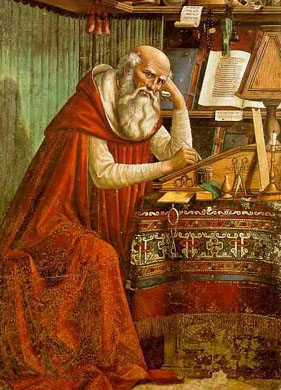
from our Father among the Saints, St. Jerome:

"If anyone stray even a little from the straight and narrow way, it is a small matter whether he wander to the right hand or to the left. The great matter is that he hath lost the right way." "Liber I Comment. in cap 5 et 6 Matt.", from The Anglican Breviary

Thursday, March 09, 2006

Second Meditation: On Lust


+In the name of the Father, and of the Son, and of the Holy Spirit. Amen.

"Our second struggle is against the demon of unchastity and the desire of the flesh, a desire that begins to trouble man from the time of his youth. This harsh struggle has to be fought in both soul and body, and not simply in the soul, as is the case with other faults. We therefore have to fight it on two fronts." St. John Cassian, "On the Eight Vices," Philokalia: The Complete Text Compiled by St Nikodimos of the Holy Mountain and St. Makarios of Corinth (trans. G.E.H. Palmer et al). London and Boston: Faber and Faber, 1979 Vol. I

A man is driving on a typically crowded L.A. freeway sytem, thinking about a business meeting, or an errand that he has to accomplish that day. His mind is thinking about so many different things at once: work, home, the great big parking lot called an L.A. freeway he is stuck on. All of a sudden, something in the distance grabs a hold of his attention. Moving with the traffic, the object comes into sharper focus. It looms larger and larger, until it is quite clear what has caught his attention-a billboard portraying a scantily-clad woman, selling, well, who knows-A brand of cheap beer? A line of barely visible clothing? A "Gentleman's Club"? What is being advertised takes a back seat to what readily begins to go on in this fellow's mind. "Wow, if only my wife/girlfriend looked like that!!!" What goes on in his mind begins to affect him physically, and before he knows it, the thought becomes desire, and the rest...well, you know how it will turn out.

St. Cassian hits us hard with the nature of this vice, and is uncompromising in the way that it is to be fought against: on the level of both body and soul. It is a two-front war that he invites us to engage in, continuing his theme of watchfulness against that most distracting and "delicious" of temptations. It is fought on the level of the body by physically refraining from sensual activities that lead to sin, such as watching sexually-charged movies, reading pornographic material, and putting ourselves in circumstances that contribute to sexual sin.

But this is the easy part. There is an even more intense struggle, one that takes place in our soul. St. Cassian exhorts us to "guard the heart from base thoughts," because "out of the heart proceed evil thoughts, murders, adulteries, unchastity." (Matthew 15:19) Lust is a perversion of love, its misdirection which turns it from God and the good of the other as its proper focus to the self as the primary object of fulfillment. There is an inherent selfishness in a lustful thought (though not totally, as I will explain below), because the object is not necessarily to seek the other's good, but to satisfy our own base desires. Fighting these thoughts becomes the most intense and rigorous part of our struggle.

But St. Cassian also knows that ascetic struggle alone is insufficient to fight this battle. He specifically enjoins his monks first "not to trust our own strength and ascetic practices," but to trust "in the help of God, our Master."

Secondly, St. Cassian highlights another essential weapon in this struggle-self restraint. This means, on the level of the body, not readily gratifying our desire for pleasure (as with gluttony). On the level of the soul, this means, again, to guard our thoughts. St. Cassian even goes so far as to suggest to his monastic charges that they refrain thinking about all women, even their mothers!

Avoidance of lustful thoughts may not require such draconian measures for those of us living in the world. However, there is a lesson to be learned here. For St. Cassian, this is a war, a spritual war. He goes quickly from physical to spiritual struggle when he says that "virginity (chastity) is achieved not so much by abstaining from intersourse with women as by holiness and purity of soul." This level of spritual warfare requires nothing less than contrition of heart, prayer and repentance. The purpose is always the healing of our base desires so that we can rightly direct the heart to God, thereby turning our lusts into love.

St. Maximus the Confessor sheds light on the nature of lust (and other vices)when he calls it "the wrong use of our conceptual images of things, which leads us to misuse the things themselves." Sexual intercourse, when performed in a loving relationship between a husband and a wife, is good and proper. And for St. Maximus, as for the Fathers in general, there is a primary purpose to it: the beggeting of children. Like eating, which is undertaken for the primary purpose of sustaining life, so with sexual intersourse. A misuse of food leads to gluttony, and a misuse of sex brings about incontinence.

In Dante's Inferno, the Circle of the Incontinent is the second circle, just below Limbo (the Circle of the Righteous Pagans). Here they are carried away by a black wind, forever adrift in a torment of endless futility. The lovers who in life were carried away by their lustful passions now experience these passions for what they really are, without the illusion of pleasure (See D. Sayers' note to Canto V of Inferno). This is the tragedy of the lovers Paolo and Francesca. Francesca da Rimini explains their predicament, capturing in truth this fundamental reality about lust:

Love, that so soon takes hold in the gentle breast,
Took this lad with the lovely body they tore
From me; the way of it leaves me still distressed.

Love, that to no loved heart remits love's score,
Took me with such great joy of him, that see!
It holds me yet and never shall leave me more.

At first it may seem that this is a nice romantic image, but there is a more fundamental truth here. You see, what Paolo and Francesca experience now is the effects of lustful passion, and what they mistakenly call "love" turns out to be a whirlwind of unfulfilled desire and yearning. There is no hope for Paolo and Francesca to ever truly be united in true love. They simply drift. As Sayers notes, in hell, the sin, which in life is so delicious, is now seen for what it truly is, stripped of its cosiness.

And yet, this sin, for Dante, is only the beginning. Though St. Cassian ranks unchastity above gluttony in his catalog of vices, still it is not the worst of sins. After the conquest of lust, for St. Cassian, there is a yet greater strugglein which we are to be engaged. There are as yet more powerful demons to fight. That is why lust is ranked so low on the scale of vices. Dorothy Sayers illuminates truth by saying that lust is "a type of shared sin...there is mutuality in it,", and therefore it is not WHOLLY selfish. This is important to keep in mind, because the Church has never taught that lust is the worst of all sins. Again, there are more powerful demons against which we are to fight. Let us not deceive ourselves into thinking that once we have conquered lust, we are now home-free. This is only the beginning.

How many times do we allow our eyes to "wander"? A thought enters. We can do either two things-repel it, or harbor it, allowing to descend into our hearts. We try to do the former, but find ourselves succumbing to the latter. Thought becomes desire. Desire becomes a movement to gratify passion, and this leads to action. Action leads to habit. Sinful habit leads to a hell-bent life. Therefore, says St. Cassian, cut lustful passion at the very beginning, in your thoughts. Replace this vice with chastity, which brings with it a singleness of purpose-the very life of the Holy Trinity, and the joys of "Deep Heaven."

Wednesday, March 08, 2006

First Meditation: On Gluttony


"I shall speak first about control of the stomach, the opposite of gluttony, and about how to fast and what and how much to eat. I shall say nothing on my own account, but only what I have received from the Holy Fathers. They have given us only a single rule for fasting or a single standard and measure for eating, because not everyone has the same strength ; age, illness or delicacy of body create differences. But they have given us all a single goal: to avoid overeating and the filling of our bellies." St. John Cassian, "On the Eight Vices," Philokalia (ed. Ware et al).

+In the name of the Father, and of the Son, and of the Holy Ghost. Amen.

Few things bring such a sense of sensual pleasure than a good meal. It is attended with such conviviality, with celebrations such as weddings, birthdays and even funerals. Whatever the event, we can usually count on a generous provision of food. Food seems to make its way even into some of the less social aspects of our daily lives-somehow a movie or a show is enjoyed much more with a sandwich or some other snack.

St. John Cassian points us to the true and most essential aspect of food. Like other things, it is directed towards a goal-the nourishment of the body. But gluttony, by its very nature, subverts this purpose. Instead of nourishing and strengthening him for the service of God, food, through gluttony, is turned to other purposes-the gratifying of the flesh, and what the Apostle calls the "pride of life."

Dante's Divine Comedy reveals the true essence of this sin, as those lost souls in the circle of the gluttons partake of a cold mouthfull of mud and muck. In Dante's hell, this sin is devoid of all the conviviality that attends it in this life, and all we are left with is what Dame Dorothy Sayers called a "cold sensuality, a sodden and filthy spiritual wretchedness." The images of the three-headed dog Cerberus, ravenously eating the miry much that Dante's guide, Virgil, throws at him, and the unfortunate character Ciacco, condemned to this state for eternity, drive home to us the animal-like nature of this vice. In hell, gluttony is no longer fun.

St. John Cassian gives the remedy-the holy discipline of fasting. He is careful, of course, to point out that there is no "single rule" for everyone, thus revealing the reasonableness of the patristic genius. There is, however, one goal to our fasting, which our holy father St. John Cassian lays down as "do not be deceived by the filling of the belly." The identification of gluttony with deception is quite intruiging here. Ultimately, gluttony is a deceives us into thinking that we need sensual stimulation and satisfaction as replacements for our one true need-God.

Often I must ask myself whether or not I need what I want to eat. But this is a question I often don't want to ask myself. Why, after all, ask probing questions about my motivations that will simply "rain on my parade," and a good feast? St. John Cassian gives a sober answer-THAT YOU BE NOT DECEIVED!

Perhaps when we engage in gluttonous activities, we are open to a great deal of other passions, which derail us from our main goal of uniting ourselves to Him who is our ultimate source of being, the One who wishes to bring us to a higher realm of complete humanity and fulfillment that comes only through sanctification (theosis). Instead, we are deceived into thinking that nothing is higher than our own sensual pleasures and desires. The gluttonous spirit is nothing else than the spirit of self-indulgence, the root of which goes back to the sin of our first parents. It is no accident, I think, that the first sin involved food.

But our deification also involves food-bread and wine, transformed into the body, blood, soul and divinity of the God-Man Christ, who is our bread of life. As Fr. Alexander Schmemann, rightly observed, man needs many things, but his first and primary need is for God. Fasting brings about self-control, and helps us to see that behind all our hungers, there is a deeper hunger still-the hunger for God.

Tuesday, March 07, 2006

Beer: The Perfect Lenten Meal


A bit of pre-lenten levity.
William Hogarth's Beer Street
Beer! happy produce of our isle,
Can sinewy strength impart,
And wearied with fatigue and toil,
Can cheer each manly heart.
Labour and art upheld by thee,
Successfully advance,
We quaff thy balmy juice with glee,
And water leave to France.
Genius of Health! thy grateful tasteRivals the cup of Jove,
And warms each English generous breast
With liberty and love.

St. John Cassian's On the Eight Vices: A Series of Lenten Meditations


With all the festivities of Shrove Tuesday (for those Orthodox Christians following the Western Rite), I am reminded of that late medieval Spanish ditty composed for that day: Hoy comamos y bebamos porque manana ayunaremos (Today let us eat and drink, for tomorrow we fast). Of course, you Russians have your blini fests (birreta tip to Huw Raphael).

Thinking ahead, of course, I ponder upon my lenten discipline-spiritual readings, meditations on Scripture and the Fathers, fasting, giving more towards efforts to feed the hungry and clothe the naked, etc.-in essence, living as we should live throughout the year. A fair amount of that time is ususally given over to what we should get rid of from our lives, i.e. a spiritual spring cleaning.

For this purpose, I will be posting a number of meditations on St. John Cassian's On the Eight Vices, from his Spiritual Conferences, beginning tomorrow (Ash Wednesday). I will make a few forays into Dante's Divine Comedy and St. Maximus the Confessor. Stay tuned!

Friday, March 03, 2006

Jephthah Holley, +Requiescat in Pace

Around 5am this morning, Jeph Holley, the son of Deacon Stephen Holley of St. Michael Orthodox Church, Whittier, was found dead in his bathroom by his 7 year-old daughter. He had had a heart transplant two years ago, and recently had double pneumonia. Of your charity pray for his soul, and for the Deacon and his whole family.

O God, whose mercies cannot be numbered; Accept our prayers on behalf of the soul of thy servant departed, and grant him an entrance into the land of light and joy, in the fellowship of thy saints; through Jesus Christ our Lord. Amen.

Thursday, March 02, 2006

NCC's "Sua Culpa"

Here they go again! The National Council of Churches, faced with dwindling numbers of congregants, are nonetheless hell-bent (I mean this in every possible way) on their own downhill-slide to permanent irrelevance. And of course, whose sins are they confessing? Not their own, but George W. Bush's. Who is leading this "litany"? I'm ashamed to say, it is a member of my own communion, Fr. Leonid Kishkovsky, of the Orthodox Church in America (OCA). A humble request to the OCA: Please follow us Antiochians out of this Babylon.

Here's the scoop from Alan Wisdom on OrthodoxyToday.org: http://www.orthodoxytoday.org/articles6/WisdomNCC.php

Wednesday, March 01, 2006

Militant Islam the New Communism?

Placard at London demonstration
This is perhaps one of the most significant statements coming from moderate Muslim writers and intellectuals. This should teach us not to paint Muslims with such a broad brush, as well as to drive home the fact that militant fundamentalist Islam is not good for Muslims either. God bless these good souls. Story from http://news.bbc.co.uk/2/hi/europe/4763520.stm:


Writers issue cartoon row warning

The cartoons provoked outrage across the Muslim worldSalman Rushdie is among a dozen writers to have put their names to a statement in a French weekly paper warning against Islamic "totalitarianism".
The writers say the violence sparked by the publication of cartoons satirising the Prophet Muhammad shows the need to fight for secular values and freedom.
The statement is published in Charlie Hebdo, one of several European papers to reprint the caricatures.
The images, first published in Denmark, have angered Muslims across the world.
One showed the Prophet Muhammad, whose depiction is banned in Islam, as a terrorist bomber.
Many newspapers defended their decision to reprint the cartoons on the grounds of freedom of expression.
'Global threat'
Almost all of those who have signed the statement have experienced difficulties with Islamic militancy first-hand, says the BBC's Caroline Wyatt in Paris.
They include Dutch MP and filmmaker Ayaan Hirsi Ali and exiled Bangladeshi writer Taslima Nasreen.
Philippe Val - director of Charlie Hebdo"After having overcome fascism, Nazism, and Stalinism, the world now faces a new global threat: Islamism," the manifesto says.
"We, writers, journalists, intellectuals, call for resistance to religious totalitarianism and for the promotion of freedom, equal opportunity and secular values for all."
The clashes over the cartoons "revealed the necessity of the struggle for these universal values," the statement continues.
"It is not a clash of civilisations nor an antagonism of West and East that we are witnessing, but a global struggle that confronts democrats and theocrats."
The writers said they refused to accept that Muslim men and women "should be deprived of their rights to equality, liberty or secularity in the name of respect for culture or tradition".
They also said they would not give up their critical spirit out of fear of being accused of Islamophobia.
"Islamism is a reactionary ideology which kills equality, freedom and secularism wherever it is present," the writers added, saying it is nurtured by fears and frustrations.

STATEMENT SIGNATORIES
Salman Rushdie - Indian-born British writer with fatwa issued ordering his execution for The Satanic Verses
Ayaan Hirsi Ali - Somali-born Dutch MP
Taslima Nasreen - exiled Bangladeshi writer, with fatwa issued ordering her execution
Bernard-Henri Levy - French philosopher
Chahla Chafiq - Iranian writer exiled in France
Caroline Fourest - French writer
Irshad Manji - Ugandan refugee and writer living in Canada
Mehdi Mozaffari - Iranian academic exiled in Denmark
Maryam Namazie - Iranian writer living in Britain
Antoine Sfeir - director of French review examining Middle East
Ibn Warraq - US academic of Indian/Pakistani origin

Tuesday, February 28, 2006

St. Augustine and Mystical Theology


Here's a lecture I gave to my students to guide their reading of St. Augustine's Confessions. Caution: I do not take as dim a view of the influence of Neoplatonism on his theology as many theologians do, east and west.

The essence of any Christian mystical theology is union with God. But such a union must take place in such a manner that the human soul will always be conscious of itself, and not lost into a cosmic "oneness" which is characteristic of Hindu and Buddhist spiritualities. Indeed, for a Christian mystic, such "spirituality" is false, for it destroys the fundamental distinction that obtains between lover and beloved. Indeed, the Christian notion of union with God is always an "I-Thou" relationship, a union of persons in a bond of love, where God remains uniquely Himself, and man does not lose any of his essential attributes. This is what makes this a union of love-the union between two different persons, a sacro convivio, where love can be dynamically expressed.
Given this dynamic relationship, Christian theology in the patristic period was very much concerned with the dogmatic distinctiveness that would make such a union possible. The Christological controversies between the 4th and 9th centuries were precisely about those elements in Christian dogma that facilitated such a divine-human union. The hypostatic union of divinity and humanity in Christ entails a possibility for humanity to be united to the Triune Godhead. For the Nicene and post-Nicene Fathers, these dogmatic disputes were not mere academic exercises, but serious issues that involved nothing less than the possibility of such a union. If in fact God did not become man in Jesus Christ, then this union is impossible.
This is why much of the richest and most meaningful literature produced by the Cappodocian Fathers (Basil the Great, Gregory of Nyssa, and Gregory Nazianzen) and the Latin Fathers (Ambrose, Augustine and Jerome) have strong mystical elements. Their dogmatic theology, in this case, forms a harmonious and holistic union with their mystical theology. However, it is also the case that they borrow quite heavily from the philosophic and intellectual currents of their day to expound their unique vision of man's union with God. This was no mere mimicry, since they also sought to go beyond the parameters of these philosophic systems in order to pursuit a more biblical vision, one in which man enjoys an eternal union with the Godhead.
These movements are readily apparent in the mystical theology of St. Augustine, especially as expounded in Confessions and De Trinitate. In Augustine, we have a western Christian writer who takes philosophical and theological notions learned from some Greek and Latin Christian sources, but in turn applies them in very unique ways, influencing the movements of later Latin theology. His importance in the history of western theology is undeniable; however, many of the concerns of western theologians have revolved around his dogmatic reflections on nature and grace, worked out in the red heat of the anti-Pelagian controversies. I would submit that many Augustine scholars have tended to focus on this dimension of his theology in isolation of his mystical theology, a cleavage Augustine himself would not have understood. Like many writers in the patristic period, both east and west, dogma and experience formed an integral whole. If you get the dogmatic dimension wrong, you compromise a whole theology of salvation and experience, and since the whole point of the Incarnation is to bring man into union with God, the one would have adverse effects on the other if certain dogmatic lines were crossed. With Augustine, then, just as with the Cappodocian Fathers and, later, St. Maximos the Confessor, we have to treat his dogmatic concerns in concert with his theology of mystical experience.
Of course, Augustine the Neoplatonist informs many of the mystical movements made by Augustine the Christian mystic, and Plotinus is the key that unlocks some (but I'm quick to say not all) of his mystical reflections. The Platonic universe of Plotinus, as he lays it out in the Enneads, can be seen in three ways, according to Andrew Louth: as a hierarchical structure, as a chain of being, or as an introspective vision of the self (Louth, Origins of Christian Mystical Tradition, p. 37). Seen as a hierarchical structure, there are three principles of being, beginning with the highest, the One ('en), also known as the Good. The second level is nous (nous), or the Intelligence, and then Soul (psukh), which is the realm of sense perception, of logical discourse. The Intelligence is the realm of greater unification, where knowledge is more intuitive and experiential, a higher realm of knowing. This is the realm of Plato's "Forms", and where in essence the mind has an apprehension of those perfect forms, and "knower and known are one". Here knowledge is intuitive, and is based on a direct apprehension of those perfect forms. Yet this cannot be the ultimate reality, for while our minds are united to the forms, there is still multiplicity, and therefore duality. For Plotinus, the One still eludes us, since in the realm of Intelligence, our experience is still one of duality, multiplicity, and while there is a harmonious unity between the Forms, there are still "many Forms". For Plotinus, to achieve real unity is to reach the ultimate level of meaning, where all dualities cease, and there is only the One.
The One, for Plotinus, is the absolute ground of all being, the very source of all that is. It is the realm of absolute simplicity, and is also called the Good in that it has no need of anything else to give it its being, and in fact, goes beyond being itself. Direct apprehension of the Good is impossible, since it is so incomprehensible, but at the same time, it is the source of all being. Now it is important to note that the One is not the source of all things in the sense of the Judeo-Christian doctrine of creatio ex nihilo, for in the Plotinian system the universe is eternal. The only way that the One is understood to be the source of all things is by the very fact that it is eternal, and that creation, or emanation, is part of its intrinsic nature. In other words, the One is "creating" (i.e. emanating) because of an internal necessity to do so. It is from the One that Intelligence and the Soul emanate. Andrew Louth describes this process of emanation very well:
These three hypostases, the One, Intelligence or nous, and Soul, are related by processes of Plotinus calls emanation and return-proodos and epistrophe. Intelleigence emanates from the One, and Soul from Intelligence: out of the utterly simple there comes multiplicity, and that multiplicity is further diversified and broken up at the level of discursive understanding. This process of emanation is a process of "overflowing", the potent simplicity of the one "overflows" into Intelligence, and Intelligence overflows into Soul. (Louth, p. 38)

This process of emanation and return is one in which the One unfolds and discloses its simplicity, and return constitutes the Good drawing all things back to itself, thus creating equilibrium. From the Soul, again, comes discursive logic, but also various embodiments, of which flesh is the lowest. The object of the mind is to rise up beyond discursive logic, and transcend to the Intelligence, where knowledge is more intuitive, and thereby pass on into ecstasy in union with the One. It is at this stage that the soul is taken up, "enraptured", in its contemplation, for the One snatches it up into itself. Porphyry, Plotinus' student and biographer, says that three times he was snatched up into this ecstasy, but that it was only a momentary one, a flight into the "darkness" beyond being, to the source of all things. It is one that cannot be sustained, however, for it is a fleeting moment of absolute clarity and union.
How does one achieve this state in Plotinus' account? The answer comes in the first book, sixth treatise in the Enneads, "On Beauty". After posing the rhetorical question "how can one see the inconceivable beauty", the answer is forthcoming: "Let him who can, follow and come within, and leave outside the sight of his eyes and not turn back to the bodily splendors he saw before" (Enneads Book I:6:8). In other words, withdraw into your own soul, and leave behind the realm of the senses. Whatever beauty you see in the external world is temporary, and partakes of change. Our contemplation of outer beauty should in fact cause us to turn inward, and pursue our true "fatherland".
What precisely is seen in this inner contemplation? Plotinus answers this question in a rather lengthy way, which I will quote in its entirety:
When it is just awakened it is not at all able to look at the brilliance before it. So that the soul must be trained, first of all to look at the beautiful ways of life: then at beautiful works, not those which the arts produce, but the works of men who have a name for goodness: then look at the souls of the people who produce the beautiful works. How then can you see the beauty a good soul has? Go back into yourself and look; and if you do not see yourself beautiful, then, just as someone making which has to be beautiful cuts away here and polishes there and makes one part smooth and clears another till he has given his statue a beautiful face, so you too must cut away excess and straighten the crooked and clear the dark and make it bright, and never stop "working on your statue" till the divine glory of virtue shines out on you, till you see "self-mastery enthroned upon its holy seat". If you have become this, and see it, and are at home with yourself in purity, with nothing hindering you from becoming in this way one, with no inward mixture of anything else, but wholly yourself, nothing but true light, not measured by dimensions, or bounded by shape into littleness, or expanded to size by unboundedness, but everywhere unmeasured, because greater than all measure and superior to all quantity; when you see that you have become this, then you have become sight; you can trust yourself then; you have already ascended and need no one to show you; concentrate your gaze and see. This alone is the sight that sees the great beauty…First the soul will come to its ascent to intellect and essence. That which is beyond this we call the nature of the Good, which holds beauty as a screen before it. So in a loose and general way of speaking the Good is the primary beauty; but if one distinguishes the intelligibles (from the good) one will say that the place of the Forms is the intelligible beauty, but the Good is that which is beyond, the "spring and origin" of beauty; or one will place the Good and the primal beauty on the same level: in any case, however, beauty is in the intelligible world. (Enneads, Book I:6:8)

The meaning of this internal reflection is very clear: you must go further in, in order to ascend further up. However, when contemplating beauty, you have reached the heights of the Intelligible world, but even then the "true beauty" is still beyond you, and it is here that the One snatches you up into itself, and the experience of oneness, beyond dualities and mixture. Now let us turn to Augustine and see how he has appropriated Plotinus, but how, in some important ways, he has departed from him.
Let us begin with the Confessions. St. Augustine here does something that no other writer does before him, but which sets a precedent in subsequent western mystical theology. He writes a history of his own spiritual odyssey, culminating, in many ways, in the mystical experience recorded in Book IX. He begins his masterful work of spiritual self-reflection with these moving words: "Man, a little piece of your creation, desires to praise you, a human being 'bearing his mortality with him'…you stir man to take pleasure in praising you, because you have made us for yourself, and our heart is restless until it rests in you" (Confessions, Book I:1). This passage shows how, in many ways, Plotinus prepared Augustine for Christianity (a theme he will unpack later). Just as Plotinnus, Augustine is like a restless deer wishing to slake his thirst, finding no satisfaction in the "region of dissimilarity". It is here that Augustine sets out the theme of his work-the soul's search for God, and God's condescension, by grace, to bring him into union with himself. This longing is nothing new in Christian and Platonic literature. Plato certainly expresses similar movements in his desire to transcend the world of becoming for the realm of ultimate being, a theme powerfully taken up by Plotinus. And though "Augustine is deeply indebted to Plotinus", we nonetheless see "that in (Augustine's) hands this longing for God is transformed from a human restlessness to our response to the incredible love and condescension of God (by) the movement of the Holy Spirit Himself in our hearts" (Louth, p. 134). The culminating moment occurs in Book IX, where he records a powerful mystical vision he had in Ostia, in an intimate conversation with his mother Monica:
The conversation led us towards the conclusion that the pleasure of the bodily senses, however delightful in the radiant light of this physical world, is seen by comparison with the life of eternity to be not even worth considering. Our minds were lifted up by an ardent affection towards eternal being itself. Step by step we climbed beyond all corporeal objects and the heaven itself, where sun, moon and stars shed light on the earth. We ascended even further by internal reflection and dialogue and wonder at your works, and we entered into our own minds. We moved up beyond them so as to attain to the region of inexhaustible abundance where you feed Israel eternally with truth for food. . There life is the wisdom by which all creatures come into being, both things which are and which will be. Furthermore, in this wisdom there is no past and future, but only being, since it is eternal…And while we talked and panted after it, we touched it in some small degree by a moment of total concentration of the heart. And we sighed and left behind us "the firstfruits of the Spirit" (Rom. 8:23) bound to that higher world, as we returned to the noise of our human speech where a sentence has both a beginning and an ending. But what is to be compared with your word, Lord of our lives? It dwells in you without growing old and gives renewal to all things. (Confessions, Book IX:24)

Plotinus' impact on Augustine is a very marked one here in this passage, especially in its ascending movement from the heart, to the center of ultimate being itself, which, rather than some vague notion of the Good, is the personal Triune God Himself. As a matter of fact, the whole structure of the Confessions may very well take on this Plotinian format, as we follow Augustine from his youth in the "region of dissimilarity", where his search for fulfillment of soul leads him through sensual pleasure, into Manicheanism. His acquaintance with Plotinus leads him from these false hopes, and fixes his gaze on ultimate being, eternity. Augustine was a good student of Plotinus. In the vision at Ostia, Augustine learned from Plotinus to "climb up" by "internal reflection", and there contemplate the ultimate ground of being itself. He goes inward in order to find the traces of the divine image, but he cannot stop there. The divine image is a stamp on his soul, and this must impel him to go higher. Yet here is where the Plotinian mystic tradition ends, for the One in Plotinus' account is not a personal being, and therefore not relational.
In Book X, Augustine develops his own account, and goes beyond Plotinus, for Augustine's God is very much a relational being-in fact, a person-and he must develop his dynamic theology of mystic experience from that point. The ultimate union with God, the ground of all being, is one of love. Love, of course, presupposes community, a sacrum convivium or communion between lover and beloved. Here the break with Plotinus is complete, for this union is a union of persons, as Augustine's heart ascends, and divine love descends upon him. This is an ascent to communion, not an absorption, into a concrete relationship with a concrete personal being:
My love for you. Lord, but a matter of conscious certainty. With your word you pierced my heart, and I loved you. But heaven and earth and everything in them on all sides tell me to love you. Nor do they cease to tell everyone that "they are without excuse" (Rom. 1:20). But at a profounder level you will have mercy on whom you will have mercy and will show pity on whom you will have pity (Rom. 9:15). Otherwise heaven and earth would be uttering your praises to the deaf. But when I love you, what do I love? It is not physical beauty nor temporal glory nor the brightness of light dear to earthly eyes, nor the sweet melodies of all kinds of songs, nor the gentle odour of flowers and ointments and perfumes, nor manna or honey nor limbs welcoming the embraces of the flesh; it is not these I love when I love my God. Yet there is a light I love, and a food, and a kind of embrace when I love my God-a light, voice, odour, food, embrace of my inner man, where my soul is floodlit by light which space cannnot contain, where there is sound that time cannot seize, where there is a perfume which no breeze disperses, where there is a taste for food no amount of eating can lessen, and where there is a bond of union that no satiety can part. That is what I love when I love my God. (Confessions, Book X:8)

Here Augustine an ultimate ontological break between created and uncreated, as his love for God transcends all physical analogies. No longer do we have the ontological union between the One and the emanations that flow from it. For the doctrine of emanation, Augustine's Christian mystical experience teaches him a radical ontological distinction between divinity and created being-creatio ex nihilo. And yet this ontological distinction is not without the traces of divine being, and this leads him to look beyond, to the source of all things. And though man seeks God, he cannot bridge this gap, for he understands St. Paul's doctrine of sin and grace very well. God's ultimate union with man ultimately requires a special act of grace, a grace which is a supernatural act of God, and not attained in the natural realm of things. It is here that, after the divine condescension, Augustine finds the sacred commerce he so actively craved at the beginning of Book I.
Perhaps Augustine's final break with Plotinus comes in De Trinitate, where he lays out the soul's relationship to the Trinity, and tries to explicate the mystery of the Trinity through a psychological analogy. The cogency of his psychological analogy will not be my focus here, for my main interest is in fact how, in his account, the soul relates to the Trinity. For him, the soul's love for God discloses a trinity-the lover, the beloved, and the love. This, however, is not a real trinity, for "the lover and beloved are distinct persons": "A further ascent still remains for us, a higher realm in which our search is to be pursued, so far as men may. We have found, not the thing itself, but where it is to be sought; and that will suffice to give us a point from which a fresh start may be undertaken" (De Trinitate, VII:X:14, quoted in Louth, p. 150). It is from here that Augustine looks at the very nature of man as an image of God which discloses a trinitarian image. Andrew Louth again explains this process very well: "Augustine begins by considering the mind loving itself. There is now identity between the lover and the beloved, but the trinity of love has vanished, and we have only two terms: the mind and its love. Augustine, however, recalls the interpenetration of love and knowledge: the mind cannot love itself, if it cannot know itself. The trinity has now reappeared, and we have found a trinity in man himself: the trinity of mens, notitia, and amor: mind, knowledge, and love" (Louth, p. 150). This image will reflect God truly only if it is a real image. It must not mistake its own trinity for the divine Trinity. Once the soul thinks itself divine, it ceases to be a real image of the divine Trinity, and its reflective power is damaged.
Here there is a dimension of self-knowledge, which he develops in Book X, and while the mind's knowledge may be imperfect, it is never entirely obscured, because the mind is always present to itself:
Who doubts that he is alive, and remembers, and understands, and wills, and knows, and judges? If one doubts, one lives; if one doubts whether one doubts, one remembers; if one doubts, one understands that one doubts; if one doubts, it is certain that one wills to. If one doubts, one thinks; if one doubts, one knows that one does not know; if one doubts, one judges that one ought not to consent rashly. Whatever anyone doubts, he ought not to doubts these: if it were not so, it would be impossible to doubt anything. (De Trinitate, Book X:x:14)

From this Augustine argues for the spiritual nature of the mind, for "these spiritual properties are certain", since they are true and observable functions of the mind (Louth, p. 152). From these certain functions of the mind (memory, understanding and will), he begins to argue that this triad discloses a trinity, in that the triad reveals not "three lives", but one life, since each It is only as the mind reaches the summit of its memory, understanding and will that it realizes itself as an image of the divine Trinity, and imperfect image, but an image nonetheless. The cure of this image in man must take place as a divine condescension from God Himself, as He sends the Divine Word to take on flesh and open up the possibility of union with the Trinity, and finally realize the fullness of this image in man. Unlike the ecstasy in Plotinus, the restoration of the image is only a beginning, which is initiated at baptism (or purification), but continues in a long process of illumination, and finally in glorification. This process is one that is familiar in the Cappadocians, and in the later mystical theology of St. Maximos the Confessor, for whom this process is necessary for the attainment of true love (See Centuries on Charity, I:1).
From these general contours, it is easy to see why the Pelagian heresy was so repugnant to his sense of mystical union with God. The soul certainly seeks God, but ultimately, it cannot find God without the supernatural intervention of grace, which, apart from the general operations of this world, acts from without, but then works from within, bringing the soul greater illumination and finally glorification, as it comes into union with the Trinity in a communion of love. The Pelagian heresy threatened this dimension of his theology.
So we come full circle to the dogmatic dimensions of Augustine's theology. We began our odyssey, if you will, with some general comments as to what constitutes the content of Christian mystical experience. It is still rather unclear what comes first-the dogma, or the experience of the divine life. As dogmatic teaching develops in response to heresy, especially in these early centuries, it is no accident that many of the most engaging teachers of Christian dogma, writing treatises in defense of the Church's received tradition, have also been virtuoso expounders of mystical poetry and literature, where the drama of the union between God and man, through the incarnate dispensation of the Son of God, takes place in prayer, word and sacrament. It may very well be argued that what the Cappadocians, Augustine, and later St. Maximos the Confessor, was, in addition to the received dogmatic tradition (or in concert with it) was their mystical experience with the Triune Godhead, or perhaps their experience confirmed the truth, for them, on a very personal level, the truth of received dogma. For Augustine, the matter was a question of what made most sense in his contemplation of Scriptures, the received dogmatic tradition of the Church, and his own experience, and though he used his experience as a Neoplatonist to make sense, on one level, of his spiritual journey, the ultimate mystery that he was trying to express was deeply Christian. Augustine the Neoplatonist had truly become Augustine the Christian mystic.