Friday, June 11, 2010

Archbishop Chrysostomos of Cyprus' Address to Pope Benedict XVI


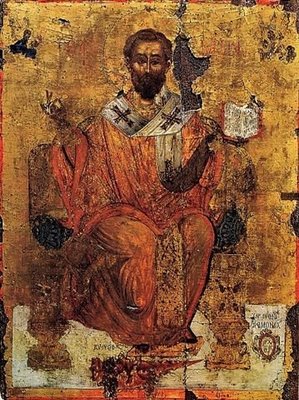
http://eirenikon.files.wordpress.com/2010/06/apostle-barnabas.jpeg


“It Is Here … That the Christian Roots of Europe Took Seed”

PAPHOS, Cyprus, JUNE 4, 2010 (Zenit.org) – Here is the address delivered today by the Cypriot Orthodox Archbishop Chrysostomos II during an ecumenical celebration at the archeological area of the Church of Agia Kiriaki Chrysopolitiss. [emphasis added]

* * *

Your Holiness, Pope Benedict of old Rome, welcome to the Island of Saints and Martyrs!

Welcome to the first Church of the Nations, founded by the Apostles Barnabas, Paul and Mark!

Welcome to the Church of the Apostles, after the establishment of which the Holy Spirit led the Apostles to separate themselves from their brethren and sent them towards the Nations!

“So, being sent out by the Holy Spirit, they went down to Seleucia, and from there they sailed to Cyprus. When they arrived at Salamis, they preached the word of God in the synagogues of the Jews … they had gone through the island to Paphos” (Acts 13:4-6).

In this very spot, your Holiness, stood the synagogue of the Jews and from this place St Barnabas and St Paul preached the word of God to the Jews.

“But the word of God is not chained” (2 Timothy 2:9). It could not have been possible for the Spirit of Love of the Incarnate, Crucified and Resurrected Lord to remain restricted among the Jews. Jesus Christ came to the world “that whoever believes in Him should not perish but have everlasting life” (John 3:15).

The commandment of the Holy Ghost was for them to preach to the Nations. Thus, when the Roman deputy, Sergius Paulus, “a prudent man” according to St. Luke, invited the Apostles “to hear the word of God” (Acts 13:7) they gladly went forth to the place where the political administration of the island was based in order to preach the word of the Lord for the first time among the Gentiles also.

At this point, “Barnabas and Paul exchanged their roles. Here was a place not for the Cypriot, but the Roman citizen”.

As of that moment Paul became the leader of the mission. He also changed his name. From this moment on he was no longer called Saul in the New Testament, but Paul!

It was in this town that the first miracle of the Apostles was performed, as recorded in the New Testament. It was here that the first European citizen was baptized in the name of the Holy Trinity. It was here that the first official citadel of idolatry fell and in its place the glory of the Cross was raised in all its splendor, and would gradually spread to cover the whole of Europe and shape its historical future.

It is here, your Holiness, that the Christian roots of Europe took seed and from here its spiritual shoots first burst forth. The foundations of the edifice of Christian civilization in Europe were laid on this very spot where we now stand, deeply moved by the sense of history. It is for this reason that Cyprus is justly called “the Gate of Christianity in Europe”.

Here in Paphos, after the wondrous events that took place, Paul became established as the Apostle to the Nations, and went on to sow the seeds of the bread of life in your own cathedra and throughout the whole of Europe.
Your Holiness,

Since 45 AD when the Apostles first set their foot upon this island until the present day, the Church of Cyprus has had a long and fruitful Christian course. Throughout its long progress it has endured numerous troubles and difficulties, lived through dark nights, experienced many conquests, gone ‘through fire and water’, but guided always by the Holy Spirit, not only did it survive, but it continues to give its Orthodox Christian Testimony, and to fulfill its God-given mission.

But, alas, since 1974, Cyprus and its Church have been experiencing the most difficult times in their history.

Turkey, which attacked us barbarously and, with the power of its arms, occupied 37% of our territory, is proceeding — with the tolerance of the so-called ‘civilized’ world — to implement its unholy plans, first to annex our occupied territories and then the whole of Cyprus.

In the case of our island, as it has done elsewhere, Turkey has implemented a plan of ethnic cleansing. It drove out the Orthodox Christians from their ancestral homes and brought — and continues to bring — hundreds of thousands of settlers from Anatolia, thus altering the demographic character of Cyprus. In addition, it has changed all the historical place names into Turkish ones.

Our cultural heritage has been plundered relentlessly and our Christian monuments are being destroyed or sold on the markets of illicit dealers in antiquities, in an attempt to rid the island of every last trace of all that is Greek or Christian.

We hope that in this terrible ordeal, which has caused so much agony to the Christian congregation of our Church since 1974, the Good and All-Merciful Lord will not turn His face from our suffering people, but will grant us Peace, Freedom, and Justice, thus granting to us the all-fulfilling love given by His presence in our hearts.

In this struggle of ours, Your Holiness, which the Cypriot people are waging with the guidance of their Leaders, we would greatly appreciate your active support. We look forward to your help in order to ensure protection and respect for our sacred monuments and our cultural heritage, in order that the diachronic values of our Christian spirit might prevail. These values are currently being brutally violated by Turkey — a country desirous of joining the European Union.

Your Holiness,

In this joyful moment of your presence among us together with your retinue, we, the President of the Republic, the Government, the Holy Synod, the pious congregation of our Church, and I personally, would like once again to address to you a heartfelt welcome and wish you a pleasant stay.

+Chrysostomos Archbishop of Cyprus
Holy Archbishopric of Cyprus
4 June 2010

Biretta tip: Eirenikon
Wednesday, June 09, 2010

Ron Paul on "Why Governments Hate Gold"

Dr. Paul on how it is that Greek-style debt explosions spread to other nations, and what is at the root of falling currencies, massive debt and out-of-control inflation: fiat currencies that have no value, but we keep performing the ultimate alchemy: printing more paper money, based on...nothing!

As governments and central banks continue the cycle of spending and inflating, the purchasing power of their currencies is constantly being degraded. These currencies are what the people are working for and saving. This inflation guts the savings and earnings of the people, who have very limited options for protecting themselves against these ravages. One option is to convert their fiat currency into something out of reach of central banks and government spending, such as gold or silver.

Read the whole article here.

Monday, June 07, 2010

St. Conleth Blog

for readers interested in efforts in Ireland to preserve the ancient liturgy, I am happy to offer St. Conleth's Catholic Heritage Association blog. You will find links to articles from the Christus Regnat journal. Definitely worth a visit.

Meltup: the movie

This is not fiction, ladies and gentlemen!


After that, this:


Fasten your seat belts, ladies and gentlemen! After the meltup, it's certainly going to be a bumpy night for the world economy. Fiat money, higher debt to savings ratios, etc., and things will indeed come to this.

Friday, June 04, 2010

Lauda Sion


Sion, lift up thy voice and sing:
Praise thy Savior and thy King,
Praise with hymns thy shepherd true.
All thou canst, do thou endeavour:
Yet thy praise can equal never
Such as merits thy great King.
See today before us laid
The living and life-giving Bread,
Theme for praise and joy profound.
The same which at the sacred board
Was, by our incarnate Lord,
Giv'n to His Apostles round.
Let the praise be loud and high:
Sweet and tranquil be the joy
Felt today in every breast.
On this festival divine
Which records the origin
Of the glorious Eucharist.
On this table of the King,
Our new Paschal offering
Brings to end the olden rite.
Here, for empty shadows fled,
Is reality instead,
Here, instead of darkness, light.
His own act, at supper seated
Christ ordain'd to be repeated
In His memory divine;
Wherefore now, with adoration,
We, the host of our salvation,
Consecrate from bread and wine.
Hear, what holy Church maintaineth,
That the bread its substance changeth
Into Flesh, the wine to Blood.
Doth it pass thy comprehending?
Faith, the law of sight transcending
Leaps to things not understood.
Here beneath these signs are hidden
Priceless things, to sense forbidden,
Signs, not things, are all we see.
Flesh from bread, and Blood from wine,
Yet is Christ in either sign,
All entire, confessed to be.
They, who of Him here partake,
Sever not, nor rend, nor break:
But, entire, their Lord receive.
Whether one or thousands eat:
All receive the self-same meat:
Nor the less for others leave.
Both the wicked and the good
Eat of this celestial Food:
But with ends how opposite!
Here 't is life: and there 't is death:
The same, yet issuing to each
In a difference infinite.
Nor a single doubt retain,
When they break the Host in twain,
But that in each part remains
What was in the whole before.
Since the simple sign alone
Suffers change in state or form:
The signified remaining one
And the same for evermore.
Lo! bread of the Angels broken,
For us pilgrims food, and token
Of the promise by Christ spoken,
Children’s meat, to dogs denied.
Shewn in Isaac's dedication,
In the manna's preparation:
In the Paschal immolation,
In old types pre-signified.
Jesu, shepherd of the sheep:
Thou thy flock in safety keep,
Living bread, thy life supply:
Strengthen us, or else we die,
Fill us with celestial grace.
Thou, who feedest us below:
Source of all we have or know:
Grant that with Thy Saints above,
Sitting at the feast of love,
We may see Thee face to face.
Amen. Alleluia.

Thursday, June 03, 2010

O Salutaris Hostia: A Happy Feast of Corpus Christi


To all my fellow Western Orthodox, who celebrate this feast, as well as to all my Roman Catholicand Anglo-Catholic friends: A Happy Feast to all!

http://escproductions.bizland.com/hpics/eucharisticon.jpg

O saving Victim, opening wide
The gate of Heaven to us below;
Our foes press hard on every side;
Your aid supply; Your strength bestow.
To your great name be endless praise,
Immortal Godhead, One in Three.
O grant us endless length of days,
In our true native land with thee.
Amen.

Greece Urged to Give Up the Euro

http://www.greeklandscapes.com/images/various/euro_coins.jpg


If this happens, Greece would be the first in the many unravelings of the EU. Should Greece return to the Drachma, my only concern is that she do so by pegging its value not against any other paper currency, but against gold or silver.

Read the story here.

Hat tip: The Young Fogey

Monday, May 31, 2010

Arturo Vasquez on Lady Gaga, David Mills, and Being Played by the Culture Wars

Arturo weighs in on David Mills' article:

To get straight to the point: I think that, in a way, Mills and Co. commit the same errors that they accuse Lady Gaga and Co. of committing. The real ground of all religion in the modern world is cosmological agnosticism. The “spiritual not religious” crowd pretends to know nothing of God so that they can do whatever they want. The “orthodox religious” crowd pretends to know God so well that they can employ him for any agenda that is in their interest, all under the pretension that it is not their will, but God‘s. In either case, God is a puppet; he is a Caspar the Friendly Ghost-character who fulfils their true desires and makes them feel good about themselves.

Again, my study of “folk” Catholicism is very illuminating in terms of the issues involved here. Mills’ God is primarily a moral being: one who maintains societal order for the benefit of decency. In the more common, simple Catholic mind, God’s intervention in daily life was far less moralistic. People had needs and wants, and God could either grant or deny the satisfaction of these. If you ask God or a saint for something, you should pay them back or suffer the consequences. And of course, if you need something morally ambiguous, there were saints and prayers for those things as well.

In other words, a Catholic peasant a hundred years ago would never say that he was “spiritual but not religious”, but that did not make him a foot solider in a culture war either. He employed officially approved methods of interaction with the Divine as well as things that were off the beaten path. Within the context of societal propriety, he picked and chose what he believed just as much as any modern person. The institution does not completely govern the soul of any individual. People have always taken what they need from it, and left aside those things that they don’t need. The idea of a mass militant populace of “well-catechized” Catholics is a peculiarly American one, probably passed down to us from the Irish. For further reading, one should consult such books as The Cheese and the Worms: The Cosmos of a Sixteenth Century Miller by Carlo Ginzburg to really find out the crazy things “average” Catholics believed.

Read the whole article here.

Saturday, May 29, 2010

"Spiritual but not religious"

Rod Dreher addresses the big scam of the 21st century: "Spiritual but not religious."

Quoting David Mills:
It's one of those easily remembered phrases that work like a "get out of jail free" card for anyone who feels he has to explain his lack of religious practice, and as a claim to superiority for those who care about being superior to those who practice an established religion. It's the religious equivalent of "I gave at the office" or "There's a call on the other line" or "I don't eat meat."

And so it goes..."materialism in a tuxedo."

Read the whole article here.

I would post a picture of "Lady Gaga", cited in the article as the latest porn-pop-princess giving this profound spiritual self-revelation, but I'm afraid doing so would put me in trouble with my Christian university's web censors, thus giving them the wrong impression.

Friday, May 07, 2010

More on Sterligov


Former Russian tycoon finds a better life, and in the process, finds a better way out of the global economic crisis: bartering, and the gold standard.

It's not all "Greek" to Ron Paul


It's a currency issue, as Ron Paul schools the masses.

Friday, April 30, 2010

The "Virtues" of the Internet: Think Again

Evgeny Morozov says:

They told us it would usher in a new era of freedom, political activism, and perpetual peace. They were wrong.

"Et in Arcadia ego." Sin and death follow all of our best endeavors.

Read article here.

Hat tip: The Young Fogey

Thursday, April 22, 2010

Presidentialising the Prime Minister


From Taki's Magazine

The PM’s job was long more human-scale job than the president’s, less insulated from normal life by security and by deference (which in Britain was paid instead to the Queen as head of state). For example, when I attended a conference with ex-PM Margaret Thatcher in 1999, she showed up accompanied only by a secretary and a bodyguard, wearing an old dress that had been mended with needle and thread. Tony Blair and his money-hungry wife Cheri were the first to indulge fully American superstaritis.

Read the entire article here.

Hat Tip: The Young Fogey

Monday, April 19, 2010

Russell Kirk's Wariness of Neoconservatives

From The Heritage Foundation

In their publications, the Neoconservatives thrust upon us a great deal of useful information, and obviously are posse ssed of considerable knowledge of the world about us. But in the understanding of the human condition and in the apprehension of the accumulated wisdom of our civilization, they are painfully deficient.

Infatuation with Ideology. An instance of this lack of wisdom is the Neoconservatives' infatuation with ideology. Some of you ladies and gentlemen present here today may have heard some years ago my exchange, on this very platform, with Mr. Irving Kristol, concerning ideology. He and various of his colleag u es wish to persuade us to adopt an ideology of our own to set against Marxist and other totalist ideologies. Ideology, I venture to remind you, is political fanaticism: at best it is the substitution of slogans for real political thought. Ideology animate s, in George Orwell's phrase, "the streamlined men who think in slogans and talk in bullets."


Read the entire article here.

Democracy and Universalism

Article by Fjordman, in The Brussels Journal: The Voice of Conservatism in Europe

Not only did Bush perceive his country to be a “democracy,” despite the fact that it was founded as a Constitutional Republic; he perceived it as being “universal.” Every person on planet Earth from whatever cultural background can move to the United States and become an equal citizen. The USA is thus a “universal” nation, and its universal democracy should be exported to all countries around the world. This version of “universalism” would have been profoundly alien to the ancient Greeks, yet has become a prominent feature of the post-Enlightenment West. “We no longer consider any human action legitimate, or even intelligible,” wrote the French late twentieth century philosopher Pierre Manent, “unless it can be shown to be subject to some universal rule of law, or to some universal ethical principle.”

Where does this notion come from?

And the concept's connection to the Scientific Revolution?

Read the whole article here.

Hat tip: American Monarchist

Sonoma County's War against Voluntary Association and Property Rights

Two elderly gay men are forcefully separated by the Sonoma County authorities, and their property is auctioned off. Read the story here.

I take a traditional, biblical view about what constitutes marriage: a man and a woman in a covenantal union blessed by almighty God. Homosexual relationships fall short of this, and are sinful.

That being said, this is no grounds for taking away anyone's property! This is a clear attack on property rights and free association.

Thursday, April 15, 2010

The Early Modern State, the Catholic Church, and the Sum of Disunities

This article by Arturo Vasquez reminds me of Nicholas Henshall's book, The Myth of Absolutism: Change and Continuity in Early Modern European Monarchy, especially this passage: Only in the fifteenth and sixteenth centuries were legal customs written down, and even then there was no attempt at uniformity. In the eighteenth century Voltaire remarked that a traveller changed laws as often as he changed horses. (p. 8)

Up until the nineteenth century, people paid homage and loyalty to their towns, communities, their families, their regions or states, their lords and their kings, but hardly ever to their "country." This was especially true in the U.S., where, up until the Civil War, when men spoke of their "country," they were making reference to their state, not to the federal union.

Arturo's reflections here are especially worth pondering:

Modernity in its highest phase thus equals the death of the local. Local accents die, local foods die, local tales are cast into the oblivion of anthropological scholarship. They either die, or they are assimilated into the “national whole”, just as foods and language are changed to “fit into” the ethos of the dominant culture. (American “Italian” or “Chinese” food for example.) This is not so much a “tragic” thing, as an inevitable thing. I am not one to be reactionary for reaction’s sake, nor “localist” just for the sake of romanticist provincialism. After all, every time honored tradition is at bottom an adaptation of something else that has its origin in a not so pristine past.

But neither should we overlook the dangers of this drive to unify everything. Especially in our deepest philosophical and theological beliefs, we cannot disregard the fact that we function under a daily regime where difference is to be stamped out in the name of societal harmony. Even in the most “postmodern”, politically correct acceptances of “diversity”, there is a subtext of totalizing liberalism: it’s okay to be diverse, as long as you are diverse “like us”.

How do these reflections apply to the state of the Catholic Church today? Read the rest here

I leave it to my fellow Orthodox readers to draw conclusions about some attitudes concerning Western Orthodoxy for themselves.

Crown Prince Alexander of Serbia's Easter Message


http://www.royalfamily.org/pictures/2011_1.jpg

Image credit

The great day of the Resurrection of Our Lord is upon us. The great day, that enlightened the world with joy and gave the purpose to our existence. The day above all days and the feast above all feasts. I am joined by my wife Crown Princess Katherine, sons Hereditary Prince Peter, Prince Philip and Prince Alexander in wishing that this Holy Day remind us that we are all God’s children and that the sacrifice of Jesus Christ is a call to find within ourselves what is good, for our sake and for the sake of general salvation.

We pray to the Lord to give us strength and wisdom to overcome all pain and trouble. We pray that we will work together for the benefit of Serbia and everyone in our country for today’s and future generations. We pray that during these days, when the global economic crisis and various natural and human-inflicted disasters caused by negligence are threatening countries and nations all over the world, that people who are elected to govern will have the wisdom, strength and responsibility to envisage and implement measures of recovery, peace and progress during these difficult times that are upon us and that eventually await us in the future.

We pray to Lord Resurrected to bless and save our devastated compatriots in Kosovo and Metohija, and everywhere in the world where there is suffering, pain, injustice and violence.

Let Easter resurrect in us the noblest virtues that will make us endure as nation and as people. These are qualities of love for our neighbours, justice for every wrong, peace for the troubled, strength for the weak, help for the poor and needy, and unity to enable us to live and work together.

The resurrection of Jesus offers us a message of hope, love, and grace. Once again my wife and sons join me to extend our warmest wishes, and we do so in the very same spirit of Easter.

Christ is Risen!

Indeed, He is Risen!

ALEXANDER II

Government Health Insurance and Catholic Social Doctrine

Richard Aleman of The Distributist Review asks a key question: Is it a coincidence that, while critiquing largesse government, none of the bishops of these nations have ever objected to socialized medicine, which according to conservatives conflicts with the doctrine of the Church?

Read the whole article here.

Wednesday, April 14, 2010

On the Dangers of Unchecked Federal Power

From Ludwig von Mises Institute Blog

Abel Parker Upshaw (1790-1844) critiques Justice Joseph Story's Commentaries on the constitution of the United States and its support for expanded federal power. The expansion of federal power on the part of the Neo-Conservatives and the Liberal left has all but wiped out subsidiarity today, and Upshaw's warnings give us a sense of how we got to this point.

It is too late for the people of these States to indulge themselves in these undiscriminating eulogies of their Constitution. We have, indeed, every reason to admire and to love it, and to place it far above every other system, in all the essentials of good government. Still, it is far from being perfect, and we should be careful not to suffer our admiration of what is undoubtedly good in it, to make us blind to what is as undoubtedly evil.

When we consider the difficulties under which the convention labored, the great variety of interests and opinions which it was necessary for them to reconcile, it is matter of surprise that they should have framed a government so little liable to objection. But the government which they framed is not that which our author has portrayed. Even upon the guarded principles for which I have contended in this review, the action of the whole system tends too strongly towards consolidation.

Much of this tendency, it is true, might be corrected by ordinary legislation; but, even then, there would remain in the federal government an aggregate of powers which nothing but an enlightened and ever-vigilant public opinion could confine within safe limits. But if our author's principles be correct, if ours be, indeed, a consolidated and not a federative system, I, at least, have no praises to bestow on it. Monarchy in form, open and acknowledged, is infinitely preferable to monarchy in disguise.

Read the entire article here


Friday, March 19, 2010

St. Joseph, the Foster-Father of the God-Man

http://www.stjosephwakefield.org/images/StJosephIcon.jpg
and the Blessed Virgin Mary's chaste spouse.

A faithful man shall abound with blessings, and he that waiteth on his Master shall be honoured.-Proverbs 28:20; 27:18, assigned for chapter reading for the first Vespers on the Feast of St. Joseph.

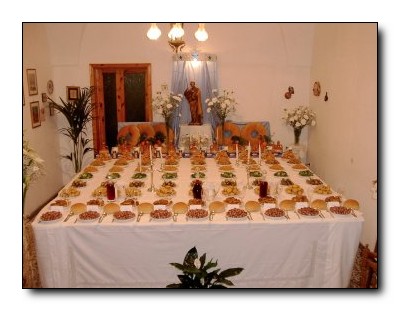
For my Italian brethren: Hope you had something good from the Tavola di San Giuseppe, paesani!
http://pugliamipiaci.files.wordpress.com/2009/03/tavole.jpg
Image credit

Tuesday, March 16, 2010

The "Celtic Thing"

from The Young Fogey:

It’s linked to the long-standing English tendency to use the ‘Celtic fringe’ as sort of foil or mirror for their own society, sentimentalising or demonising it in the process. In the 19th century the supposedly poor, lazy Celts were the antithesis of modern industrial England. Now the supposedly spiritual, nature-loving Celts are the antithesis of modern, industrial England. What’s changed is how the English perceive themselves.

Call me an old cynic if you like, but I suspect that quite a lot of our modern ‘Celtic stuff’ would be dismissed as sentimental rubbish or dangerous syncretism if we were to preach it to a congregation of 5th-century Christians.

And as Serge is quick to remind us: "St. Patrick actually prayed in Latin." Which would be perfectly proper, given the fact that he was a ROMANIZED Briton. Patrick is actually a perfectly good Latin name. It was the name of St. Augustine's father: Patricius

Friday, March 12, 2010

A Sweet Invitation

http://www.religionfacts.com/jesus/images/christ-mosaic-hagiasophia.jpg
Image Credit

After exhorting his monastic charges to "listen" and "arise" from spiritual slumber, St. Benedict continues along the same train of thought to include a solemn invitation to holiness in the form of a kind of scriptural "dialogue." The Lord seeks his workmen and, crying out, poses the quintessential question in this section of the prologue (14-19): "What man is there that desires life, and deign to see good days?" (Psalm 43:12) Quoting the Psalmist, he poses the question that is at the center of all Christian experience: the longing for life, and the desire for good days, i.e. eternal life. This is no mere rhetorical question, but is one that is posed to every monk, every priest, every lay Christian laboring int he world-the housewife, the father, the schoolboy and schoolgirl.

The monk, responding to the voice like a soldier responds to the call of his commanding officer, hails "I am the one.!" St. Benedict expects his monks respond to this call without a moment's hesitation.

St. Benedict responds to this summons, this invitation, with another scriptural quote: "If you desire true and eternal life (veram et perpetuam vitam), keep your tongue from evil, and your lips from speaking deceit. Turn aside from evil and do good, seek peace and pursue it." (Psalm 34: 13-14) The answer to the summons is one of directness, drawn again from Scripture, from the same Psalm, exhorting us to seek this eternal life by turning aside from evil, like a Roman legionary who, upon taking the oath, the sacramentum, turned away from civilian life and devoted himself completely to the "Senate and People of Rome." Likewise, St. Benedict's monks were to turn from the world, and live a life of total dedication to God in such a way that their tongues, and their lips, were no longer their own, but God's.

"And when you have done these things, my eyes will be upon you and my ears towards your supplications; and before you call upon me I will say to you: Behold, I am here." (18; Isaiah 58:9) The rhythm of dialogue, scripture, and response come to a close in this prophetic passage, where our Lord promises his people his eagerness to hear their prayers. In this context it serves as a promise, a covenant, that the total consecration of life, of speech, will bring us into the very presence of God, holding out the hope of an intimate encounter with God where He, before we even utter a word, says to us "I am here, my son."

This section ends in verse 19, where St. Benedict culminates this dynamic scriptural dialogue with an almost ecstatic affirmation of God's loving graciousness: "What can be sweeter to us (dulcius nobis) than the voice of the Lord inviting us, dearest brothers? Behold, in his loving kindness the Lord shows us the way of life."

The prayer of St. Ephrem the Syrian:
O Lord and Master of my life,
Drive away from me the spirit of despondency, negligence, avarice, and idle talk.
But grant unto me, thy servant, the spirit of chastity, obedience, patience and love.
O Lord and King, grant me to see mine own transgressions, and not to judge my brother.
For blessed art thou unto the ages of ages, amen.

Monday, March 01, 2010

On the Origins of the Church's Feast of Feasts

By Dr. William Tighe

For all Christians today who observe a “liturgical year,” the high point of that year is the annual commemoration of Christ’s passion, death, and resurrection at the end of Holy Week. Good Friday recalls to the faithful the Lord’s suffering and death, and in most Christian traditions is a day of ascetical practices, particularly fasting. Holy Saturday commemorates his entombment and descent to hell, and thus is also a day of asceticism. Easter Sunday, by contrast, is the joyous celebration of his resurrection, and of the resurrection of mankind in him.

Despite these discrete “episodes,” however, most Christian churches or denominational traditions have not completely lost track of the ancient sense that what we commemorate in the course of these three days is a process rather than separate events: the Lord’s “passing over” from life through death to new and eternal life, as both a realization and a promise to those who, by faith and baptism, have been incorporated into Christ. How and when the Church came to observe this annual “feast of feasts” has long been a matter of dispute, and in recent decades the areas of disagreement have grown greater—or at least a longstanding scholarly consensus has been strongly challenged.

“Easter” is, of course, an English word, and one lacking the multivalence of the more widespread term “Pascha.” This term, which has different forms in different languages, derives ultimately from the Hebrew Pesach, or “Passover,” and thus can mean both “Easter” specifically and more generally the “triduum” of Good Friday, Holy Saturday, and Easter Sunday.

Read the rest here


Tuesday, February 23, 2010

Exsurgamus!

http://home.comcast.net/~DiazStudents/MiddleAgesChurchMonksIlluminatedManuscript1.jpg
Image credit

Exsurgamus ergo tandem aliquando, excitante nos scriptura ac dicente: Hora est enim de somno surgere, et apertis oculis nostris ad deificum lumen, attonitis auribus audiamus divina cotidie clamans quid admonet vox, dicens: Hodie si vocem eius audieritis, nolite obdurare corda vestra. Et iterum: qui habet aures audiendi audiat quid spiritus dicat ecclesiis.Et quid dicit? Venite, filii, audite me; timorem Domini docebo vos. Currite dum lumen vitae habetis, ne tenebrae mortis vos comprehendant. (Let us therefore arise at last, since the Scripture arouses us, saying "The hour is come for us to arise from sleep." Let us open our eyes to the deifying light, attune that we may hear the divine voice daily crying out "Today if you will hear his voice, harden not your hearts." And again: "He who has ears to hear let him hear what the Spirit says to the churches." And what does he say? "Come, my sons, and listen to me, and I will teach you the fear of the Lord." Run, while you have the light of life, lest the darkness of death overtake you.)

This part of the prologue forms an organic union with the first exhortation to "listen." This is the part of the rule that moves us to action. Listening with the aurem cordis, the ear of our hearts, where we listen to divine realities most directly with fear and love of God, leads us to arise from the sleep of ignorance, from the stupor of forgetfulness, and be attentive to the voice that comes to us in the silence of our hearts and tells us "harden not your heart". It is the call to wake up, to remember that our time on this earth is short, so therefore "run" to the "deifying light" that seeks to exalt us from the darkness of death.

http://www.restoredtraditions.com/images/products/detail/dyck_sir_antony_van_portrait_of_benedictine_holding_skull.jpg
Image credit

The "darkness of death" is the last word in this part of the exhortation, but it is not ultimately the "last word." It is, rather, a memento mortis which St. Benedict adds in order to add force to the command to rise from sleep. Antony van Dyck's painting of a Benedictine monk pointing to a skull communicates our common human destiny. "Dust thou art, and to dust shalt thou return." And yet, it is not really the last word. Echoing Evelyn Waugh in the last scene of Brideshead Revisited, "it is not even an apt word," for the remembrance of death is not an end in itself, but a reminder to look to the "deifying light", that light that descends to us from within the life of Holy Trinity, giving us the promise of lifting us up to the divine life. Our need to listen, then to rise, from sleep is not merely to remember that we must die, but that we must rise from concern for worldly power and from the illusions that beset us, and to wake up to that which is more real, true and alive than we are.

Listening, then, involves action, action that is geared towards making our hearts more open to the life-giving words of Christ. For St. Benedict, the relationship between abbot and monk is one where the one receiving the instruction-the monk-is the one who actively hears the instructions of the master, the abbot, who stands as an image of Christ. Behind the abbot stands Christ, and the charge to every monk is to listen to, and obey, the abbot as one would obey Christ. One is immediately brought to St. Paul's exhortation in Colossians 3:22: "Slaves, obey your masters according to the flesh, not with eye-service, as men pleasers, but in singleness of heart, fearing God..." The abbot-monk relationship is predicated on this principle, and the reason St. Benedict ties the two themes together, i.e. "listen" and "arise," is to impress on his monks the necessary rhythm of listening and obedience. The center of rhythmic relationship is the heart, for it is the "ear of the heart" that receives the instructions of Christ through the abbot, as it is then fired to arise out of its spiritual slumber to "hear the Spirit." Obedience is predicated here on that tension between fear and love that St. Benedict establishes in the beginning of the prologue. We listen not only with our ears, but with our hearts, and obey the commands of "a loving father." The voice of our loving Father bids us, with that mixture of love and authority, to arise from spiritual slumber in order to attune ourselves, our hearts, to his instructions, and it is his Spirit that empowers us in Christ to the task of the opus Dei, the work of God. Knowing that we have such a short time, let us arise!

Exsurgamus!

Tuesday, February 16, 2010

Obsculta!

http://www.christian-meditation.com.ua/gallery/albums/userpics/10001/St._Benedict_delivering_his_rule_to_the_monks_of_his_order.jpg
Image Credit

Obsculta, o filii, praecepta magistri, et inclina aurem cordis tuis et admonitionem pii patris libenter excipe et efficaciter comple; ut ad eum per obedientiae laborem redeas, a quo per inobedientiae desidiam recesseras. (Listen, my son, to the precepts of the Master, and incline the ear of your heart, and willingly receive and faithfully fulfill the admonition of your loving father; that you may return by the labor of obedience to him from whom, through laziness and disobedience, you had departed.)-Prologue to the Rule of St. Benedict

"Listen!" This is the first word of the Rule, the word St. Benedict uses to awaken the heart from spiritual lethargy. He appeals, not to our physical ears, but to the aurem cordis truis, to the ears of our heart, for it is there that the truths of God are communicated directly to the soul. Benedict quotes liberally from the opening of the book of Proverbs, as the king enjoins his son to listen to the precepts of his loving father, as he presents him with two paths, the one that leads to wisdom and life, and the other to folly and death. It is also reminiscent of St. Basil's Admonition to a Spiritual Son, bringing to his audience both the lessons of Scripture and the teachings of the monastic fathers. (Fr. Adalbert de Vogue, Reading St. Benedict, p. 23) In this, the spiritual relationship that exists between abbot and community is established, and the call to obedience as the path to God illuminates the need to the novice's first duty: to listen with the ears of his heart.

The call to listen with the ears of the heart is a call to do more than just hear words, but to bring those words down to the heart. This is the real meaning of reciting something "by heart": going beyond mere memorizing of words to a meditation of their meaning, and thereby hearing God's message to the human heart. It is a process where the words we hear become a part of us, as food becomes part of the body as it is consumed through the digestive track.

St. Benedict, following the Rule of the Master, links this listening with the ears of the heart to the "labor of obedience". What is the relationship between hearing with the ears of the heart and the call to obedience? Fr. Adalhbert de Vogue offers a clue: "Like Basil and the inspired scribes of the Book of Proverbs, Benedict experiences himself as a 'father' as well as a 'master' (magister). He shares these two qualities with God, who speaks though him. At the end of the passage we will meet God the 'father' and 'Lord' (dominus) once more, but kindness will have given way to wrath. Entrance into monastic life thus stands between a loving call and a fearsome judgment." (de Vogue, p. 23) It is in that nexus between love and fear that Benedict will have his novices stand as he enjoins them to "listen." Listening comes from an attitude of love, as we relate to God as Father, and also from a place of fear, as we relate to God as the righteous judge. Listening to the voice of God, then, comes from this crucible of love and fear. The fear, of course, is not a fear rooted in despair, but a fear that, according to Proverbs, is the beginning of wisdom. St. Maximus the Confessor demonstrates the close connection between these two seemingly opposite attitudes by using ladder imagery: "If you have faith in the Lord you will fear punishment, and this fear will lead you to control the passions. Once you control the passions you will accept affliction patiently, and through such acceptance you will acquire hope in God. Hope in God separates the intellect from every worldly attachment, and when the intellect is detached in this way it will acquire love for God." (St. Maximus the Confessor, "Four-Hundred Texts on Love", Philokalia, p. 53) In the same way, fear of God causes us to listen for fear of punishment, which leads to self-control, ultimately leading us to hope in God, and then love of God. We listen to God as we not only fear him, but also love him.

It is this crucible between fear and love that St. Benedict wants to situate the novice, for it is there that the heart becomes refined in listening to his spiritual father, as he relates the life-giving words the the Heavenly Father. Obedience comes as a result of listening, and listening comes from a heart that is refined by the fear and love of God. Listening is the first command, the first rule; all that follows in St. Benedict's rule is predicated on this one word: Obsculta!

Thursday, February 11, 2010

Reditus

Sorry for the long absence. A full teaching load, plus editing my dissertation for the third time, have kept me from blogging regularly. My meeting with my main reader has assured me that the dissertation needs just a little more finessing, especially the introduction, which is quite do-able. That, and taking care of the typos, will make it ready for defense. New date for final submission: March 15.

This leaves me with quite a bit of time for blogging, since the revisions are not very rigorous. During Lent, I will be posting my own musings on the Rule of St. Benedict as they touch everyday life. The Benedictine motto Ora et labora (pray and work) will be the focus of much of what I write, as I seek ways of consecrating all of life to Christ, in my prayer, and my work. I hope you will derive some benefit from it. If you do, dear Christian soul, praise God, and not my strength and powers for it. All errors are entirely my own. Pray for me, a sinner!

Wednesday, January 06, 2010

Calling all Anglo-Catholics...

http://www.northernbishop.com/IMAGES/weston02.jpg
Image credit

It's been a good run, chaps, but now it's time to get serious about being Catholic.

This way to Rome

This way to Antioch

What to bring with you: The Prayer Book (as printed by Lancelot Andrewes Press, which is the best Prayer Book for Catholic use out there), the Coverdale Psalter, and the great tradition of hymnody, chant and anthems ever sung in the English language.

What to leave behind: Latitudinarian moralism and Katherine Jefferts-Schori.

Come, dear friends! We're waiting for you!

Friday, December 04, 2009

Contra Khomiakov

http://energeticprocession.files.wordpress.com/2009/12/khomiakov.jpg

It has often been taken for granted among some popOrthodox apologists that Khomiakov's notion of Sobornost is the normative rule in Orthodox ecclesiology. Not so, say various Orthodox theologians.

Read about it here, and do read the discussion that follows.

Father Hunwicke on Waspish Respectability and Hatred of the Sacrament of Confession

The sexual drive is certainly very, VERY strong. That's why The Rev. Nathaniel Woodard, founder of Lancing College in Sussex, insisted his boys go to confession...to the loathing of the Victorian gentlemen of his day!!!

Read the article here.

Monday, November 23, 2009

Is America Ungovernable?

From The Distributist Review

Otto von Bismark, the 19th century Iron Chancellor and architect of modern Germany, once remarked that “If you like law and sausages, you shouldn't watch either being made.” One could observe that this is not quite correct; the process of stuffing offal into sausage skins is far less disgusting than that of stuffing bribes into legislators. Still, statute law will always be a matter of negotiations between those who have an interest in the bill at issue. Thus it has always been, and thus it will always be. In itself, this is not too bad; everybody should have a voice in drafting legislation, and compromise, while cumbersome, is likely to be better on the whole.

Democracy is supposed to solve the problem by giving everyone a voice in the process. And this would certainly be true, if we were speaking of a local assembly. But in a nation of 300 million plus, it can't be true; the very size limits the number of voices that can be heard. Hence, a “place at the table” becomes a scarce commodity, and like all scarce commodities it has a market price, a price that prices the public out of the process; as the nation grows, the size of the legislative “table” shrinks; there aren't enough places to go around, and the form of democracy is easily converted into the substance of oligarchy. But even at the local level, government must be guided by some notion of the common good, even when the parties are seeking their own interests. But as the cost of participation rises, this becomes less possible.


Read the rest here

The Great Depression of the Fourteenth Century

http://upload.wikimedia.org/wikipedia/commons/c/c9/Pieter_Bruegel_the_Elder-_The_Triumph_of_Death_-_detail_2.JPG
Pieter Bruegel the Elder, The Triumph of Death, 1562

An article by Murray Rothbard, excerpted from An Austrian Perspective on the History of Economic Thought, vol. 1, Economic Thought Before Adam Smith

in The Ludwig von Mises Institute Blog

The successful battle to establish the fact of the great decline has done little, however, to establish the cause or causes of this debacle. Focus on the devastation caused by outbreaks of the Black Death in the mid-14th century is partially correct, but superficial, for these outbreaks were themselves partly caused by an economic breakdown and fall in living standards which began earlier in the century. The causes of the great depression of western Europe can be summed up in one stark phrase: the newly imposed domination of the State. During the medieval synthesis of the High Middle Ages there was a balance between the power of Church and State, with the Church slightly more powerful. In the 14th century that balance was broken, and the nation-state came to hold sway, breaking the power of the Church, taxing, regulating, controlling and wreaking devastation through virtually continuous war for over a century (the Hundred Years' War, from 1337 to 1453).

SNL on U.S. Debt to China

The writers of Saturday Night Live must be listening to Peter Schiff.

From LRC

This must be the most substantive and the most anti-government sketch in the show’s history.

Tuesday, September 29, 2009

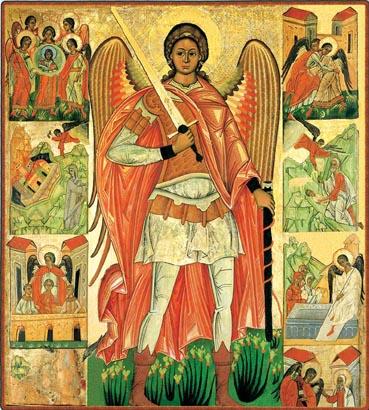
St. Michael and All Angels

http://orthodoxwiki.org/images/0/02/Michael_Icon.jpg

Who is like God?

Icon of spiritual warfare, patron of the chivalric orders, patron saint of paratroopers, fighter pilots and police officers...ora pro nobis!

Monday, September 28, 2009

Do School Vouchers Pass the Anarcho-Libertarian Test?

Read article here

From The Young Fogey: The slippery slope here is the lesson of Notre Dame and other formerly RC colleges which have ‘taken the soup’ (assimilated; sold out to the larger culture): once you hand over control from the bishop to the state to get subsidies (long a goal of the RC schools, still under the bishops... founded to get away from the state and its de facto Protestantism), the state calls the shots on the content. Then there’s the problem nothing to do with the state of the clergy slinking off and joining the enemy.

Monday, September 07, 2009

Episcopacy and Reformation

From Energetic Procession:

First they revered the Episcopate, longed to retain it, and when they found they had lost the Apostolic Succesison, sought earnestly to recover it. It is well known how Luther and Melancthon believed in Episcopacy. Their confession of faith [Augs. pt. 1, art. 22], speaking of bishops, says: ‘The Churches ought necessarily and jure divino to obey them.’ Melancthon wrote : ‘I would to God it lay in me to restore the government of bishops. For I see what manner of Church we shall have, the ecclesiastical polity being dissolved.’ Beza protested [in his treatise against Saravia] : ‘If there be any (which you shall hardly persuade me to believe) who reject the whole order of Episcopacy, God forbid that any man of sound mind should assent to the madness of such men.’ Calvin, in his commentay on Titus (I.5), admits that there was no such thing as ‘the parity of ministry.’ Again he says: ‘If the bishops so hold their dignity, that they refuse not to submit to Christ, no anathama is too great for those who do not regard such a hierarchy with reverence and the most implicity obedience.’

Read the rest here.

Thursday, August 13, 2009

The Case for Early Marriage

Bottom line: Biology is telling our young people to get married soon. Society, with its senseless expectation that everyone needs to go to college, is telling them to wait. Add to that the big corporate-inspired mobility that moves families around from place to place, forcing us to reduce the definition of the family as the "nuclear family" (sanz aunts, uncles and cousins) and you have a culture where young couples are estranged from the support of a larger family unit. The answer so far: Preach abstinence. Make virginity pledges. Have chastity balls. Push courtship.

All fine and good, but we still have the central problem: we expect these young people to wait ten, maybe fifteen years, before they can fulfill nature's call for them to marry. The answer? How about early marriage? Does everyone indeed need to go to college? Why not have apprenticeship programs that allow young people to start work and be productive as soon as possible (say, at 18 or 19)?

Maybe the economic slowdown, with peak oil and rising fuel prices, can be good for us, forcing us to live closer to our extended relatives, and providing the support needed for early marriage. If they are not called to a life of celibacy, then we should encourage some of our young people to marry soon, and facilitate, rather than get in the way of, their marriage with unrealistic expectations. That means making it possible for them to make a living that can sustain family life at a much earlier age. This will take the support of family (which will include grandma and grandpa, aunties and uncles, and a plethora of cousins, all living close by), church and community. The question is: Can, and will, our culture make such a transition?

Yes, it will mean early maturity, rather than extended adolescence.

Read the article here

Hat tip: The Young Fogey

Postscript: What might actually mitigate against early marriage is no-fault divorce.

Obamacare: A Distributist Perspective

Can a distributist support HR 3200?

Healthcare and subsidiarity: Local solutions are better.

Donald Goodman at The Distributist Review looks at the pros and cons of the proposed bill.

Are local systems possible? Certainly. The first hospitals in the Western world, of course, were Catholic hospitals, and they treated the poor---and everyone else---for free. In other words, they were operated on a purely charitable basis, generally by religious, who didn't expect payment for their work because they were doing it for the glory of God, not for their own pocketbooks.

Read article here

Wednesday, August 12, 2009

Tomas Luis de Victoria's Salve Regina

#t=502


Image credit


In honor of our Most Holy, Most Pure, Immaculate Lady Mother of God and Blessed Virgin Mary, the Birth-Giver of our God!

Tuesday, August 11, 2009

YouTube - Byzantine Chant "Agni Parthene" - Sung by Nana Peradze

YouTube - Byzantine Chant "Agni Parthene" - Sung by Nana Peradze

Eunice Shriver, Requiescat in Pace!


She has been hailed as the "Pro-Life Kennedy." Her work in establishing the Special Olympics, which transformed "America's view of the Mentally Disabled from institutionalized patients to friends, neighbors and athletes"-in short, full human beings, made in the image of God just like the rest of us-is a resounding testament to her conviction that all human life is sacred and must not only be protected, but celebrated.

May God receive her in His Kingdom, where the faces of the saints shine with the everlasting glory of Him who trampled down death by death.

+Memory Eternal! +Memory Eternal! +May her memory be eternal!

Monday, August 10, 2009

Caritas in Veritate: A Mixed Blessing

Or: "There is no such thing as Catholic (or Orthodox) economics, any more than there is any such thing as Catholic (or Orthodox) physics"-The Young Fogey (parenthetical addition mine)

The recent papal encyclical, I think, is sound. It all depends on how one interprets "society." If by "society" we mean "government," then I must voice my most vehement disagreement. The equation of "society" with "government" is a faulty one, since governments are formed by societies for the peace and well-ordering of citizens, allowing them to engage in their business lawfully and peacefully. Government is a product of society, and not the other way around.

If by "society" we mean the three pillars of civilization-family, faith and community-then I think the encyclical is right on, and could be a boon to the Distributist movement.

Read the whole article here, from The Distributist Review

Thursday, July 30, 2009

Fires of Faith: Review of Eamon Duffy's New Book

From Tea at Trainon

Eamon Duffy, author of Stripping of the Altars, offers his alternative interpretation on the reign of Queen Mary Tudor, in contrast to the received "wisdom" of Whig historiography.

Read it here.

Bocaccio's Jew


Image credit

This story from Giovanni Bocaccio's Decameron reminded me of a rhetorical question put by a non-Orthodox blogger in reference to the financial shenanigans going on in the Antiochian Orthodox Archdiocese: "Why would anyone want to join a church like this?"

In the story, the Jew on pilgrimmage to Rome sees the corrutption in the papal court, in all of its unmasked unpleasantness, adn decides to become a Catholic anyway.

Why?

Read about it here, in Leon Podles' blog.

Just substitute the Antiochian Archdiocese, and the answer to the blogger's question becomes clear.

Biretta tip to Arturo Vasquez

Monday, July 27, 2009

The Immorality of Taxpayer-Funded Abortion

Dr. Ron Paul talks about life, liberty, and the pursuit of healthcare. Some gems:

The most basic function of government is to protect life. It is unconscionable that government would enable the taking of it. However this is to be expected when government oversteps its constitutional bounds instead of protecting rights. When government supercedes this very limited role, it cannot help but advance the moral agenda of whoever is in power at the time, at the expense of the rights of others.

Free people should be left alone to follow their conscience and determine their own lifestyle as long as they do not interfere with other people doing the same. If morality is dictated by government, morality will change with every election. Even if you agree with the morality of the current politicians and think their ideas should be advanced, someday different people will inherit that power and use it for their own agendas. The wisdom of the constitution is that it keeps government out of these issues altogether.

From Lew Rockwell

Hat tip: The Young Fogey

Romulus, Remus, Stimulus: A Brief history of Monetary Madness


Image credit

Bill Bonner gives an historical account of how stimulus has never, EVER, produced any real prosperity.

From Lew Rockwell

Sunday, July 26, 2009

The Alternative Right

by Kevin DeAnna

In my view, the graying boomers who run and staff the current “conservative movement” probably represent the last generation of the Right that can justifiably call itself conservative. The constitutional and laissez-faire republic is long gone, a victim of the world wars, hot and cold. And the traditional Protestant and upright culture that once characterized American society as a whole, as well as the United States’ identity as a Western nation-state, won’t last much longer if present trends continue.

More than that, at a core level, we should ask ourselves seriously, What is there going to be worth conserving in the America of the next generation?
I’ve often thought that we got here because the conservative movement’s fetish about “the state” and the size of government fatally compromised its ability to challenge the left-wing ruling class. Who is a more important question than what, and a political movement that has as its chief concern what level of bureaucracy should handle policy can not accomplish anything important.

In contrast, Daniel McCarthy has argued, in the September 2008 issue of New Guard, that there is an anti-state Right and a national Right concerned about American identity, virtue, and culture. He points out the stupidity of trying to protect American through the government since, “[t]he state is the indispensable means by which the Left carries out its transformation of the country, and government in 21st century America cannot be turned into an instrument of virtue or nationhood.” I’d first counter that there hasn’t been much of a “national Right” in this country to begin with; those “conservatives” most interested in using the state for their ends have been social gospel types, who are as equally invested as the Left and the neocons in the idea of America as a “universal” nation.

But in the end, this debate actually doesn’t matter much—conservatives lost the battle against the state and the Left. Progress is not possible on either front without dismantling the current managerial regime.

Reas the rest in Taki's Magazine

Friday, July 24, 2009

Jobs of Our Own: A New book on Distributism

From The Distributist Review:

A history of distributism is often a short history of a few distributists: Belloc, Chesterton(s), and perhaps a McNabb, a Penty, and other assorted English scribblers. Between the failure of Ditchling and the trauma of World War II, the general impression is that distributism has never actually happened in real life.

Wrong. Mathews shows exactly how distributism has happened and is happening, right in the midst of the real economy.

Read the book review here.

Thursday, July 23, 2009

Paving the Road to Hell

To reiterate Serge's matter-of-fact observation, many religious folk don't understand economics.

Rather than a job at a market rate how about no job at all or more people on the dole (the money for which comes from...)? The usual suspects seem to be out in force for this: Modernist RCs (whose average age is at least 60ish by now), self-hating Jews (Jews historically act economically conservative, which is why they made it big time, but vote left) and most of all (as Chris Johnson says) the National Council of Churches People Don’t Go to Any More.

This makes me wish the works of the Salamanca Theologians were required reading in all major seminaries, especially their reflections on economics.

Another biretta tip to The young Fogey

The Other Modern


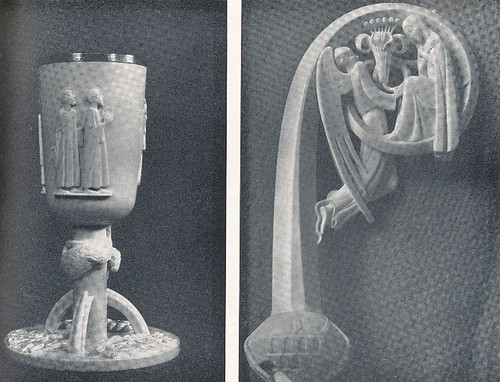
A crozier for an English abbess and a chalice, both executed in ivory by Fernand Py and featured in Liturgical Arts Quarterly. Image Credit


Innovative approaches to design that nonetheless fell within the bounds of tradition, and sought to expand them in new directions rather than simply forsaking them.

Read article here

From New Liturgical Movement (Novus Motus Liturgicus)

Biretta Tip: The Young Fogey

Tuesday, July 21, 2009

St. Cyril on Divine Simplicity


An interesting discussion by the good fellows at Energetic Procession on St. Cyril's view of "divine operations". Are these to be viewed as "divine energies"? Who's closer to Cyril-Thomas Aquinas or Gregory Palamas?

Read the article, and read the discussion taking place there.

Heresy vs. Hope

Dr. Peter Bouteneff of St. Vladimir Orthodox Theological Seminary compares and contrasts the Orthodox Church of Greece's "Confession of Faith Against Ecumenism" (given by a quarter of the Church of Greece, but endorsed by many bishops, metropolitans and monks) and Archbishop Athanasios of Albania's address to the Conference of European Churches.

Listen to it here.

Read discussion here.

Biretta tip: Eirenikon

Two By Congressman Paul


Image credit


Update on Congressman Paul's attempt to get a bill passed that would require auditing the Federal Reserve-Tomorrow Dr. Paul will grill Bernake.

Article: Healthcare is a Good, not a Right

Political philosopher Richard Weaver famously and correctly stated that ideas have consequences. Take for example ideas about rights versus goods. Natural law states that people have rights to life, liberty and the pursuit of happiness. A good is something you work for and earn. It might be a need, like food, but more “goods” seem to be becoming “rights” in our culture, and this has troubling consequences. It might seem harmless enough to decide that people have a right to things like education, employment, housing or healthcare. But if we look a little further into the consequences, we can see that the workings of the community and economy are thrown wildly off balance when people accept those ideas.

First of all, other people must pay for things like healthcare. Those people have bills to pay and families to support, just as you do. If there is a “right” to healthcare, you must force the providers of those goods, or others, to serve you.

Obviously, if healthcare providers were suddenly considered outright slaves to healthcare consumers, our medical schools would quickly empty. As the government continues to convince us that healthcare is a right instead of a good, it also very generously agrees to step in as middle man. Politicians can be very good at making it sound as if healthcare will be free for everybody. Nothing could be further from the truth. The administration doesn’t want you to think too much about how hospitals will be funded, or how you will somehow get something for nothing in the healthcare arena. We are asked to just trust the politicians. Somehow it will all work out. Universal Healthcare never quite works out the way the people are led to believe before implementing it. Citizens in countries with nationalized healthcare never would have accepted this system had they known upfront about the rationing of care and the long lines.

Read the rest here

Thursday, July 16, 2009

Remember the First Victims of the Bolshevik Revolution

[untitled.bmp]

The Royal PAssion-Bearers, The Right Victorious Nicholas, Emperor of All the Russias, The Empress, the Right Victorious Alexandra, and the Royal PRinces: Tsarevich Alexei, the Princesses Maria, Olga, Tatiana and Anastasia: Orate pro nobis!


From The Young Fogey:

Lovely people, but an incompetent emperor, not particularly bright, getting the country mired in an immoral war, World War I, owing to nationalism and misplaced loyalties, causing (as Rasputin predicted) his own downfall - and death. The war destroyed so much of Catholic Europe, east (in this case) and west (the soon-to-be beatified Emperor Charles of Austria-Hungary abdicated and his empire was carved up). Besides a basic monarchist inclination - a sacramentally crowned king is profoundly Catholic - what turned me in favour of the Russian royals was reading Robert Massie's Nicholas and Alexandra back in 1996. This American historian (writing about 40 years ago) with no bias either way (royalist or Communist) convinced me that personally they are saints. (As for politics, saints are fallible in their prudential judgement.) In a society littered with loveless dynastic marriages (like the late Diana in recent years) the tsar was a country gentleman who truly loved his wife.

This is something I'm asked often: If the Emperor Nicholas was such a saint, why was he an incompetent ruler? My answer: Who says saints have to be competent rulers? He did the best he could under the circumstances, but made some mistaken judgments. saints are fallible, after all. What makes a saint a saint is humility, and a thorough recognition of his own weakness and his need for God.

A film produced recently in Russia brings this out very well. Here's a clip:

http://www.youtube.com/watch?v=gw5AJ43NJoY&feature=related

Warning: The scene where they are murdered in the end is quite graphic, and the Tsarevich Alexei covering his eyes is heart-wrenching. You have been warned!

Wednesday, July 15, 2009

Crimes Against Humanity 1794

[Vendée-Position.png]

Genocide in the Vendée at the height of the Reign of Terror.

As The Young Fogey reminds us, "modern liberalism was barbaric to begin with."

Warning: If you have a weak stomach, just read the first half. But if you have a passion for truth...

Le Fleur de Lys Too

Hat tip to Tea at Trianon and The Young Fogey

On the Abuse of Ecclesiastical Power

paul-iv-1-sized
By Arturo Vasquez

Or: Things that happen when clergymen get too enthusiastic
Pope Paul IV when he was a cardinal was in charge of the Roman Inquisition: one of his first acts as a pope was to increase the powers of this institution and the penalties associated with heresy: even some cardinals were charged with heresy and Cardinal Morone was imprisoned in Castel Sant’Angelo as a hidden Lutheran. The pope imposed on the Romans a very austere lifestyle, but allowed his nephew Carlo Carafa to profit from his position to enrich himself and, according to widespread rumours, to behave badly from a moral viewpoint. He forced the Jews of the Papal State to live in two ghettos in Rome and Ancona: he built walls around an area of Rione Sant’Angelo which was subject to floods: the Jews were not allowed to live elsewhere and during the day had to go about wearing a distinctive sign… Pope Paul IV died in August 1559: the Romans reacted to the news by setting fire to the Inquisition palace and by destroying all the coats of arms of the pope: his statue in Campidoglio was beheaded and the head was rolled down the cordonata.
Source

Nisi Dominus aedificaverit domum... Psalm 126 (127): 1

Read the rest of the article here.

Giraldi says "Hands off Honduras" to both Left and Right

From Ron Paul's Campaign for Liberty

This column is from a few days ago, but it is a continuing situation. Libs and neocons have taken sides, but no consideration has been entertained about what the Honduran people actually want.

It is perhaps predictable that the unrest in Honduras is being seized upon by the usual suspects in an attempt to exploit the situation to draw conclusions that are completely unwarranted by what is taking place. Neocons are hailing the removal of a "leftist" president while liberals are shouting "coup." In an attempt to determine what Hondurans think, I have recently had the opportunity to speak to a number of military officers, students, civil servants, and businessmen. As many commentators have correctly noted, there is a sharp class divide in Honduras, with 70% of the population mired in poverty and a middle and upper class that is much better off and politically empowered to stay that way. The existence of extreme poverty with little hope for improvement in the majority of the population has been exploited by populists in Latin America through promises to bleed the rich and help the poor. Though the promises have rarely been kept, the ability to organize bloc voting by the poor has created a de facto monopoly of power for the leaders who have successfully sold themselves as being champions of the disenfranchised, leaders like Hugo Chavez of Venezuela and Evo Morales of Bolivia.

What is lacking in the media feeding frenzy is any deference to what the Hondurans themselves might want. Last month a crisis that had been building for nearly a year exploded. President Manuel Zelaya, a wealthy rancher elected as a center-leftist in 2006 but turned populist after entering into office, proposed a non-binding referendum that would have supported amending the country's constitution. Zelaya said that he was interested in changing the constitution to help the poor, though he did not propose any specific remedies. But according to most Hondurans, the particular part of the constitution that he was interested in obtaining a mandate for eventually amending was a non-amendable part that was designed to keep presidents like him from remaining in office beyond their constitutionally permitted terms. Article 239 of the Honduran Constitution reads in translation: "No citizen who has already served as head of the Executive Branch can be President or Vice-President. Whoever violates this law or proposes its reform, as well as those that support such violation directly or indirectly, will immediately cease in their functions and will be unable to hold any public office for a period of 10 years." A number of Latin American countries have such clauses in their constitutions to avoid the establishment of presidents-for-life, which have resulted in continuous one party rule. The US Constitution also has several permanent articles.

Read the rest of the article here.

Dr. Paul on Napolitano's Freedom Watch

The good doctor talks about his bill, introduced in Congress, to audit the Federeal Reserve, and the threats the Fed is making to the American people if this passes.

http://www.youtube.com/watch?v=ZLGWIrBZCvY

Audit the Fed, then phase out all our ties with it, and let it die. Back to the gold standard.

This is the time for all good men (and women) to come to the aid of their country!

From Ron Paul's Campaign for Liberty website

Tuesday, July 14, 2009

Caritas in Veritae

From The Distributist Review

Did you ever think you'd read an encyclical that advocated:
-energy efficiency, and the moral duty to reduce energy consumption
-consumer co-ops
-micro-finance
-large-scale redistribution of wealth on a world-wide scale
(this one reminds me of what Edmund Burke calls the real "Social Contract": "Society is indeed a contract. It is a partnership in all science; a partnership in all art; a partnership in every virtue, and in all perfection. As the ends of such a partnership cannot be obtained in many generations, it becomes a partnership not only between those who are living, but between those who are living, those who are dead, and those who are to be born.")
-intergenerational justice—in the context of environmental resources
-opening international markets, especially in agriculture

As Benedict shows, these ideas are merely consistent developments (or repetitions) of Catholic social teaching. But he is fearless in applying CST in today's arena.Nor does he hesitate to dig into our dirty details:

As Benedict shows, these ideas are merely consistent developments (or repetitions) of Catholic social teaching. But he is fearless in applying CST in today's arena.

Nor does he hesitate to dig into our dirty details:
-NGOs peddling contraceptives and involuntary sterilization to poor countries
-the decline in birth rates
-the hoarding of resources, especially water
-human embryos are sacrificed to research
-the poverty of isolation
-abusive tourism

-usury


Tribute to King Louis XVI


On this "Bastille Day," I offer prayers for the soul of King Louis XVI, King of France and Defender of American Liberty!

+May his soul, and that of his Queen, Marie Antoinette, Rest in Peace!

+May their Memories be Eternal!