Monday, May 31, 2010

Arturo Vasquez on Lady Gaga, David Mills, and Being Played by the Culture Wars

Arturo weighs in on David Mills' article:

To get straight to the point: I think that, in a way, Mills and Co. commit the same errors that they accuse Lady Gaga and Co. of committing. The real ground of all religion in the modern world is cosmological agnosticism. The “spiritual not religious” crowd pretends to know nothing of God so that they can do whatever they want. The “orthodox religious” crowd pretends to know God so well that they can employ him for any agenda that is in their interest, all under the pretension that it is not their will, but God‘s. In either case, God is a puppet; he is a Caspar the Friendly Ghost-character who fulfils their true desires and makes them feel good about themselves.

Again, my study of “folk” Catholicism is very illuminating in terms of the issues involved here. Mills’ God is primarily a moral being: one who maintains societal order for the benefit of decency. In the more common, simple Catholic mind, God’s intervention in daily life was far less moralistic. People had needs and wants, and God could either grant or deny the satisfaction of these. If you ask God or a saint for something, you should pay them back or suffer the consequences. And of course, if you need something morally ambiguous, there were saints and prayers for those things as well.

In other words, a Catholic peasant a hundred years ago would never say that he was “spiritual but not religious”, but that did not make him a foot solider in a culture war either. He employed officially approved methods of interaction with the Divine as well as things that were off the beaten path. Within the context of societal propriety, he picked and chose what he believed just as much as any modern person. The institution does not completely govern the soul of any individual. People have always taken what they need from it, and left aside those things that they don’t need. The idea of a mass militant populace of “well-catechized” Catholics is a peculiarly American one, probably passed down to us from the Irish. For further reading, one should consult such books as The Cheese and the Worms: The Cosmos of a Sixteenth Century Miller by Carlo Ginzburg to really find out the crazy things “average” Catholics believed.

Read the whole article here.

Saturday, May 29, 2010

"Spiritual but not religious"

Rod Dreher addresses the big scam of the 21st century: "Spiritual but not religious."

Quoting David Mills:
It's one of those easily remembered phrases that work like a "get out of jail free" card for anyone who feels he has to explain his lack of religious practice, and as a claim to superiority for those who care about being superior to those who practice an established religion. It's the religious equivalent of "I gave at the office" or "There's a call on the other line" or "I don't eat meat."

And so it goes..."materialism in a tuxedo."

Read the whole article here.

I would post a picture of "Lady Gaga", cited in the article as the latest porn-pop-princess giving this profound spiritual self-revelation, but I'm afraid doing so would put me in trouble with my Christian university's web censors, thus giving them the wrong impression.

Friday, May 07, 2010

More on Sterligov


Former Russian tycoon finds a better life, and in the process, finds a better way out of the global economic crisis: bartering, and the gold standard.

It's not all "Greek" to Ron Paul


It's a currency issue, as Ron Paul schools the masses.

Friday, April 30, 2010

The "Virtues" of the Internet: Think Again

Evgeny Morozov says:

They told us it would usher in a new era of freedom, political activism, and perpetual peace. They were wrong.

"Et in Arcadia ego." Sin and death follow all of our best endeavors.

Read article here.

Hat tip: The Young Fogey

Thursday, April 22, 2010

Presidentialising the Prime Minister


From Taki's Magazine

The PM’s job was long more human-scale job than the president’s, less insulated from normal life by security and by deference (which in Britain was paid instead to the Queen as head of state). For example, when I attended a conference with ex-PM Margaret Thatcher in 1999, she showed up accompanied only by a secretary and a bodyguard, wearing an old dress that had been mended with needle and thread. Tony Blair and his money-hungry wife Cheri were the first to indulge fully American superstaritis.

Read the entire article here.

Hat Tip: The Young Fogey

Monday, April 19, 2010

Russell Kirk's Wariness of Neoconservatives

From The Heritage Foundation

In their publications, the Neoconservatives thrust upon us a great deal of useful information, and obviously are posse ssed of considerable knowledge of the world about us. But in the understanding of the human condition and in the apprehension of the accumulated wisdom of our civilization, they are painfully deficient.

Infatuation with Ideology. An instance of this lack of wisdom is the Neoconservatives' infatuation with ideology. Some of you ladies and gentlemen present here today may have heard some years ago my exchange, on this very platform, with Mr. Irving Kristol, concerning ideology. He and various of his colleag u es wish to persuade us to adopt an ideology of our own to set against Marxist and other totalist ideologies. Ideology, I venture to remind you, is political fanaticism: at best it is the substitution of slogans for real political thought. Ideology animate s, in George Orwell's phrase, "the streamlined men who think in slogans and talk in bullets."


Read the entire article here.

Democracy and Universalism

Article by Fjordman, in The Brussels Journal: The Voice of Conservatism in Europe

Not only did Bush perceive his country to be a “democracy,” despite the fact that it was founded as a Constitutional Republic; he perceived it as being “universal.” Every person on planet Earth from whatever cultural background can move to the United States and become an equal citizen. The USA is thus a “universal” nation, and its universal democracy should be exported to all countries around the world. This version of “universalism” would have been profoundly alien to the ancient Greeks, yet has become a prominent feature of the post-Enlightenment West. “We no longer consider any human action legitimate, or even intelligible,” wrote the French late twentieth century philosopher Pierre Manent, “unless it can be shown to be subject to some universal rule of law, or to some universal ethical principle.”

Where does this notion come from?

And the concept's connection to the Scientific Revolution?

Read the whole article here.

Hat tip: American Monarchist

Sonoma County's War against Voluntary Association and Property Rights

Two elderly gay men are forcefully separated by the Sonoma County authorities, and their property is auctioned off. Read the story here.

I take a traditional, biblical view about what constitutes marriage: a man and a woman in a covenantal union blessed by almighty God. Homosexual relationships fall short of this, and are sinful.

That being said, this is no grounds for taking away anyone's property! This is a clear attack on property rights and free association.

Thursday, April 15, 2010

The Early Modern State, the Catholic Church, and the Sum of Disunities

This article by Arturo Vasquez reminds me of Nicholas Henshall's book, The Myth of Absolutism: Change and Continuity in Early Modern European Monarchy, especially this passage: Only in the fifteenth and sixteenth centuries were legal customs written down, and even then there was no attempt at uniformity. In the eighteenth century Voltaire remarked that a traveller changed laws as often as he changed horses. (p. 8)

Up until the nineteenth century, people paid homage and loyalty to their towns, communities, their families, their regions or states, their lords and their kings, but hardly ever to their "country." This was especially true in the U.S., where, up until the Civil War, when men spoke of their "country," they were making reference to their state, not to the federal union.

Arturo's reflections here are especially worth pondering:

Modernity in its highest phase thus equals the death of the local. Local accents die, local foods die, local tales are cast into the oblivion of anthropological scholarship. They either die, or they are assimilated into the “national whole”, just as foods and language are changed to “fit into” the ethos of the dominant culture. (American “Italian” or “Chinese” food for example.) This is not so much a “tragic” thing, as an inevitable thing. I am not one to be reactionary for reaction’s sake, nor “localist” just for the sake of romanticist provincialism. After all, every time honored tradition is at bottom an adaptation of something else that has its origin in a not so pristine past.

But neither should we overlook the dangers of this drive to unify everything. Especially in our deepest philosophical and theological beliefs, we cannot disregard the fact that we function under a daily regime where difference is to be stamped out in the name of societal harmony. Even in the most “postmodern”, politically correct acceptances of “diversity”, there is a subtext of totalizing liberalism: it’s okay to be diverse, as long as you are diverse “like us”.

How do these reflections apply to the state of the Catholic Church today? Read the rest here

I leave it to my fellow Orthodox readers to draw conclusions about some attitudes concerning Western Orthodoxy for themselves.

Crown Prince Alexander of Serbia's Easter Message


http://www.royalfamily.org/pictures/2011_1.jpg

Image credit

The great day of the Resurrection of Our Lord is upon us. The great day, that enlightened the world with joy and gave the purpose to our existence. The day above all days and the feast above all feasts. I am joined by my wife Crown Princess Katherine, sons Hereditary Prince Peter, Prince Philip and Prince Alexander in wishing that this Holy Day remind us that we are all God’s children and that the sacrifice of Jesus Christ is a call to find within ourselves what is good, for our sake and for the sake of general salvation.

We pray to the Lord to give us strength and wisdom to overcome all pain and trouble. We pray that we will work together for the benefit of Serbia and everyone in our country for today’s and future generations. We pray that during these days, when the global economic crisis and various natural and human-inflicted disasters caused by negligence are threatening countries and nations all over the world, that people who are elected to govern will have the wisdom, strength and responsibility to envisage and implement measures of recovery, peace and progress during these difficult times that are upon us and that eventually await us in the future.

We pray to Lord Resurrected to bless and save our devastated compatriots in Kosovo and Metohija, and everywhere in the world where there is suffering, pain, injustice and violence.

Let Easter resurrect in us the noblest virtues that will make us endure as nation and as people. These are qualities of love for our neighbours, justice for every wrong, peace for the troubled, strength for the weak, help for the poor and needy, and unity to enable us to live and work together.

The resurrection of Jesus offers us a message of hope, love, and grace. Once again my wife and sons join me to extend our warmest wishes, and we do so in the very same spirit of Easter.

Christ is Risen!

Indeed, He is Risen!

ALEXANDER II

Government Health Insurance and Catholic Social Doctrine

Richard Aleman of The Distributist Review asks a key question: Is it a coincidence that, while critiquing largesse government, none of the bishops of these nations have ever objected to socialized medicine, which according to conservatives conflicts with the doctrine of the Church?

Read the whole article here.

Wednesday, April 14, 2010

On the Dangers of Unchecked Federal Power

From Ludwig von Mises Institute Blog

Abel Parker Upshaw (1790-1844) critiques Justice Joseph Story's Commentaries on the constitution of the United States and its support for expanded federal power. The expansion of federal power on the part of the Neo-Conservatives and the Liberal left has all but wiped out subsidiarity today, and Upshaw's warnings give us a sense of how we got to this point.

It is too late for the people of these States to indulge themselves in these undiscriminating eulogies of their Constitution. We have, indeed, every reason to admire and to love it, and to place it far above every other system, in all the essentials of good government. Still, it is far from being perfect, and we should be careful not to suffer our admiration of what is undoubtedly good in it, to make us blind to what is as undoubtedly evil.

When we consider the difficulties under which the convention labored, the great variety of interests and opinions which it was necessary for them to reconcile, it is matter of surprise that they should have framed a government so little liable to objection. But the government which they framed is not that which our author has portrayed. Even upon the guarded principles for which I have contended in this review, the action of the whole system tends too strongly towards consolidation.

Much of this tendency, it is true, might be corrected by ordinary legislation; but, even then, there would remain in the federal government an aggregate of powers which nothing but an enlightened and ever-vigilant public opinion could confine within safe limits. But if our author's principles be correct, if ours be, indeed, a consolidated and not a federative system, I, at least, have no praises to bestow on it. Monarchy in form, open and acknowledged, is infinitely preferable to monarchy in disguise.

Read the entire article here


Friday, March 19, 2010

St. Joseph, the Foster-Father of the God-Man

http://www.stjosephwakefield.org/images/StJosephIcon.jpg
and the Blessed Virgin Mary's chaste spouse.

A faithful man shall abound with blessings, and he that waiteth on his Master shall be honoured.-Proverbs 28:20; 27:18, assigned for chapter reading for the first Vespers on the Feast of St. Joseph.

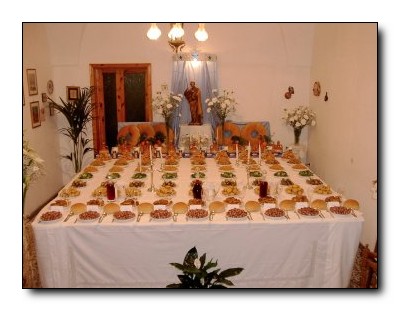
For my Italian brethren: Hope you had something good from the Tavola di San Giuseppe, paesani!
http://pugliamipiaci.files.wordpress.com/2009/03/tavole.jpg
Image credit

Tuesday, March 16, 2010

The "Celtic Thing"

from The Young Fogey:

It’s linked to the long-standing English tendency to use the ‘Celtic fringe’ as sort of foil or mirror for their own society, sentimentalising or demonising it in the process. In the 19th century the supposedly poor, lazy Celts were the antithesis of modern industrial England. Now the supposedly spiritual, nature-loving Celts are the antithesis of modern, industrial England. What’s changed is how the English perceive themselves.

Call me an old cynic if you like, but I suspect that quite a lot of our modern ‘Celtic stuff’ would be dismissed as sentimental rubbish or dangerous syncretism if we were to preach it to a congregation of 5th-century Christians.

And as Serge is quick to remind us: "St. Patrick actually prayed in Latin." Which would be perfectly proper, given the fact that he was a ROMANIZED Briton. Patrick is actually a perfectly good Latin name. It was the name of St. Augustine's father: Patricius

Friday, March 12, 2010

A Sweet Invitation

http://www.religionfacts.com/jesus/images/christ-mosaic-hagiasophia.jpg
Image Credit

After exhorting his monastic charges to "listen" and "arise" from spiritual slumber, St. Benedict continues along the same train of thought to include a solemn invitation to holiness in the form of a kind of scriptural "dialogue." The Lord seeks his workmen and, crying out, poses the quintessential question in this section of the prologue (14-19): "What man is there that desires life, and deign to see good days?" (Psalm 43:12) Quoting the Psalmist, he poses the question that is at the center of all Christian experience: the longing for life, and the desire for good days, i.e. eternal life. This is no mere rhetorical question, but is one that is posed to every monk, every priest, every lay Christian laboring int he world-the housewife, the father, the schoolboy and schoolgirl.

The monk, responding to the voice like a soldier responds to the call of his commanding officer, hails "I am the one.!" St. Benedict expects his monks respond to this call without a moment's hesitation.

St. Benedict responds to this summons, this invitation, with another scriptural quote: "If you desire true and eternal life (veram et perpetuam vitam), keep your tongue from evil, and your lips from speaking deceit. Turn aside from evil and do good, seek peace and pursue it." (Psalm 34: 13-14) The answer to the summons is one of directness, drawn again from Scripture, from the same Psalm, exhorting us to seek this eternal life by turning aside from evil, like a Roman legionary who, upon taking the oath, the sacramentum, turned away from civilian life and devoted himself completely to the "Senate and People of Rome." Likewise, St. Benedict's monks were to turn from the world, and live a life of total dedication to God in such a way that their tongues, and their lips, were no longer their own, but God's.

"And when you have done these things, my eyes will be upon you and my ears towards your supplications; and before you call upon me I will say to you: Behold, I am here." (18; Isaiah 58:9) The rhythm of dialogue, scripture, and response come to a close in this prophetic passage, where our Lord promises his people his eagerness to hear their prayers. In this context it serves as a promise, a covenant, that the total consecration of life, of speech, will bring us into the very presence of God, holding out the hope of an intimate encounter with God where He, before we even utter a word, says to us "I am here, my son."

This section ends in verse 19, where St. Benedict culminates this dynamic scriptural dialogue with an almost ecstatic affirmation of God's loving graciousness: "What can be sweeter to us (dulcius nobis) than the voice of the Lord inviting us, dearest brothers? Behold, in his loving kindness the Lord shows us the way of life."

The prayer of St. Ephrem the Syrian:
O Lord and Master of my life,
Drive away from me the spirit of despondency, negligence, avarice, and idle talk.
But grant unto me, thy servant, the spirit of chastity, obedience, patience and love.
O Lord and King, grant me to see mine own transgressions, and not to judge my brother.
For blessed art thou unto the ages of ages, amen.

Monday, March 01, 2010

On the Origins of the Church's Feast of Feasts

By Dr. William Tighe

For all Christians today who observe a “liturgical year,” the high point of that year is the annual commemoration of Christ’s passion, death, and resurrection at the end of Holy Week. Good Friday recalls to the faithful the Lord’s suffering and death, and in most Christian traditions is a day of ascetical practices, particularly fasting. Holy Saturday commemorates his entombment and descent to hell, and thus is also a day of asceticism. Easter Sunday, by contrast, is the joyous celebration of his resurrection, and of the resurrection of mankind in him.

Despite these discrete “episodes,” however, most Christian churches or denominational traditions have not completely lost track of the ancient sense that what we commemorate in the course of these three days is a process rather than separate events: the Lord’s “passing over” from life through death to new and eternal life, as both a realization and a promise to those who, by faith and baptism, have been incorporated into Christ. How and when the Church came to observe this annual “feast of feasts” has long been a matter of dispute, and in recent decades the areas of disagreement have grown greater—or at least a longstanding scholarly consensus has been strongly challenged.

“Easter” is, of course, an English word, and one lacking the multivalence of the more widespread term “Pascha.” This term, which has different forms in different languages, derives ultimately from the Hebrew Pesach, or “Passover,” and thus can mean both “Easter” specifically and more generally the “triduum” of Good Friday, Holy Saturday, and Easter Sunday.

Read the rest here


Tuesday, February 23, 2010

Exsurgamus!

http://home.comcast.net/~DiazStudents/MiddleAgesChurchMonksIlluminatedManuscript1.jpg
Image credit

Exsurgamus ergo tandem aliquando, excitante nos scriptura ac dicente: Hora est enim de somno surgere, et apertis oculis nostris ad deificum lumen, attonitis auribus audiamus divina cotidie clamans quid admonet vox, dicens: Hodie si vocem eius audieritis, nolite obdurare corda vestra. Et iterum: qui habet aures audiendi audiat quid spiritus dicat ecclesiis.Et quid dicit? Venite, filii, audite me; timorem Domini docebo vos. Currite dum lumen vitae habetis, ne tenebrae mortis vos comprehendant. (Let us therefore arise at last, since the Scripture arouses us, saying "The hour is come for us to arise from sleep." Let us open our eyes to the deifying light, attune that we may hear the divine voice daily crying out "Today if you will hear his voice, harden not your hearts." And again: "He who has ears to hear let him hear what the Spirit says to the churches." And what does he say? "Come, my sons, and listen to me, and I will teach you the fear of the Lord." Run, while you have the light of life, lest the darkness of death overtake you.)

This part of the prologue forms an organic union with the first exhortation to "listen." This is the part of the rule that moves us to action. Listening with the aurem cordis, the ear of our hearts, where we listen to divine realities most directly with fear and love of God, leads us to arise from the sleep of ignorance, from the stupor of forgetfulness, and be attentive to the voice that comes to us in the silence of our hearts and tells us "harden not your heart". It is the call to wake up, to remember that our time on this earth is short, so therefore "run" to the "deifying light" that seeks to exalt us from the darkness of death.

http://www.restoredtraditions.com/images/products/detail/dyck_sir_antony_van_portrait_of_benedictine_holding_skull.jpg
Image credit

The "darkness of death" is the last word in this part of the exhortation, but it is not ultimately the "last word." It is, rather, a memento mortis which St. Benedict adds in order to add force to the command to rise from sleep. Antony van Dyck's painting of a Benedictine monk pointing to a skull communicates our common human destiny. "Dust thou art, and to dust shalt thou return." And yet, it is not really the last word. Echoing Evelyn Waugh in the last scene of Brideshead Revisited, "it is not even an apt word," for the remembrance of death is not an end in itself, but a reminder to look to the "deifying light", that light that descends to us from within the life of Holy Trinity, giving us the promise of lifting us up to the divine life. Our need to listen, then to rise, from sleep is not merely to remember that we must die, but that we must rise from concern for worldly power and from the illusions that beset us, and to wake up to that which is more real, true and alive than we are.

Listening, then, involves action, action that is geared towards making our hearts more open to the life-giving words of Christ. For St. Benedict, the relationship between abbot and monk is one where the one receiving the instruction-the monk-is the one who actively hears the instructions of the master, the abbot, who stands as an image of Christ. Behind the abbot stands Christ, and the charge to every monk is to listen to, and obey, the abbot as one would obey Christ. One is immediately brought to St. Paul's exhortation in Colossians 3:22: "Slaves, obey your masters according to the flesh, not with eye-service, as men pleasers, but in singleness of heart, fearing God..." The abbot-monk relationship is predicated on this principle, and the reason St. Benedict ties the two themes together, i.e. "listen" and "arise," is to impress on his monks the necessary rhythm of listening and obedience. The center of rhythmic relationship is the heart, for it is the "ear of the heart" that receives the instructions of Christ through the abbot, as it is then fired to arise out of its spiritual slumber to "hear the Spirit." Obedience is predicated here on that tension between fear and love that St. Benedict establishes in the beginning of the prologue. We listen not only with our ears, but with our hearts, and obey the commands of "a loving father." The voice of our loving Father bids us, with that mixture of love and authority, to arise from spiritual slumber in order to attune ourselves, our hearts, to his instructions, and it is his Spirit that empowers us in Christ to the task of the opus Dei, the work of God. Knowing that we have such a short time, let us arise!

Exsurgamus!

Tuesday, February 16, 2010

Obsculta!

http://www.christian-meditation.com.ua/gallery/albums/userpics/10001/St._Benedict_delivering_his_rule_to_the_monks_of_his_order.jpg
Image Credit

Obsculta, o filii, praecepta magistri, et inclina aurem cordis tuis et admonitionem pii patris libenter excipe et efficaciter comple; ut ad eum per obedientiae laborem redeas, a quo per inobedientiae desidiam recesseras. (Listen, my son, to the precepts of the Master, and incline the ear of your heart, and willingly receive and faithfully fulfill the admonition of your loving father; that you may return by the labor of obedience to him from whom, through laziness and disobedience, you had departed.)-Prologue to the Rule of St. Benedict

"Listen!" This is the first word of the Rule, the word St. Benedict uses to awaken the heart from spiritual lethargy. He appeals, not to our physical ears, but to the aurem cordis truis, to the ears of our heart, for it is there that the truths of God are communicated directly to the soul. Benedict quotes liberally from the opening of the book of Proverbs, as the king enjoins his son to listen to the precepts of his loving father, as he presents him with two paths, the one that leads to wisdom and life, and the other to folly and death. It is also reminiscent of St. Basil's Admonition to a Spiritual Son, bringing to his audience both the lessons of Scripture and the teachings of the monastic fathers. (Fr. Adalbert de Vogue, Reading St. Benedict, p. 23) In this, the spiritual relationship that exists between abbot and community is established, and the call to obedience as the path to God illuminates the need to the novice's first duty: to listen with the ears of his heart.

The call to listen with the ears of the heart is a call to do more than just hear words, but to bring those words down to the heart. This is the real meaning of reciting something "by heart": going beyond mere memorizing of words to a meditation of their meaning, and thereby hearing God's message to the human heart. It is a process where the words we hear become a part of us, as food becomes part of the body as it is consumed through the digestive track.

St. Benedict, following the Rule of the Master, links this listening with the ears of the heart to the "labor of obedience". What is the relationship between hearing with the ears of the heart and the call to obedience? Fr. Adalhbert de Vogue offers a clue: "Like Basil and the inspired scribes of the Book of Proverbs, Benedict experiences himself as a 'father' as well as a 'master' (magister). He shares these two qualities with God, who speaks though him. At the end of the passage we will meet God the 'father' and 'Lord' (dominus) once more, but kindness will have given way to wrath. Entrance into monastic life thus stands between a loving call and a fearsome judgment." (de Vogue, p. 23) It is in that nexus between love and fear that Benedict will have his novices stand as he enjoins them to "listen." Listening comes from an attitude of love, as we relate to God as Father, and also from a place of fear, as we relate to God as the righteous judge. Listening to the voice of God, then, comes from this crucible of love and fear. The fear, of course, is not a fear rooted in despair, but a fear that, according to Proverbs, is the beginning of wisdom. St. Maximus the Confessor demonstrates the close connection between these two seemingly opposite attitudes by using ladder imagery: "If you have faith in the Lord you will fear punishment, and this fear will lead you to control the passions. Once you control the passions you will accept affliction patiently, and through such acceptance you will acquire hope in God. Hope in God separates the intellect from every worldly attachment, and when the intellect is detached in this way it will acquire love for God." (St. Maximus the Confessor, "Four-Hundred Texts on Love", Philokalia, p. 53) In the same way, fear of God causes us to listen for fear of punishment, which leads to self-control, ultimately leading us to hope in God, and then love of God. We listen to God as we not only fear him, but also love him.

It is this crucible between fear and love that St. Benedict wants to situate the novice, for it is there that the heart becomes refined in listening to his spiritual father, as he relates the life-giving words the the Heavenly Father. Obedience comes as a result of listening, and listening comes from a heart that is refined by the fear and love of God. Listening is the first command, the first rule; all that follows in St. Benedict's rule is predicated on this one word: Obsculta!